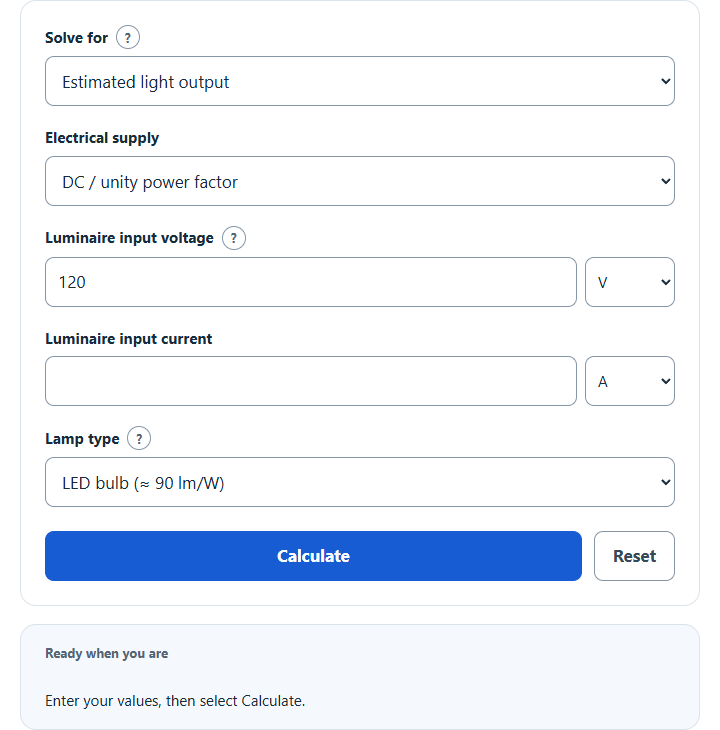
Convert volts to lumens from voltage, current and lamp type, using typical lumens per watt for LED, CFL or halogen bulbs, or solve for the amps or volts needed.
Volts To Lumens Formula
The following formula can be used to estimate lumens from voltage when the electrical current and the light source’s luminous efficacy are known.
Variables:
- L is the light output (lumens)
- V is the voltage (volts)
- I is the electrical current (amps)
- η is the luminous efficacy (lumens per watt, lm/W)
This relationship comes from two standard definitions: DC or unity-power-factor electrical power is P = V × I (watts); for single-phase AC use P = Vrms × Irms × PF, and light output can be estimated as L = P × η (lumens), where η is luminous efficacy in lm/W. In real lighting systems, current and efficacy depend on the driver, LED/lamp type, temperature, optics, and operating point—so voltage alone cannot be converted to lumens without additional information.
| Volts (V) | Lumens (lm) |
|---|---|
| 0.5 | 50 |
| 1 | 100 |
| 1.5 | 150 |
| 3 | 300 |
| 3.3 | 330 |
| 5 | 500 |
| 6 | 600 |
| 9 | 900 |
| 12 | 1200 |
| 18 | 1800 |
| 24 | 2400 |
| 36 | 3600 |
| 48 | 4800 |
| 60 | 6000 |
| 72 | 7200 |
| 96 | 9600 |
| 110 | 11000 |
| 120 | 12000 |
| 220 | 22000 |
| 240 | 24000 |
| Example only. Uses L = V × I × η with I = 1 A and η = 100 lm/W. Do not assume a fixed current from supply voltage; actual current and lumen output depend on the lamp/driver and operating conditions. | |
What is Volts To Lumens?
“Volts to lumens” usually refers to estimating a light’s output (lumens) from electrical information. There is no universal direct conversion from volts to lumens because volts measure electrical potential (voltage), not power. To estimate lumens you generally need power (watts) and luminous efficacy (lm/W), or voltage plus current and, for AC, power factor (single-phase real power is P = Vrms × Irms × PF).
How to Calculate Volts To Lumens?
Select estimated light output, current for target lumens, voltage for target lumens, or required luminous efficacy. Enter the known values with units, and pick a lamp type or enter a custom lm/W. Choose DC/unity power factor or single-phase AC; for AC use RMS voltage/current and true power factor. Select Calculate; input edits mark the previous result as outdated. Values are saved in this browser; Reset clears this calculator’s saved data. Use complete luminaire efficacy (lumens per real input watt) at the same operating point, as defined by DOE lighting guidance. Driver and optical losses are already reflected in complete-luminaire lm/W and should not be deducted again.
- Determine the voltage (V) across the light/load in volts.
- Determine the electrical current (I) through the light/load in amps.
- Determine the luminous efficacy (η) in lumens per watt (lm/W) for the light source at its operating conditions.
- Calculate light output: L = V × I × η (lumens).
- After inserting the variables and calculating the result, check your answer with the calculator above.
Example Problem :
Use the following variables as an example problem to test your knowledge.
voltage (V) = 12 volts
current (I) = 0.50 amps
luminous efficacy (η) = 100 lumens per watt