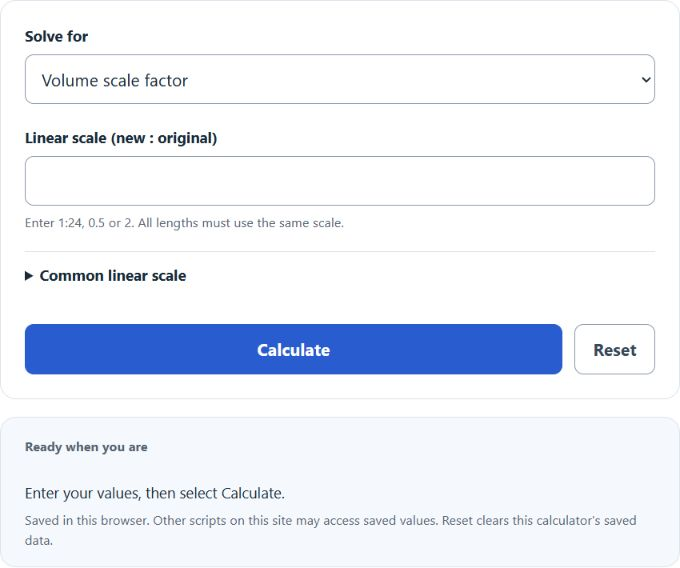
Calculate a volume scale factor from a linear scale like 1:24 or from two volumes, or scale an original volume into liters, gallons and more.
Related Calculators
- Enlargement Ratio Calculator
- Surface Area Of A Cuboid Calculator
- Box Volume Calculator
- Shrink Percentage Calculator
- All Math and Numbers Calculators
Calculator Functions
| Function | What it does | What it requires |
|---|---|---|
| Volume scale factor | Finds how many times larger or smaller a volume becomes at a linear scale | Requires the linear scale as a ratio such as 1:24 or as a single number |
| Scale a volume | Finds the new volume of a shape after it is scaled | Requires the linear scale and the original volume |
| Scale factor from two volumes | Finds the volume scale factor and the linear scale that link two volumes | Requires the original volume and the new volume |
The linear scale is new length to original length, so 1:24 is a model one twenty-fourth the size of the original and 2:1 is a doubling. Common model scales from 1:2 to 1:100, plus 2:1 and 3:1, can be picked from a list. Volumes are entered in L, mL, m³, cm³, US gallons, ft³ or in³.
Volume Scale Factor Formulas
| VSF | Volume scale factor, new volume ÷ original volume |
| k | Linear scale factor, new length ÷ original length |
Similar solids have volumes in the ratio of the cubes of their matching lengths. Euclid proved it for box-shaped solids and for spheres, and it holds for any two similar solids [1][2].
Volume scale factor
A 1:24 scale has k = 1 ÷ 24, so the volume scale factor is (1 ÷ 24)³ = 1 ÷ 13,824, or 0.00007234. The model holds 0.0072% of the original volume. A scale of 2 gives 2³ = 8 times the volume, and 3:2 gives 1.5³ = 3.375 times.
Scale a volume
SV is the scaled volume and OV the original volume. An 8 L container doubled in every direction holds 8 × 2³ = 64 L. A 500 L tank modeled at 1:10 holds 500 × 0.001 = 0.5 L.
Scale factor from two volumes
Dividing the new volume by the original gives the volume scale factor, and its cube root is the linear scale. Going from 1 L to 8 L is a volume scale factor of 8 and a linear scale of 2, so every length doubles. The areas of matching faces scale by k², which is 4 here. The two volumes can be in different units: 1 ft³ is 7.48 times 1 US gallon [3].
Limits of This Estimate
- The cube rule needs all three dimensions to change by the same factor, so the two shapes are geometrically similar. Stretching only the height of a tank, for example, changes the volume by that single factor, not its cube.
- A linear scale found from two volumes is only meaningful if the shapes really are similar.
- Unit conversions use 3.785411784 L per US gallon, 28.316846592 L per cubic foot and 0.016387064 L per cubic inch [3].
Sources
- Euclid, Elements, Book XI, Proposition 33 (D. E. Joyce edition, Clark University): similar box-shaped solids are in the cubed ratio of their sides
- Euclid, Elements, Book XII, Proposition 18 (D. E. Joyce edition, Clark University): spheres are in the cubed ratio of their diameters, and the rule for any similar solids
- NIST, Guide for the Use of the International System of Units (SP 811), Appendix B.8: gallon, cubic foot and cubic inch factors