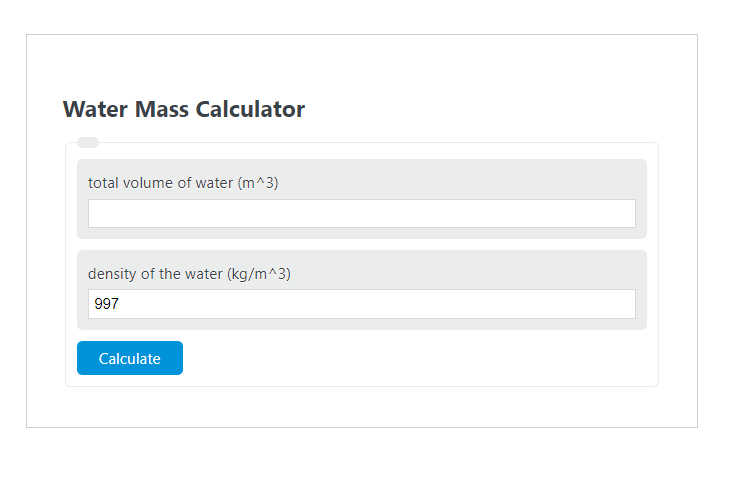
Calculate water mass and weight from volume or tank dimensions with temperature-adjusted freshwater density, custom density, and metric or imperial units.
Water Mass Formula
The following formula is used to calculate the Water Mass.
- Where WM is the Water Mass (kg)
- VW is the total volume of water (m³)
- DW is the density of the water (kg/m³)
To calculate the water mass, multiply the volume by the density using consistent units (for example, m³ and kg/m³). If you use liters for volume with density in kg/m³, divide by 1000 (since 1000 L = 1 m³).
Water Density by Temperature
Pure water reaches its maximum density of 999.97 kg/m³ at 3.98°C (39.2°F) and grows lighter as temperature rises. This is significant for mass calculations: 1,000 liters of boiling water at 100°C weighs approximately 42 kg less than 1,000 liters of water at 4°C. Engineers sizing tanks, pools, or floor load-bearing systems should always use the expected operating temperature to calculate accurate water mass.
| Temperature (°C) | Density (kg/m³) | Mass of 1,000 L (kg) |
|---|---|---|
| 0 | 999.84 | 999.84 |
| 4 | 999.97 | 999.97 |
| 10 | 999.7 | 999.7 |
| 20 | 998.21 | 998.21 |
| 25 | 997.05 | 997.05 |
| 40 | 992.22 | 992.22 |
| 60 | 983.2 | 983.2 |
| 80 | 971.82 | 971.82 |
| 100 | 958.37 | 958.37 |
Values based on the IAPWS-95 international standard for water thermodynamic properties. For calculations between 20°C and 25°C, using 998 kg/m³ introduces less than 0.02% error compared to the precise figure.
Saltwater vs. Freshwater Mass
Dissolved salts increase water density substantially. Standard ocean seawater at 35 PSU (practical salinity units) and 20°C has a density of approximately 1024.7 kg/m³, about 2.7% denser than freshwater at the same temperature. A 10,000 cubic meter volume of seawater therefore weighs roughly 265 metric tons more than the same volume of freshwater. That difference drives ship buoyancy calculations, the Plimsoll load line system on vessels, and pump sizing in desalination plants.
| Water Type | Typical Salinity (PSU) | Temperature (°C) | Density (kg/m³) |
|---|---|---|---|
| Distilled water | 0 | 20 | 998.21 |
| Freshwater (typical river) | 0.1 to 0.5 | 15 | 999.1 to 999.5 |
| Brackish water | 5 to 20 | 20 | 1003 to 1015 |
| Average ocean seawater | 35 | 20 | 1024.7 |
| Red Sea / Persian Gulf | 40 to 45 | 20 | ~1029 to 1033 |
| Dead Sea brine | ~300 to 350 | 20 | ~1240 |
| Ice (pure) | 0 | 0 | 916.7 |
The Dead Sea is roughly 9 to 10 times saltier than average ocean water. At a density near 1240 kg/m³, each cubic meter of Dead Sea brine weighs approximately 241 kg more than an equivalent volume of freshwater, which is why buoyancy makes it nearly impossible to sink in it.
Practical Water Mass Reference
The following table shows the mass of water in common containers. All figures use a density of 998.21 kg/m³ (pure water at 20°C) and are useful for structural load planning, equipment selection, and fluid storage system design.
| Container | Volume (L) | Mass (kg) | Weight (lb) |
|---|---|---|---|
| Standard water bottle | 0.5 | 0.50 | 1.10 |
| 1-gallon jug | 3.785 | 3.78 | 8.33 |
| 5-gallon water cooler jug | 18.93 | 18.89 | 41.6 |
| Standard bathtub (full) | 300 | 299.5 | 660 |
| 50-gallon residential water heater | 189.3 | 188.9 | 416 |
| 1,000-L IBC tote (full) | 1,000 | 998.2 | 2,201 |
| Residential swimming pool (avg) | 75,700 | 75,565 | 166,600 |
| Olympic swimming pool | 2,500,000 | 2,495,500 | 5,501,000 |
Water Mass in Engineering and Science
Structural engineers specify floor load ratings in kg/m² or lb/ft². A standard residential floor is typically rated for around 195 kg/m² (40 lb/ft²). A 400-liter home aquarium resting on a 1 m² footprint places a load of roughly 400 kg/m² on the floor, more than double that limit, which is why large fish tanks require dedicated structural reinforcement. Flat commercial roofs regularly fail not from snow alone but from ponding water when drainage is blocked: a 100 mm depth of standing water across 1,000 m² of roof represents approximately 100,000 kg of added mass.
In hydrology, water mass stored in snowpacks is expressed as snow water equivalent (SWE): the depth of liquid water that would result if the snowpack melted. SWE surveys in mountain ranges guide reservoir release schedules and drought planning across entire regions. The Sierra Nevada snowpack, covering roughly 65,000 km², holds on average around 150 mm SWE at peak accumulation, representing approximately 9.75 billion metric tons of stored water mass that feeds rivers and reservoirs through the summer melt season.
Mass vs. Weight of Water
Mass (kg) measures the quantity of matter; weight (N or lbf) is the gravitational force acting on that mass. On Earth's surface at standard gravity (9.80665 m/s²), 1 kg of water weighs 9.807 N (2.205 lbf). On the Moon, where gravity is approximately 1.62 m/s², that same 1 kg of water weighs only 1.62 N. Mass stays constant regardless of location; weight changes with the local gravitational environment. In everyday plumbing and construction this distinction is rarely relevant, but it becomes critical in offshore platform design, spacecraft fluid storage, and any context where local gravity differs from the standard sea-level value.