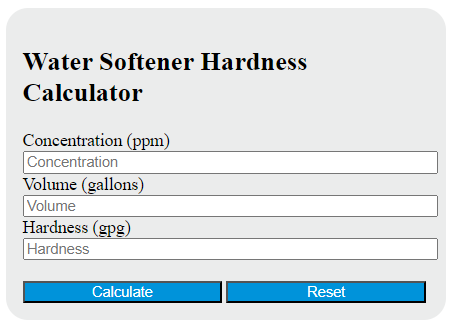
Calculate water softener hardness concentration as CaCO3, volume, or total load from any two inputs using ppm, gallons, liters, grains, or kgr.
Related Calculators
- Water Softener Salt Usage Calculator
- PPM to Grains Calculator
- PPM Calculator
- Shower Water Usage Calculator
- Water Bill Calculator
- All Everyday Life and Education Calculators
Water Softener Hardness Formula
The purpose of this calculator is to convert a hardness concentration into a total hardness load. In water treatment, that load is usually expressed in grains because residential softener capacity is commonly discussed in grains or kilograins. If your lab report shows hardness in ppm or mg/L as CaCO3, the calculator first converts that value to grains per gallon and then applies the water volume.
If you prefer metric volume units, the same hardness load can be written directly from liters or cubic meters:
Variable Definitions
- G = total hardness load in grains
- C = hardness concentration in ppm or mg/L as CaCO3
- gpg = grains per gallon
- Vgal = water volume in gallons
- VL = water volume in liters
- Vm³ = water volume in cubic meters
Why This Calculation Matters
A hardness test by itself tells you concentration, but a softener must actually remove a total amount of dissolved hardness minerals over time. That is why grains of load are useful. The result helps you:
- estimate how much hardness enters the system over a known water volume,
- compare daily hardness demand to softener capacity,
- plan regeneration frequency,
- understand the difference between a water test result and an equipment sizing result.
How to Calculate Water Softener Hardness Load
- Find the raw water hardness from a test report, usually listed in ppm or mg/L as CaCO3.
- Choose the water volume you want to evaluate in gallons, liters, or cubic meters.
- Convert hardness to grains per gallon if needed.
- Multiply the concentration by the selected water volume using the matching formula.
- Interpret the result as the total number of grains the softener would need to remove for that volume of water.
Example
Suppose the incoming water hardness is 120 ppm and the water volume is 50 gallons.
That means 50 gallons of water at 120 ppm hardness carries about 351 grains of hardness load.
Hardness Classification Reference
| Hardness Level | mg/L or ppm as CaCO3 | Approximate gpg |
|---|---|---|
| Soft | 0 to 60 | 0 to 3.5 |
| Moderately hard | 61 to 120 | 3.6 to 7.0 |
| Hard | 121 to 180 | 7.1 to 10.5 |
| Very hard | Above 180 | Above 10.5 |
Quick Unit Reference
| Unit | Practical Meaning |
|---|---|
| ppm or mg/L as CaCO3 | Concentration of hardness minerals in water |
| gpg | Common residential softener hardness unit |
| grain | Total hardness load removed over a given water volume |
| kilograin (kgr) | 1,000 grains |
Using Hardness Load for Softener Planning
Once hardness is expressed in grains per gallon, you can estimate daily demand and regeneration timing more clearly. This is especially helpful when comparing household water use to the usable capacity of a softener.
- D = daily hardness demand in grains per day
- H = hardness in grains per gallon
- Q = water use in gallons per day
- S = usable softener capacity in grains
- R = estimated days between regenerations
This calculator focuses on the hardness load for a selected water volume, but the same concept extends directly to household sizing and operating cost estimates.
Common Mistakes to Avoid
- Mixing concentration with total load: ppm and gpg describe how hard the water is, while grains describe how much hardness is present in the full volume.
- Forgetting the unit basis: hardness should be entered as CaCO3 equivalent when using these standard conversions.
- Ignoring water volume: the same hardness concentration creates a larger grain load as usage increases.
- Using nominal softener capacity only: real-world regeneration settings and salt efficiency affect usable capacity.
- Overlooking other water quality issues: iron, manganese, and scale-forming conditions can change how a system should be sized and programmed.
Frequently Asked Questions
Is ppm the same as mg/L for hardness?
For water calculations, ppm and mg/L are typically treated as approximately equivalent, which is why either unit is commonly used on hardness test reports.
Why do softeners use grains instead of ppm?
Grains make it easier to match water hardness demand to softener capacity, because resin systems are often rated by how many grains they can remove before regeneration.
What does a higher grain result mean?
A higher result means more dissolved hardness minerals are passing through the system over that water volume, which usually leads to faster capacity usage and more frequent regeneration.
Does softening remove total dissolved solids?
Not entirely. Ion-exchange softeners mainly replace hardness ions such as calcium and magnesium with sodium or potassium. They are designed to reduce hardness, not to act as full purification systems.
Can I use this for liters and cubic meters?
Yes. As long as the hardness value is entered in mg/L or ppm as CaCO3, the calculator can convert the result into grains for metric water volumes as well.