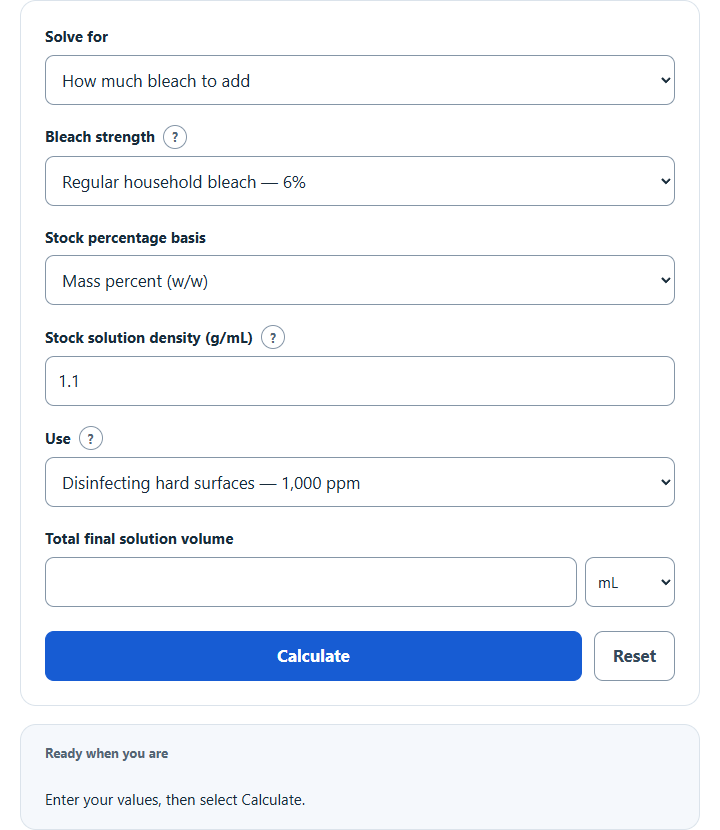
Calculate how much bleach to add to water for disinfecting or sanitizing, with household bleach strengths, ppm targets and the bleach-to-water ratio.
Bleach Dilution Formula
To find how much concentrated bleach you need to reach a target concentration, the dilution equation is rearranged for the stock volume:
The approximate water volume is the difference below; for a specified final volume, add water to that final volume rather than relying on exact volume additivity:
To find the concentration of a mix you already made:
C1 and C2 must describe the same substance on the same mass-per-volume basis. V1 is stock volume and V2 is measured final volume. For stock mass percent (w/w), the calculator uses density (1.1 g/mL, typical for household bleach, unless you change it) and converts to g/L. For mass/volume percent (w/v), 1% equals 10,000 mg/L. Mass ppm is approximately mg/L only for dilute final solutions near 1 g/mL. Sodium hypochlorite and available chlorine are different reporting bases and are not converted here.
Bleach Strengths and Disinfection Targets
The calculator starts with 6% regular household bleach; pick another strength or enter your own. Check the actual label and its concentration basis; strength varies and declines with age. Follow the product label for dilution, target, contact time, surface compatibility and protection. Never mix bleach with other cleaners.
| Product | Typical Sodium Hypochlorite |
|---|---|
| Regular household bleach | 5 to 6 percent |
| Concentrated household bleach | 7.5 to 8.25 percent |
| Industrial or pool grade | 10 to 12.5 percent |
| Use | Target Concentration |
|---|---|
| Sanitizing food-contact surfaces | Follow the registered product label |
| General hard-surface disinfecting | Follow the registered product label |
| Heavy disinfection of bodily-fluid spills | Follow the registered product label |
Example Problems
Example 1. As a mathematical example, assume stock concentration is 6% w/v and target is 1,000 mg/L of the same substance, with a final volume of 1 liter (1,000 mL). This is not a recommended disinfection target. Convert the target: 1,000 mg/L equals 0.1% w/v. The bleach volume is V1 = (0.1 x 1000) / 6 = 16.67 mL. The approximate water volume is 1000 – 16.67 = 983.33 mL; dilute to the specified final volume.
Example 2. Assume stock is 8.25% w/v. You mixed 25 mL into enough water to make 500 mL total. The final concentration is C2 = (8.25 x 25) / 500 = 0.4125% w/v, which is 4,125 mg/L (approximately 4,125 mass ppm only near 1 g/mL).
Frequently Asked Questions
What concentration should I use to disinfect? Use the registered product label or authoritative guidance for the exact product, organism, surface and contact time. The calculator offers typical targets (1,000 ppm for disinfecting, 200 ppm for food-contact sanitizing, 5,000 ppm for body-fluid spills), but the product label takes precedence.
Why do I enter percent for the stock bleach? Enter the labeled stock strength and choose w/w or w/v. Mass percent needs a density before applying a volume dilution equation; 1.1 g/mL is typical for household bleach. Use the same reported substance for the target; available chlorine and sodium hypochlorite are not interchangeable.
Can I mix the solution ahead of time? It is best to mix diluted bleach fresh. Available chlorine breaks down over time, and exposure to light and heat speeds the loss, so an old batch will be weaker than the calculated value.