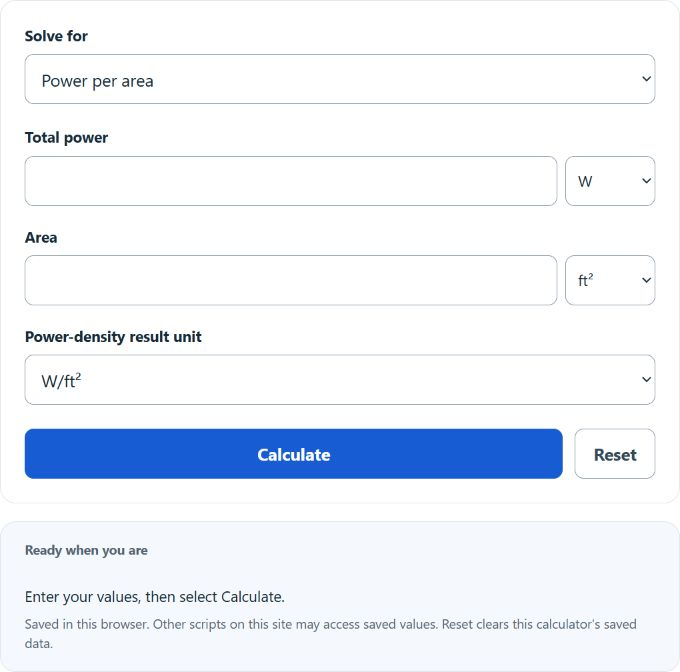
Select power per area, total power, or area, then enter the two known quantities. The calculator converts W/kW, ft²/m² and W/ft²/W/m².
- All Unit Converters
- Power Per Square Meter Calculator
- kW Per Square Foot Calculator
- kWh Per Square Foot Calculator
- Lighting Power Density (LPD) Calculator
- Load Wattage Calculator
- Watts to Amps Calculator
Watts Per Square Foot Formula
The following equation is used to calculate the Watts Per Square Foot.
- Where WPSF is the watts per square foot (W/ft²)
- TW is the total watts (W)
- A is the area in square feet (ft²)
To calculate the watts per square foot, divide the total watts by the area.
What Does “Watts per Square Foot” Mean?
Definition:
Watts per square foot is total power divided by a defined area. It describes power density; by itself it does not measure energy use, efficiency, lighting brightness or required HVAC capacity.
How to Calculate Watts Per Square Foot?
Example Problem:
The following example outlines the steps and information needed to calculate the Watts Per Square Foot.
First, determine the total area in square feet. In this example, the area is 1000.
Next, determine the total watts. In this example, the total watts are 5000.
Finally, calculate the watts per square foot using the formula above:
WPSF = TW / A
WPSF = 5000 / 1000
WPSF = 5 W/ft²
FAQ
What factors can affect the watts per square foot calculation?
The arithmetic depends only on the entered power and area. Measurement accuracy and the boundary used for each quantity affect comparisons; system conditions can change measured power but do not change the formula.
How can I improve the energy efficiency reflected by watts per square foot?
Improving energy efficiency includes optimizing the placement of power-consuming devices, reducing wiring losses with proper cables, and ensuring equipment runs at peak performance. Regular maintenance and energy audits can further enhance system efficiency.
Why is it important to calculate watts per square foot?
Watts per square foot helps compare power density using consistent power and area definitions. Energy consumption requires operating time, while lighting performance and electrical or HVAC requirements need separate design information.