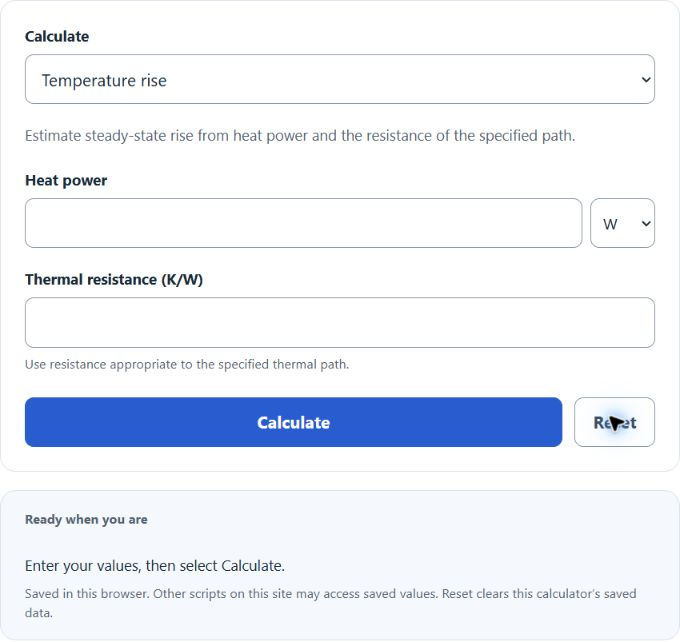
Estimate steady-state temperature rise, junction or ambient temperature, heat power and thermal resistance. Material mode models a flat layer; power alone cannot determine temperature.
- All Unit Converters
- Thermodynamics and Fluid Unit Converters
- Parcel Temperature Calculator
- Watt Seconds To Heat Calculator
- Watts to Volts
Watts to Temperature Rise Formula (Thermal Resistance)
Estimate steady-state temperature rise from heat power and resistance appropriate to the specified path. For junction temperature, use effective resistance for the complete junction-to-ambient cooling path. Texas Instruments explains why datasheet junction-to-ambient values depend on the test board and conditions.
Variables:
- ΔT is the temperature rise (K or °C)
- P is the power dissipated as heat (W)
- Rθ is the thermal resistance from the heat source to ambient (K/W or °C/W)
Multiply heat power by thermal resistance. A temperature difference of 1 K equals a difference of 1 °C; absolute temperatures use the offset 0 K = −273.15 °C. The passive heating modes accept nonnegative power and positive resistance, and reject impossible absolute temperatures. See NIST temperature units.
| Power (W) | Temperature Rise (K) | Temperature Rise (°C) |
|---|---|---|
| 0.1 | 0.4 | 0.4 |
| 0.25 | 1.0 | 1.0 |
| 0.5 | 2.0 | 2.0 |
| 0.75 | 3.0 | 3.0 |
| 1 | 4.0 | 4.0 |
| 1.5 | 6.0 | 6.0 |
| 2 | 8.0 | 8.0 |
| 2.5 | 10.0 | 10.0 |
| 3 | 12.0 | 12.0 |
| 4 | 16.0 | 16.0 |
| 5 | 20.0 | 20.0 |
| 7.5 | 30.0 | 30.0 |
| 10 | 40.0 | 40.0 |
| 12 | 48.0 | 48.0 |
| 15 | 60.0 | 60.0 |
| 18 | 72.0 | 72.0 |
| 20 | 80.0 | 80.0 |
| 22 | 88.0 | 88.0 |
| 24 | 96.0 | 96.0 |
| 25 | 100.0 | 100.0 |
| * Rounded to 1 decimal. Uses ΔT = P × Rθ with Rθ = 4.0 K/W. Note: a temperature difference in K equals the same value in °C. | ||
What is Temperature Rise (ΔT)?
Temperature rise (ΔT) is the difference between a heat source and a reference temperature. This calculator estimates steady‑state passive heating with constant positive resistance. Material mode uses R = thickness ÷ (conductivity × area), with positive dimensions and conductivity; optional heat power gives the difference between the layer faces. The plane-layer conduction model assumes uniform one-dimensional conduction, constant conductivity and no internal heat generation. It excludes contact resistance, spreading, convection and radiation, and is not automatically a complete path to ambient. Preset conductivities are illustrative; actual grade, direction and temperature matter. Air layer means conduction, not convection. This model does not calculate transient temperature changes from mass, time and specific heat.
How to Calculate Temperature Rise?
The following steps outline how to calculate the temperature rise using thermal resistance.
- Determine the power being dissipated as heat (P) in watts (W).
- Determine effective thermal resistance (Rθ) for the complete heat-source-to-ambient path and conditions, in K/W or °C/W. A datasheet RθJA depends on its test setup. The material-layer estimate covers only conduction through that layer.
- Use the formula from above: ΔT = P × Rθ.
- If you want absolute temperature, add ambient temperature: Tj = Ta + ΔT.
- Check your result with the calculator above.
Example Problem :
Use the following variables as an example problem to test your knowledge.
Power (P) = 5 W
Thermal Resistance (Rθ) = 4.0 °C/W
Ambient Temperature (Ta) = 25 °C
Temperature Rise (ΔT) = P × Rθ = 5 × 4.0 = 20 °C (same numeric rise as 20 K)
Junction / Component Temperature (Tj) = Ta + ΔT = 25 + 20 = 45 °C