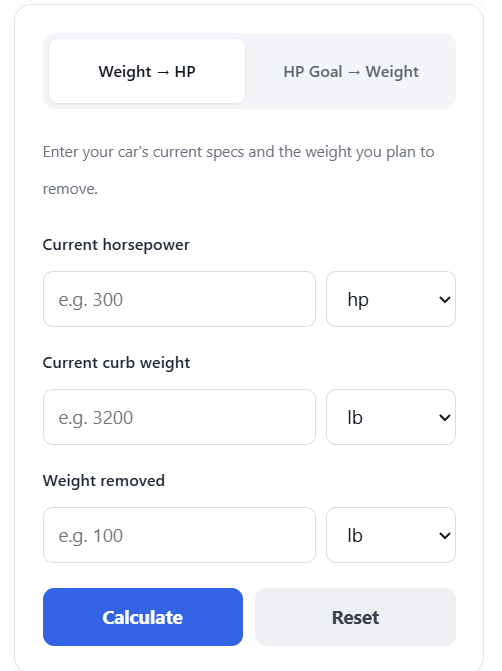
Enter your car’s current horsepower, curb weight, and the weight you plan to remove (or a target HP gain) to see how much “free” horsepower the diet delivers.
Formula
Weight → Equivalent HP Gain:
ΔHP = HP × (Δw ÷ (w − Δw))
where HP = current horsepower, w = current curb weight, Δw = weight removed.
HP Goal → Weight to Remove:
Δw = w × ΔHP ÷ (HP + ΔHP)
where ΔHP = desired equivalent HP gain.
Both forms hold the power-to-weight ratio constant: (HP + ΔHP) ÷ w = HP ÷ (w − Δw).
Interpretation
The result is the horsepower an engine would need to add to match the acceleration benefit of the weight you removed. It is not a dyno number — the engine still makes the same power. What changes is the pounds each hp has to move. As a rough rule of thumb, most street cars gain roughly 1 equivalent hp for every 8–12 lb removed, scaling with how much power the car already has.
- Under 0.5% of curb weight: Noticeable only on the stopwatch, not in the seat.
- 0.5%–2%: Typical street-driven results from wheels, seats, or a battery relocation.
- 2%–5%: Dedicated weight-reduction build; clearly felt under acceleration and braking.
- Over 5%: Track-car territory (stripped interior, lightweight panels, cage trade-offs).
Weight-to-HP Reference Table
Quick look at equivalent hp gained from common weight reductions, based on a 3,200 lb car:
| Weight Removed | 300 hp car | 400 hp car | 500 hp car |
|---|---|---|---|
| 25 lb | 2.4 hp | 3.2 hp | 3.9 hp |
| 50 lb | 4.8 hp | 6.3 hp | 7.9 hp |
| 100 lb | 9.7 hp | 12.9 hp | 16.1 hp |
| 200 lb | 20.0 hp | 26.7 hp | 33.3 hp |
| 400 lb | 42.9 hp | 57.1 hp | 71.4 hp |
FAQ
Should I use curb weight or weight with driver and fuel?
Use whatever weight the car actually has when you drive it — that’s what the engine is moving. For comparison to published 0–60 figures, curb weight plus a 150–200 lb driver allowance is closest.
Is this the same as a real dyno horsepower gain?
No. The engine output does not change. The result tells you how much extra hp would be needed to match the same performance improvement you get from the weight loss.
Why does the same weight loss give different HP equivalents on different cars?
The formula scales with existing power. A 500 hp car gains more equivalent hp per pound than a 200 hp car because each pound is a smaller share of its already-strong power-to-weight ratio.
Does removing weight also help braking and handling?
Yes, and often more than acceleration. Lower mass reduces braking distance, cornering loads on tires, and suspension wear — benefits this calculator does not quantify but that are real.