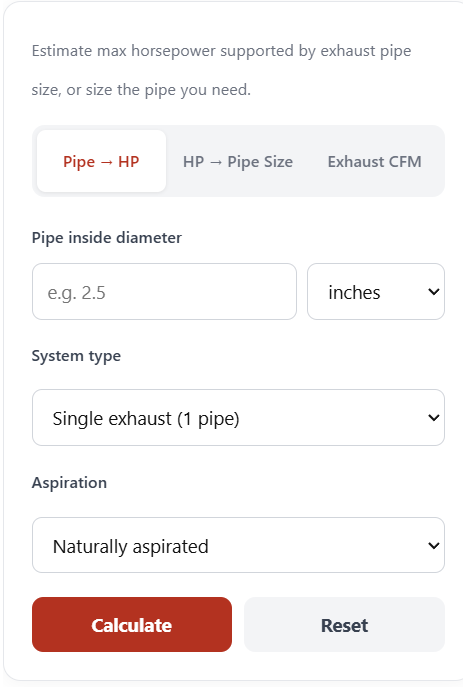
Enter your exhaust pipe inside diameter to estimate the maximum horsepower it can support, enter a target horsepower to size the pipe, or enter engine displacement and RPM to estimate exhaust CFM.
Formula
Pipe → HP:
HP = A × k × n
where A = π × (d/2)², d = pipe inside diameter (in), k = 115 for naturally aspirated or 135 for forced induction, n = number of pipes (1 or 2).
HP → Pipe Size:
d = 2 × √(A / π), where A = HP / (k × n)
where d = required inside diameter per pipe (in), HP = target crank horsepower, k and n as defined above.
Exhaust CFM:
Intake CFM = (CID × RPM × VE) / 3456
Exhaust CFM ≈ Intake CFM × 1.5
where CID = displacement (cu in), RPM = peak engine speed, VE = volumetric efficiency (decimal).
Interpretation
The Pipe → HP result is the upper limit of power the pipe can flow before backpressure starts costing you measurable horsepower. Staying below it means the exhaust is not the restriction; going above it means you're leaving power on the table. Use these rough bands as a sanity check:
- Under 200 HP: small displacement, economy builds — 2" to 2.25" pipe.
- 200–400 HP: V6 and small V8 street cars — 2.5" single or 2.25" dual.
- 400–700 HP: performance V8 and muscle — 3" single or 2.5" dual.
- 700 HP+: race and high-boost — 3.5"+ single or 3" dual.
For the CFM mode, exhaust volume runs roughly 1.5× intake because combustion gases are hot and have expanded. The estimated peak HP is a flow-based approximation, not a dyno number.
Pipe Size Reference Table
| Pipe ID | Single Exhaust (N/A) | Dual Exhaust (N/A) | Single (Forced Induction) |
|---|---|---|---|
| 2.0" | ≈ 360 HP | ≈ 720 HP | ≈ 425 HP |
| 2.25" | ≈ 455 HP | ≈ 915 HP | ≈ 535 HP |
| 2.5" | ≈ 565 HP | ≈ 1130 HP | ≈ 660 HP |
| 3.0" | ≈ 810 HP | ≈ 1625 HP | ≈ 955 HP |
| 3.5" | ≈ 1105 HP | ≈ 2210 HP | ≈ 1300 HP |
| 4.0" | ≈ 1445 HP | ≈ 2890 HP | ≈ 1695 HP |
FAQ
Should I use inside or outside pipe diameter?
Use inside diameter (ID). Exhaust tubing is usually sold by OD, so subtract roughly 2× the wall thickness (typically 0.065" per side for 16-gauge) to get ID.
Why does a dual exhaust support roughly double the horsepower?
Each pipe flows independently, so total flow area scales with the number of pipes. A true dual system with two 2.5" pipes flows like a single pipe with about 3.5" of diameter.
Why is the recommended pipe larger for turbo or supercharged engines?
Forced induction pushes more mass through the exhaust and raises gas temperature and volume. The calculator bumps the flow coefficient from 115 to 135 to account for that extra volume at a given crank horsepower.
Is bigger always better?
No. Oversizing the pipe reduces exhaust gas velocity, which hurts scavenging and low-end torque. Pick the smallest size that comfortably handles your target HP rather than the largest that fits.