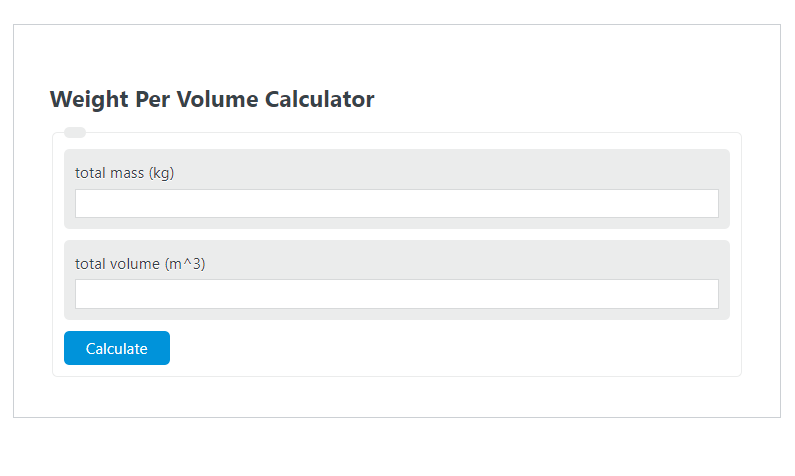
Calculate mass, volume, or weight per volume from the other two values in metric or imperial units like kg, L, ft³, lb/ft³, and more.
Weight Per Volume Formula
The weight per volume calculator uses mass, volume, and weight per unit volume. In SI units, the base calculation uses kilograms for mass, cubic meters for volume, and newtons per cubic meter for weight per volume.
To solve for mass:
To solve for volume:
- WPV = weight per volume, usually in N/m³
- m = total mass, in kg after unit conversion
- V = total volume, in m³ after unit conversion
- 9.81 = standard gravitational acceleration in m/s²
If you enter mass and volume, the calculator finds weight per volume. If you enter weight per volume and volume, it finds total mass. If you enter mass and weight per volume, it finds total volume. Unit selections are converted to base units first, then the result is converted back to the unit you selected for the missing value.
Supported Units and Base Conversions
The calculator converts inputs to kilograms, cubic meters, and N/m³ before solving.
| Quantity | Unit | Conversion to Base Unit |
|---|---|---|
| Mass | g | 1 g = 0.001 kg |
| Mass | lb | 1 lb = 0.453592 kg |
| Volume | L | 1 L = 0.001 m³ |
| Volume | ft³ | 1 ft³ = 0.0283168 m³ |
| Volume | US gallon | 1 gal = 0.00378541 m³ |
| Material | Approx. Density | Approx. Weight Per Volume |
|---|---|---|
| Water | 1000 kg/m³ | 9810 N/m³ |
| Air at room conditions | 1.2 kg/m³ | 11.8 N/m³ |
| Concrete | 2400 kg/m³ | 23544 N/m³ |
| Steel | 7850 kg/m³ | 77008.5 N/m³ |
Example
Example 1: Find weight per volume
You have a material with a mass of 50 kg and a volume of 0.02 m³.
The weight per volume is 24,525 N/m³. If expressed as kg/m³ in the calculator, the equivalent value is 2,500 kg/m³.
Example 2: Find mass
A substance has a weight per volume of 9810 N/m³ and occupies 3 m³.
The total mass is 3000 kg.
FAQ
Is weight per volume the same as density?
Not exactly. Density is mass per volume, such as kg/m³. Weight per volume is force per volume, such as N/m³. They are related by gravity:
For example, water has a density of about 1000 kg/m³ and a weight per volume of about 9810 N/m³.
Why does the formula use 9.81?
The value 9.81 m/s² is the standard acceleration due to gravity on Earth. It converts mass in kilograms into weight force in newtons. If you are doing a calculation for a location with different gravity, such as another planet, the result would be different.
Why do you need to enter exactly two values?
The relationship has three variables: mass, volume, and weight per volume. Any two of them determine the third. If you enter fewer than two values, there is not enough information. If you enter all three, there is no missing value to solve for.