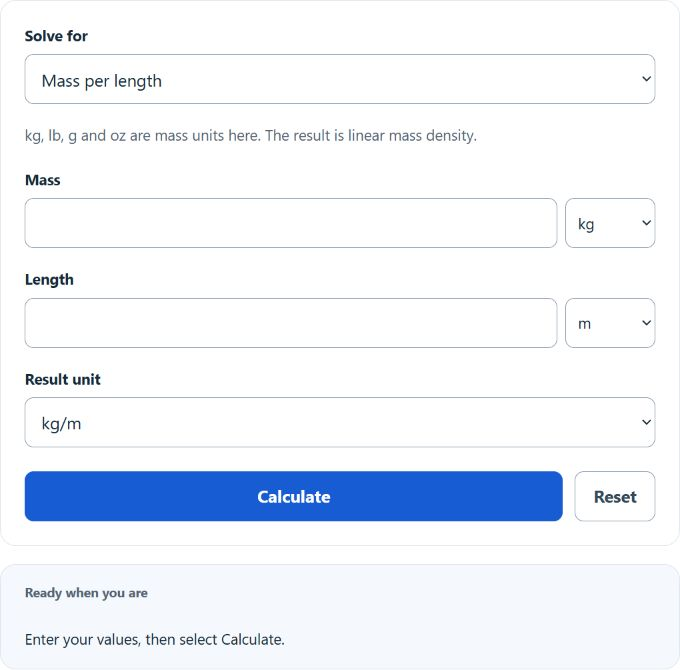
Calculate weight-to-length ratios or convert between weight and length for wire, beams and cable using unit and density inputs quickly.
Weight to Length Ratio Formula
In this calculator, weight means mass: the ratio is mass divided by length. kg/m and lb/ft are linear mass density, not force per length.
- R = weight-to-length ratio (kg/m, lb/ft, g/cm, lb/in)
- W = total mass (called weight in the original notation)
- L = total length
To get length from a known ratio and weight, rearrange to L = W / R. To get weight from a known ratio and length, use W = R × L.
For round wire or rod, the ratio comes from material density and cross-section area:
- ρ = material density (kg/m³)
- D = wire diameter (m)
- π × D² / 4 = cross-sectional area
Choose Mass per length, Length from mass and ratio, Mass from length and ratio, or Solid round wire or rod. The round-section model requires a uniform solid circular section and a specified density.
Illustrative Values and Unit Conversions
The following are illustrative linear mass-density inputs, not product specifications. The lb/ft column is calculated from each kg/m input using exact unit conversions.
| Item | Approx. ratio (kg/m) | Approx. ratio (lb/ft) |
|---|---|---|
| Illustrative A | 0.029 | 0.0195 |
| Illustrative B | 1.00 | 0.6720 |
| Illustrative C | 3.98 | 2.6744 |
| Illustrative D | 1.7 | 1.1423 |
| Illustrative E | 0.07 | 0.0470 |
| Illustrative F | 0.55 | 0.3696 |
Unit conversion factors used by the calculator:
| From | To | Multiply by |
|---|---|---|
| kg/m | lb/ft | 0.6720 |
| lb/ft | kg/m | 1.4882 |
| kg/m | g/cm | 10.000 |
| kg/m | lb/in | 0.0560 |
Example Problems
Example 1. A 10 m steel cable weighs 50 kg. The ratio is 50 / 10 = 5 kg/m. If you have a 200 kg spool of the same cable, the length is 200 / 5 = 40 m.
Example 2. Find the linear weight of a 3 mm copper wire. Assume a density of 8960 kg/m³ for this example; use the actual material density for a real wire. The cross-section area is π × (0.003)² / 4 ≈ 7.069 × 10⁻⁶ m². The ratio is 8960 × 7.069 × 10⁻⁶ ≈ 0.0633 kg/m, or about 0.0426 lb/ft.
FAQ
Is weight-to-length ratio the same as linear density? Here the ratio is linear mass density. Force per length is a different quantity (such as N/m); at acceleration g it equals mass per length multiplied by g.
Why does the round wire mode ask for density? A measured weight already accounts for the material. With diameter alone, you need density to know how much mass that volume holds. Steel and aluminum of the same diameter have very different ratios.
Does the ratio change with length? No. The ratio is constant for uniform material. A 1 m and a 100 m piece of the same wire share the same kg/m value.
Can I use this for rope, cable, or chain? Yes, as long as the product is uniform along its length. Use Mass per length with a known sample mass and length, or check the manufacturer’s spec sheet for the listed linear weight.