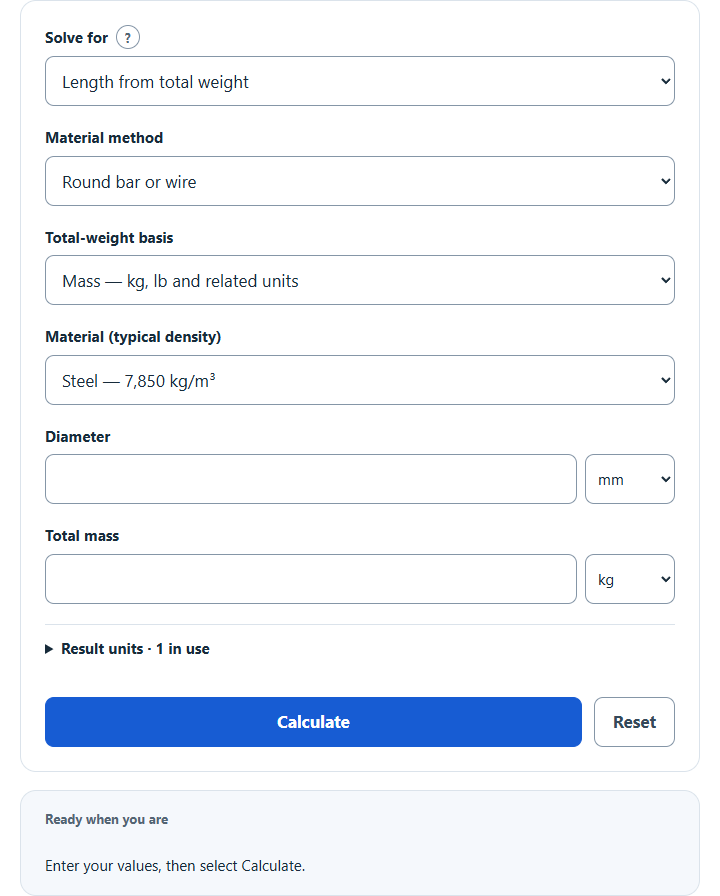
Calculate the length of wire, bar, pipe or flat stock from its weight, or the weight from its length, using material presets like steel and aluminum.
Weight to Length Formula
For uniform material, length L = mass m ÷ linear mass density λ, where λ = density ρ × cross-sectional area A. If weight W is gravitational force in newtons instead, first use m = W/g. Choose the matching Total-weight basis in the calculator.
- Where L is the material length (m)
- W is the total weight (N)
- D is the density (kg/m3)
- A is the cross-sectional area (m2)
For gravitational force W in N and the explicit assumption g = 9.81 m/s², L = W/(9.81 × ρ × A). For mass in kg, use L = m/(ρ × A) without dividing by gravity. Select Direct cross-sectional area and Custom density to reproduce the examples below.
| Weight (N) | Length (m) | Length (ft) |
|---|---|---|
| 10 | 0.201 | 0.660 |
| 25 | 0.503 | 1.651 |
| 50 | 1.006 | 3.302 |
| 75 | 1.510 | 4.953 |
| 100 | 2.013 | 6.604 |
| 150 | 3.019 | 9.905 |
| 200 | 4.026 | 13.207 |
| 250 | 5.032 | 16.509 |
| 300 | 6.038 | 19.811 |
| 400 | 8.051 | 26.414 |
| 500 | 10.064 | 33.018 |
| 750 | 15.096 | 49.527 |
| 1000 | 20.128 | 66.036 |
| 1500 | 30.192 | 99.054 |
| 2000 | 40.255 | 132.071 |
| 2500 | 50.319 | 165.089 |
| 3000 | 60.383 | 198.107 |
| 4000 | 80.511 | 264.143 |
| 5000 | 100.638 | 330.179 |
| 10000 | 201.277 | 660.357 |
| * Rounded to 3 decimals. Assumptions: steel (ρ = 7850 kg/m³), cross-sectional area A = 1.000 in² = 0.00064516 m², gravity g = 9.81 m/s². Formula: L = W / (ρ·g·A). Under these assumptions: ρ·g·A = 49.6828038600 N/m, so 1 N ≈ 0.02012769 m ≈ 0.06603572 ft. In the calculator choose Direct cross-sectional area 1 in², steel density 7850 kg/m³, force in N and g = 9.81 m/s². | ||
How to Calculate Weight to Length?
The following two example problems outline the steps and information needed to calculate the Weight to Length.
Example Problem #1
- First, determine the total weight (N).
- The total weight (N) is calculated to be 500.
- Next, determine the density (kg/m3).
- The density (kg/m3) is measured to be 3.
- Next, determine the cross-sectional area (m2).
- The cross-sectional area (m2) is found to be 5.
- Finally, calculate the Weight to Length using the formula above:
L = W/9.81/D/A
The values provided above are inserted into the equation below and computed.
L = 500/(9.81 × 3 × 5) ≈ 3.397893 m. These are illustrative inputs; choose force in N, custom density 3 kg/m³ and direct area 5 m².
Example Problem #2
The variables required for this problem are provided below:
total weight (N) = 600
density (kg/m3) = 4
cross-sectional area (m2) = 8
Choose Length, Direct cross-sectional area, Custom density 4 kg/m³, area 8 m², and Gravitational force 600 N with the article gravity assumption 9.81 m/s².
L = 600/(9.81 × 4 × 8) ≈ 1.911315 m.