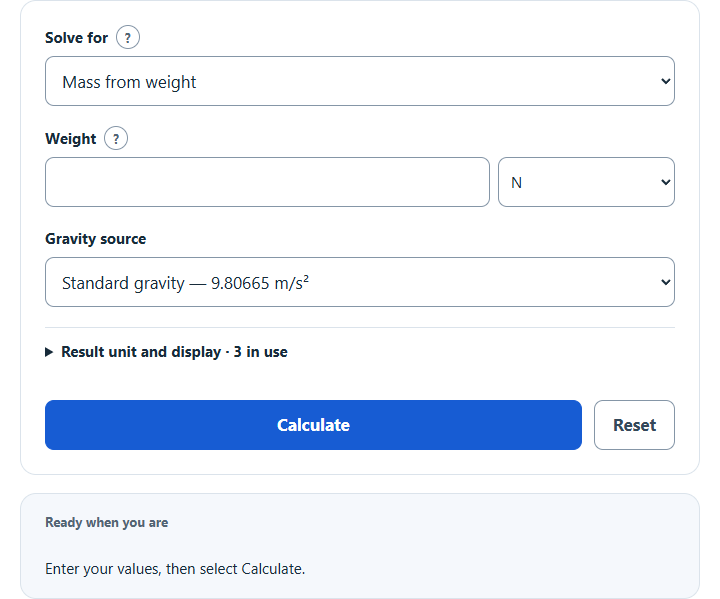
Convert weight to mass with m = W ÷ g: enter a weight in newtons, lbf or kgf to get mass in kg, lb and slugs, or turn a mass into weight.
Mass From Weight Formula
Mass equals gravitational weight force divided by the local gravitational acceleration: M = W/g. The displayed 9.81 formula is a rounded Earth-gravity assumption, while standard gravity is exactly 9.80665 m/s².
- Where M is the Mass From Weight (kg)
- W is the total weight (N)
Divide gravitational weight in newtons by the explicitly chosen acceleration in m/s² to obtain mass in kilograms. Choose Custom measured gravity and enter 9.81 m/s² to reproduce the article table and example; the calculator defaults to the exact standard-gravity reference 9.80665 m/s².
| Newtons (N) | Kilograms (kg) |
|---|---|
| 1 | 0.102 |
| 2 | 0.204 |
| 5 | 0.510 |
| 10 | 1.019 |
| 20 | 2.039 |
| 25 | 2.548 |
| 50 | 5.097 |
| 75 | 7.645 |
| 100 | 10.194 |
| 150 | 15.291 |
| 200 | 20.387 |
| 250 | 25.484 |
| 300 | 30.581 |
| 400 | 40.775 |
| 500 | 50.968 |
| 750 | 76.453 |
| 1,000 | 101.937 |
| 2,000 | 203.874 |
| 5,000 | 509.684 |
| 10,000 | 1019.368 |
| *Assumes Earth gravity (g = 9.81 m/s²). 1 N ≈ 0.10197 kg. | |
How to Calculate Mass From Weight?
The following example problems outline how to calculate Mass From Weight.
Example Problem #1:
- First, determine the total weight (N).
- The total weight (N) is given as 550.
- Finally, calculate the Mass From Weight using the equation above:
M = W / 9.81
The values given above are inserted into the equation below and the solution is calculated:
M = 550 / 9.81 ≈ 56.07 kg (56.06523955… kg). At the default standard gravity 9.80665 m/s², the same 550 N corresponds to about 56.0844 kg.
FAQ
What is the difference between mass and weight?
Mass is a measure of the amount of matter in an object, typically measured in kilograms or grams. Weight, on the other hand, is the force exerted by gravity on an object and is measured in newtons. Mass is a scalar quantity and does not change with location, while weight is a vector quantity and can change depending on the gravitational pull of the planet or celestial body.
Why do we use 9.81 in the Mass From Weight formula?
9.81 m/s² is a rounded Earth-gravity assumption. Standard gravity is exactly 9.80665 m/s²; actual local gravity varies. The latitude/elevation option estimates normal gravity using the retained GRS80 latitude series and a first-order height correction. It ignores terrain, gravity anomalies and height-datum differences, and is not a precision local measurement.
Can this formula be used on other planets?
Yes. Use gravitational force and the acceleration appropriate to its location. The listed body values are illustrative approximate assumptions; reference level and rotation conventions can differ. Mass remains unchanged by location, while gravitational weight changes. An apparent scale force affected by buoyancy or motion need not equal gravitational weight.