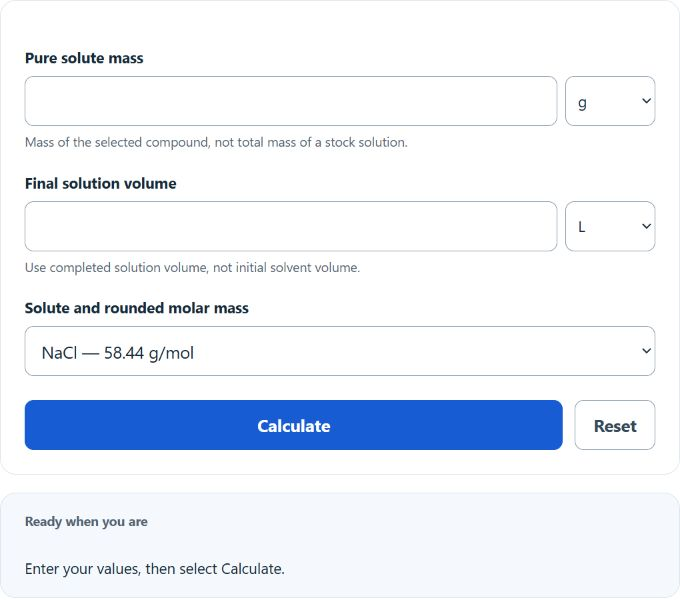
Calculate molarity from pure solute mass and final solution volume using a rounded molar-mass preset for NaCl, KCl, anhydrous glucose, NaOH, HCl or H₂SO₄, or enter another molar mass.
- mmol to meq Converter
- hemoglobin mmol/l to mg/dl Converter
- ppm To Volume Calculator
- nm to ug/ml Converter
- All Unit Converters
Weight to Molarity Formula
The following formula is used to calculate molarity from a known solute mass and solution volume.
Because molarity is based on moles per liter, the mass must first be converted to moles using the compound’s molar mass.
- M is the molarity in mol/L
- m is the mass of pure selected solute in grams, not total stock-solution mass
- MM is the molar mass in g/mol
- V is the final solution volume in liters, not initial solvent volume
To calculate molarity, divide the solute mass by the product of the molar mass and the solution volume in liters.
What is Weight to Molarity?
Weight to molarity conversion is the process of turning a measured solute mass into a concentration expressed in moles per liter. Since molarity describes how many moles of solute are present in each liter of solution, the grams must first be converted into moles using the chemical’s molar mass. This is a common calculation in chemistry, laboratory preparation, and solution formulation.
For example, sodium chloride has a molar mass of approximately 58.44 g/mol, so 58.44 g of pure NaCl corresponds to approximately 1.00 mole (exactly 1.00 in the rounded preset model). If that amount is dissolved to make 1.00 liter of solution, the concentration is 1.00 mol/L. Heavier compounds produce fewer moles for the same mass, which lowers the molarity when the volume stays constant.
How to Convert Weight to Molarity?
The following steps outline how to convert a solute mass into molarity.
- First, determine the mass of the solute.
- Next, identify the molar mass of the compound in g/mol.
- Convert the mass to moles using moles = mass ÷ molar mass.
- Determine the final solution volume in liters.
- Calculate the molarity using M = moles ÷ volume.
- After inserting the values and calculating the result, check your answer with the calculator above.
Example Problem:
Use the following variables as an example problem to test your knowledge.
Solute = Sodium chloride (NaCl)
Mass = 58.44 g
Volume = 1.00 L
Molarity = 1.00 mol/L
Weight to Molarity Example Table
The table below shows the molarity produced by using 10.0 g of pure selected solute to make a final solution volume of 1.00 L.
| Solute | Molar Mass (g/mol) | 10.0 g in 1.00 L → Molarity |
|---|---|---|
| Sodium Chloride (NaCl) | 58.44 | 0.171 mol/L |
| Potassium Chloride (KCl) | 74.55 | 0.134 mol/L |
| Anhydrous glucose (C₆H₁₂O₆) | 180.16 | 0.055 mol/L |
| Sodium Hydroxide (NaOH) | 40.00 | 0.250 mol/L |
| Hydrochloric Acid (HCl) | 36.46 | 0.274 mol/L |
| Sulfuric Acid (H₂SO₄) | 98.08 | 0.102 mol/L |
This calculation assumes the selected chemical form and pure solute mass. Hydrates require their own molar mass. For aqueous acid stocks, the bottle solution’s total mass is not the solute mass. Molarity also depends on final solution volume and temperature. The arithmetic does not establish solubility, purity, reaction behavior or safe preparation procedures.