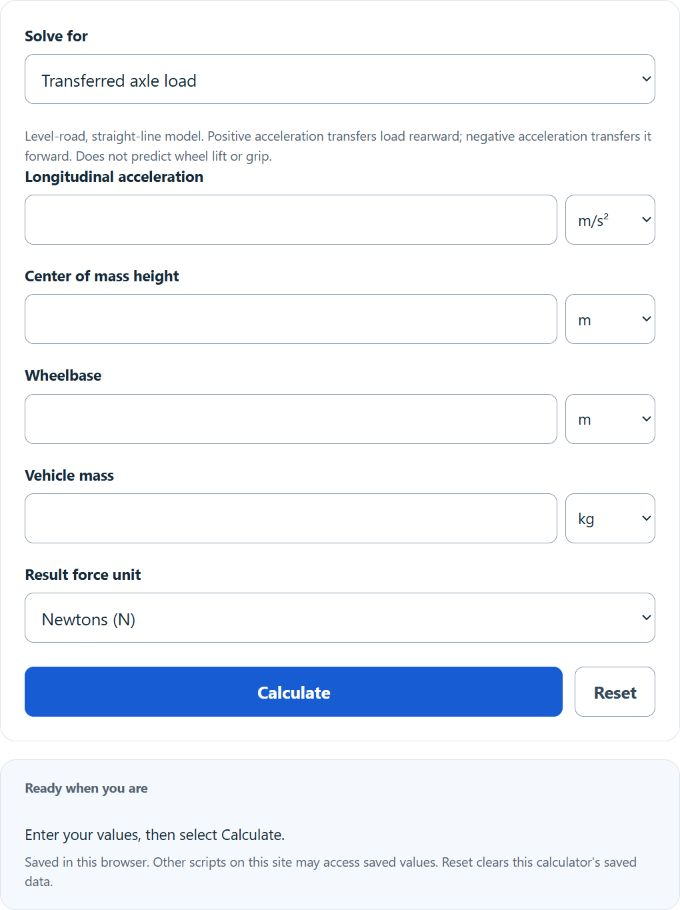
Choose a solve mode for transferred axle load, acceleration, center of mass height, wheelbase or mass, then enter the four known values. Transferred load is shown in N or lbf.
Understanding the Weight Transfer Calculator
The weight transfer calculator estimates how much load shifts between a vehicle’s front and rear axles during straight-line acceleration or braking. In vehicle dynamics, this is usually called longitudinal load transfer. The shift occurs because the center of mass sits above the ground, so any forward or backward acceleration creates a pitching moment about the tire contact patches.
Three inputs increase transfer directly: higher acceleration, higher center of mass, and greater vehicle mass. One input reduces transfer: a longer wheelbase. The calculator returns the amount of force transferred, not a change in total vehicle weight. Total weight stays constant; only the axle loading changes.
Weight Transfer Formula
Where:
| Variable | Meaning | Typical Units | Effect on Transfer |
|---|---|---|---|
| WT | Signed longitudinal load transfer | N or lbf | Calculated result |
| a | Signed longitudinal acceleration: forward positive, braking negative | m/s² or ft/s² | Higher value increases transfer |
| h | Center of mass height | m or ft | Higher value increases transfer |
| w | Wheelbase | m or ft | Higher value decreases transfer |
| m | Total vehicle mass | kg or lb | Higher value increases transfer |
What the Result Means
If the vehicle is accelerating forward, the calculated force generally shifts from the front axle to the rear axle. If the vehicle is braking, the same magnitude shifts from the rear axle to the front axle. This makes the result useful for traction analysis, brake balance review, launch behavior, and suspension tuning.
You can relate the transfer value to axle loads with the following relationships:
Use negative acceleration for braking: WT is then negative, so the front gains load and the rear loses load in the signed equations above. The absolute value gives the amount transferred.
Rearranged Equations
Choose the requested value and supply the other four. The relationship rearranges as follows; zero denominators can make an inverse nonunique or impossible.
How to Calculate Weight Transfer
- Determine the vehicle’s longitudinal acceleration or braking rate.
- Measure or estimate the center of mass height.
- Enter the wheelbase.
- Enter the total vehicle mass.
- Apply the formula to compute the transferred load.
- Interpret the sign or direction based on whether the vehicle is accelerating or braking.
Example
Suppose a vehicle has a mass of 1,500 kg, a center of mass height of 0.55 m, a wheelbase of 2.70 m, and is accelerating at 3.0 m/s².
This means about 916.7 N of normal load shifts rearward during acceleration. The front axle unloads by that amount, and the rear axle gains that same amount.
Practical Interpretation
- Higher center of mass: SUVs, trucks, and lifted vehicles usually experience more transfer than low sports cars.
- Longer wheelbase: A longer vehicle spreads the pitch moment over more distance, reducing the load shift.
- Hard braking: More load moves to the front axle, increasing front tire demand and reducing rear axle normal force.
- Hard acceleration: More load moves to the rear axle, which can help rear-wheel traction but reduce front axle grip.
Unit Notes
Use a consistent unit system when solving by hand. The safest method is to calculate in SI units and convert the final result if needed. A common mistake is mixing mass and force units in imperial calculations. If your calculator allows unit selection, make sure every input matches the selected units before solving.
Assumptions and Limitations
This equation is a useful first-pass model, but it is intentionally simplified. It assumes:
- A level surface
- Straight-line acceleration or braking only
- No aerodynamic lift or downforce effects
- Overall axle-load moment balance; suspension geometry affects internal force paths rather than removing total transfer
- No transient pitch dynamics
- No tire load sensitivity modeling
For detailed race setup, chassis development, or brake system design, more advanced vehicle dynamics models may be needed.
Common Questions
Is weight transfer the same as total vehicle weight?
The total vehicle weight does not change. Weight transfer only describes how much load moves from one axle to the other.
What happens if wheelbase increases?
Weight transfer decreases because the same pitching effect is distributed over a longer distance.
Why does a taller vehicle transfer more load?
A higher center of mass creates a larger moment arm, which increases the amount of load shifted during acceleration or braking.
Can the formula be used for braking?
Yes. The magnitude is computed the same way, but the direction of the transfer is toward the front axle instead of the rear.
Does this equation include cornering?
No. Cornering creates lateral load transfer, which requires a different model than straight-line acceleration or braking.