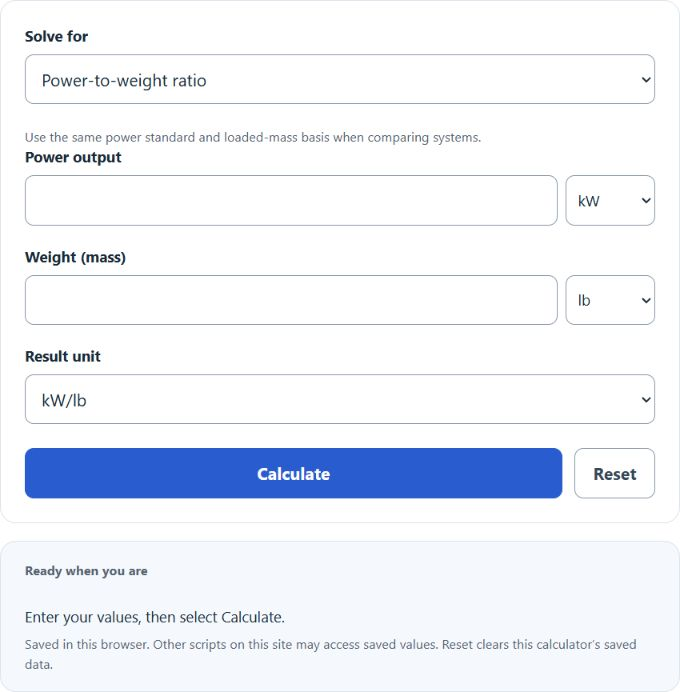
Choose power-to-weight ratio, power output, or weight (mass), then enter the two known values using kW or MW and lb or kg.
Understanding the kW to Weight Ratio
The kW to weight ratio shows how much power is available for each unit of weight. It is a compact way to compare performance potential across vehicles, machines, and other powered systems. In practical terms, a higher ratio usually means stronger acceleration, better responsiveness under load, and more power available for climbing, towing, or carrying weight.
This calculator can be used in either pounds or kilograms, so the result may be expressed as kW/lb or kW/kg. The most important rule is to keep the power and weight inputs on a consistent basis when comparing two setups.
kW to Weight Ratio Formula
- KWR = kW to weight ratio
- P = total power output
- W = total weight
If weight is entered in pounds, the result is in kW/lb. If weight is entered in kilograms, the result is in kW/kg.
Rearranged Forms
The calculator can also solve for the missing power or weight when the other two values are known.
How to Calculate the Ratio
- Enter the total power output in kilowatts.
- Enter the total weight in either pounds or kilograms.
- Divide power by weight.
- Interpret the result as power available per unit of weight.
Because the ratio is a direct division, the value rises when power increases and falls when weight increases. That makes it useful for quickly evaluating modifications such as engine upgrades, battery changes, cargo loads, passenger loads, and weight reduction.
Unit Conversions That Are Often Helpful
| Conversion | Formula |
|---|---|
| Horsepower to kilowatts | kW = hp × 0.7457 |
| Kilowatts to horsepower | hp = kW × 1.34102 |
| Pounds to kilograms | kg = lb × 0.45359237 |
| Kilograms to pounds | lb = kg × 2.20462 |
| Convert kW/lb to kW/kg | kW / kg = kW / lb × 2.20462 |
| Convert kW/kg to kW/lb | kW / lb = (kW / kg) / (2.20462) |
Example Calculation
Suppose a vehicle produces 300 kW and has a total weight of 1,800 kg.
The result is 0.1667 kW/kg.
If the same weight is expressed in pounds, the vehicle weighs about 3,968.3 lb.
The result is 0.0756 kW/lb.
Both values describe the same system; they are simply shown in different unit bases.
How to Interpret the Result
The ratio is best used for comparison. If two vehicles are measured using the same power standard and the same weight basis, the one with the larger kW to weight ratio generally has the stronger performance potential.
- Higher ratio: more power available for each pound or kilogram.
- Lower ratio: less power available for each pound or kilogram.
- Same power, less weight: ratio increases.
- Same weight, more power: ratio increases.
This is why lightweight designs can feel quick even with moderate power, while heavy systems often need significantly more output to achieve the same response.
Common Uses
- Comparing cars, motorcycles, ATVs, and race vehicles
- Estimating the effect of engine or motor upgrades
- Evaluating the impact of added cargo, passengers, or towing load
- Comparing electric and combustion platforms on a common power basis
- Checking whether weight reduction produces a meaningful performance gain
Important Measurement Notes
For accurate comparisons, make sure the inputs are defined the same way each time. Small differences in how power or weight is measured can noticeably change the ratio.
| Input Choice | Why It Matters |
|---|---|
| Peak power vs. continuous power | Peak output gives a larger ratio, while continuous output may better reflect sustained operation. |
| Crank power vs. wheel power | Wheel power is lower because drivetrain losses are removed from the measurement. |
| Dry weight vs. curb weight | Dry weight excludes fluids and often produces a more favorable ratio than curb weight. |
| Vehicle only vs. loaded weight | Passengers, cargo, tools, batteries, and fuel can materially reduce the ratio. |
Common Mistakes
- Mixing pounds and kilograms without switching the calculator units
- Entering horsepower values as if they were kilowatts
- Comparing one setup at dry weight to another at curb or loaded weight
- Using estimated power from marketing material instead of measured output
- Assuming the ratio alone predicts real-world acceleration without considering traction, gearing, aerodynamics, and torque delivery
Frequently Asked Questions
Is a higher kW to weight ratio always better?
For raw performance potential, usually yes. However, traction, transmission ratios, tire grip, aerodynamic drag, and how the power is delivered all affect actual results.
Why do my kW/kg and kW/lb values look very different?
The numerical values differ because a kilogram and a pound are different size units. A result expressed in kW/kg will always be larger than the same ratio expressed in kW/lb.
Can this ratio be used for electric vehicles?
Yes. The same calculation works for electric motors, hybrid systems, combustion engines, and many industrial drive systems. Just make sure the power figure and weight figure are measured on a comparable basis.
Should I use curb weight or total loaded weight?
Use the weight basis that matches your goal. Curb weight is useful for standardized vehicle comparisons, while loaded weight is better for real-use performance estimates.
What happens if I reduce weight instead of adding power?
Reducing weight improves the ratio the same way adding power does. In many cases, weight reduction improves acceleration, braking, and handling at the same time, which makes it especially valuable.