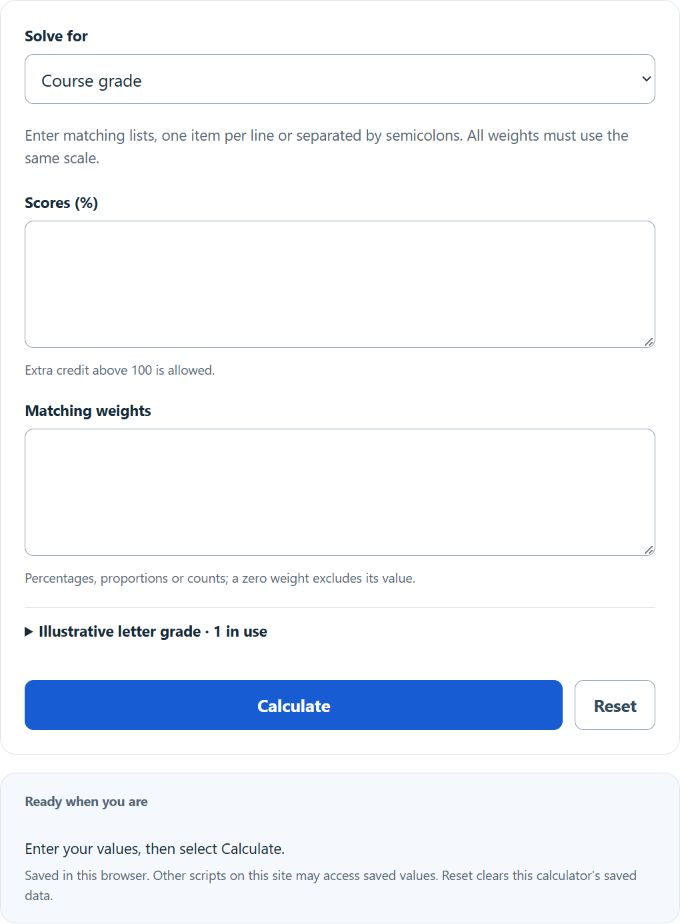
Calculate the weighted mean from matching value and weight lists, with a course score mode and an optional illustrative letter grade guide.
Related Calculators
- Least Square Error Calculator
- Z-Score Calculator
- Survey Percentage Calculator
- Modified Z Score Calculator
- All Statistics Calculators
Weighted Mean Formula
A weighted mean is an average that gives different levels of importance to different values. Instead of treating every observation equally, each value is multiplied by its assigned weight before the average is computed.
- WM = weighted mean
- wi = weight of each value
- xi = value being averaged
- n = number of values
If your weights are already normalized so their total equals 1, the denominator simplifies and the calculation becomes even shorter:
The weighted mean has the same units as the original values. The weights themselves only control influence; they do not change the unit of the result.
How to Calculate a Weighted Mean
- List each value and its matching weight.
- Multiply every value by its corresponding weight.
- Add all weighted products together.
- Add all weights together.
- Divide the total weighted products by the total weight.
This process is useful when some observations matter more than others, such as grade categories, portfolio allocations, survey adjustments, or prices tied to different quantities.
Example
Suppose the values are 10, 15, and 20, with weights 0.2, 0.3, and 0.5. The weighted mean is:
Because the largest weight is attached to the value 20, the final average is pulled upward toward 20 more than it is toward 10 or 15.
Solving for a Missing Input
For a manual inverse problem, rearrange the formula to solve for an unknown value or weight using the equations below. The calculator itself averages complete matching lists.
Unknown Value
If one value is missing and its weight is known, you can isolate that value:
Unknown Weight
If one weight is missing and the related value is known, you can isolate that weight:
For either rearrangement, the denominator must not be zero. Also, the total of all weights must not be zero, or the weighted mean is undefined.
When to Use a Weighted Mean
| Scenario | Values represent | Weights represent | Why weighting matters |
|---|---|---|---|
| Course grades | Scores in assignments, quizzes, exams | Category percentages | Final exams usually count more than homework |
| Investment returns | Return of each asset | Portfolio allocation | Larger holdings affect total return more |
| Survey analysis | Responses or subgroup averages | Population adjustment factors | Prevents overrepresented groups from distorting results |
| Inventory costing | Unit costs | Units purchased | Larger purchases should influence average cost more |
| Average price paid | Price at each transaction | Quantity bought | Buying more units at one price changes the true average more |
Weighted Mean vs. Regular Mean
A regular mean assumes every value contributes equally. A weighted mean changes that assumption by assigning more influence to some observations than others. If all weights are equal, the weighted mean reduces to the ordinary arithmetic mean.
Key Properties
- Higher weight means greater influence. A value with a large weight pulls the result toward itself.
- Zero weight means no influence. That value does not affect the final weighted mean.
- Positive weights keep the result bounded. With all positive weights, the weighted mean stays between the smallest and largest value.
- Equal weights reproduce the standard average. Weighting only changes the result when the weights differ.
- Scaling all weights by the same factor does not change the answer. Doubling every weight leaves the weighted mean unchanged.
Common Mistakes
- Mismatching values and weights. Each weight must correspond to the correct value.
- Forgetting to divide by total weight. This is a common error when weights do not add to 1 or 100%.
- Mixing decimals and percentages incorrectly. Use a consistent format for all weights.
- Assuming weights must add to 1. They do not have to, as long as you divide by the total of the weights.
- Using a total weight of zero. A denominator of zero makes the result undefined.
Weighted Mean FAQ
Do the weights need to add up to 1 or 100%?
No. Use nonnegative weights by default and divide by their sum. General mode also supports an explicitly selected advanced signed-weight convention; a zero or nearly cancelling total is rejected.
Can frequencies or counts be used as weights?
Yes. Counts, quantities, percentages, proportions, and importance scores can all be used as weights, provided they correctly represent how much influence each value should have.
What happens if one weight is zero?
A zero weight means that value contributes nothing to the weighted mean. It is effectively ignored in the calculation.
Can weights be negative?
General mode permits them only under the advanced signed-weight convention. Course mode requires nonnegative weights. Negative weights may place the result outside the observed range; zero or nearly cancelling totals are rejected.
Why is the weighted mean more accurate than a simple mean in some cases?
It is more representative whenever the observations do not contribute equally. Weighting prevents small or less important observations from affecting the result as much as large or more important ones.