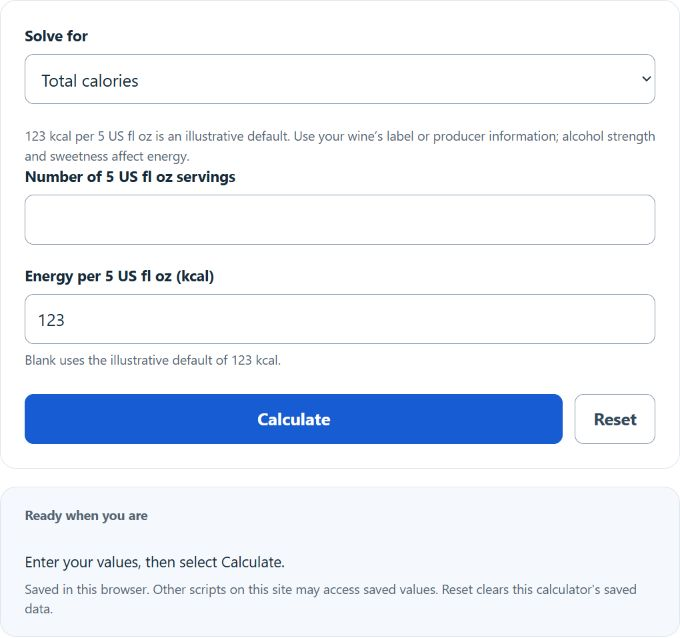
Select total calories or equivalent 5 US fl oz servings, then enter the required value and the energy per serving for your wine.
Note: Results are estimates. The retained default (123 kcal per 5 US fl oz) is illustrative, not a universal average; actual calories can vary significantly by ABV and sweetness. For best accuracy, use the bottle’s nutrition label/manufacturer information or consult a registered dietitian. Alcohol may not be safe for everyone (e.g., pregnancy, certain medications/conditions); follow national health guidelines (see the CDC and Dietary Guidelines) or ask a clinician.
- All Food and Cooking Calculators
- All Calories Burned Calculators
- Wine Pricing Calculator
- Calorie Calculator
- Macro Calculator
- Percentage of Calories Calculator
- Wine Sugar Calculator
Wine Calories Formula
Variables:
- WC is the total Wine Calories (calories)
- WG is the total number of glasses of wine (5 fl oz size)
- C is the energy in kcal per 5 US fl oz serving (illustrative default 123; actual values vary by wine)
To calculate total Wine Calories, multiply the number of 5 fl oz servings by the calories per 5 fl oz serving (use the label value when available; 123 is only an approximate default).
How to Calculate Wine Calories?
The following steps outline how to calculate the Wine Calories.
- First, determine the total number of glasses of wine (5 fl oz size).
- Next, gather the formula from above: WC = WG × C.
- Finally, calculate the Wine Calories.
- After inserting the variables and calculating the result, check your answer with the calculator above.
Example Problem :
Use the following variables as an example problem to test your knowledge.
total number of glasses of wine (5 fl oz size) = 10
Frequently Asked Questions
What factors can affect the calorie content of wine?
The calorie content in wine can be affected by several factors including the alcohol content (ABV), the type of wine (red, white, sparkling, etc.), and any added sugars or residual sweetness. Generally, higher alcohol content and sweeter wines can increase the calorie count.
How does the serving size of wine impact its calorie content?
The serving size directly impacts the calorie content as calories are calculated per serving. This calculator defines one volume serving as 5 US fluid ounces (147.8676478125 mL). It is not necessarily one standard alcoholic drink, which also depends on alcohol strength. Larger servings will have more calories.
Can the wine calories calculator be used for any type of wine?
It can provide a rough estimate for many wines, but calorie values vary meaningfully by ABV and sweetness (for example, “light” wines and dessert wines can differ a lot). For best accuracy, use the calories-per-serving shown on the bottle label/manufacturer information and enter that value in the calculator.
Is there a way to reduce the calorie intake from wine?
To reduce calorie intake from wine, consider choosing wines with a lower alcohol content and less sweetness, and be mindful of serving sizes. Some people opt for “light” wines that are specifically made to have fewer calories.