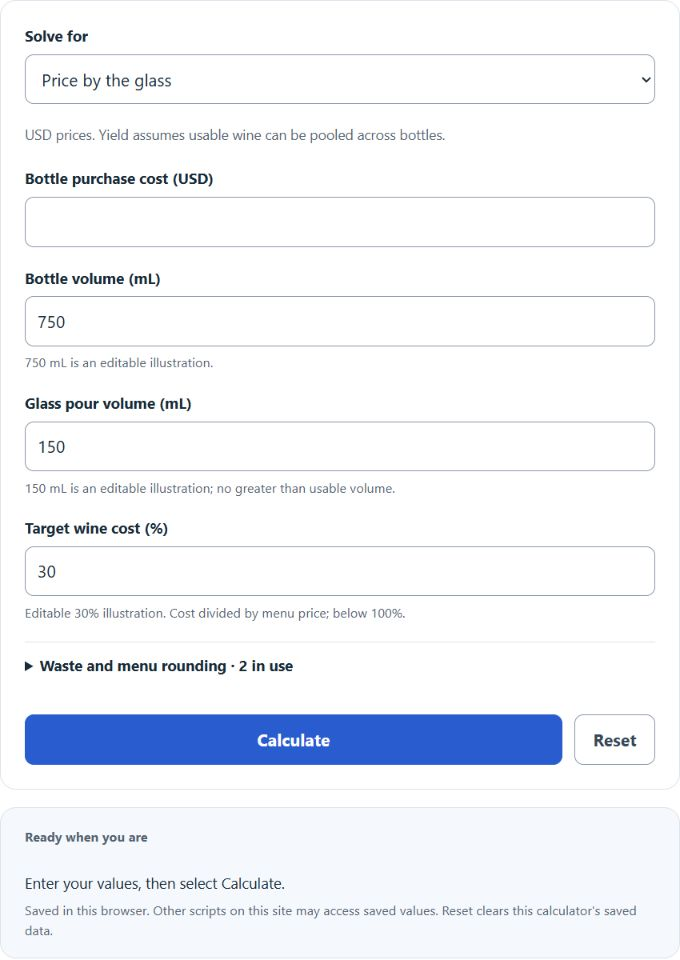
Price wine by the glass or bottle from your bottle cost and target wine-cost percentage, with a standard 750 mL bottle and 150 mL pour preset.
Wine Pricing Calculator Formula
Choose glass pricing, whole-bottle pricing, or an audit of existing menu prices. Enter the purchase cost in USD. Pricing modes divide cost by your target wine-cost percentage, then round upward to your menu increment. The editable 30% target, 750 mL bottle, 150 mL pour and 5% waste are illustrations, not recommendations.
- Menu price is the selling price in USD, rounded upward to the selected increment.
- BC = bottle cost, in dollars
- BP = bottle price; GP = glass price; T = target cost percent / 100; P = pour volume; U = usable volume. Usable volume = bottle volume * (1 – waste percent / 100). Pooled glass yield = usable volume / pour volume.
Glass allocation uses fractional pooled yield across bottles. The result also shows whole pours from one bottle and leftover volume; these are different quantities. A pour cannot exceed usable volume. Whole-bottle pricing uses the full purchase cost and excludes glass-service waste.
Audit mode uses your existing glass and bottle menu prices. Wine cost percentage = allocated wine cost / menu price * 100. Gross margin = (menu price – allocated wine cost) / menu price * 100; gross profit excludes labor, taxes, fees and other overhead. Blank waste means zero. Blank or zero menu increment rounds up to the next cent.
The following tables illustrate multipliers rather than a fixed calculator rule. A 3x selling price gives a 200% markup on cost, about 33.3% wine cost and about 66.7% gross margin.
Common Wine Markup and Cost Targets
| Pricing multiplier | Wine cost percentage | Example bottle cost | Example menu price |
|---|---|---|---|
| 2x | 50.0% | $20 | $40 |
| 2.5x | 40.0% | $20 | $50 |
| 3x | 33.3% | $20 | $60 |
| 4x | 25.0% | $20 | $80 |
Sample Prices Using the 3x Rule
| Bottle cost | Menu price at 3x | Wine cost percentage |
|---|---|---|
| $8 | $24 | 33.3% |
| $12 | $36 | 33.3% |
| $18 | $54 | 33.3% |
| $25 | $75 | 33.3% |
Example Problems
Example 1: You bought a bottle for $14. In whole-bottle mode, choose a 25% target cost and a $0.50 menu increment:
The wine menu price is $56.00, with 25% wine cost and 75% gross margin before other costs.
Example 2: Audit a $21 purchase cost, $63 bottle menu price and $14 glass menu price. With 750 mL, 150 mL pours and zero waste, the pooled yield is five glasses:
Allocated glass cost (GC) is $4.20. Glass gross margin = (14 – 4.20) / 14 * 100 = 70%. Bottle wine cost is 21/63 = 33.333333%, and bottle gross margin is 66.666667%.
FAQ
What does a 3x wine markup mean?
A 3x wine markup means the menu price is three times the bottle cost. For example, a $15 bottle cost becomes a $45 menu price. This gives a wine cost percentage of about 33.3%.
Is bottle cost the same as retail price?
Not always. Bottle cost usually means the amount the business paid for the bottle. Retail price is what a customer pays in a store. If you are pricing for a restaurant or bar, use your actual purchase cost when possible.
Should every wine be priced at exactly 3x?
No fixed multiplier fits every business. Enter your own target percentage or audit your current prices. A 3x price is only one illustration. The calculator models wine cost and gross profit in USD; it does not convert currencies or recommend a target margin.