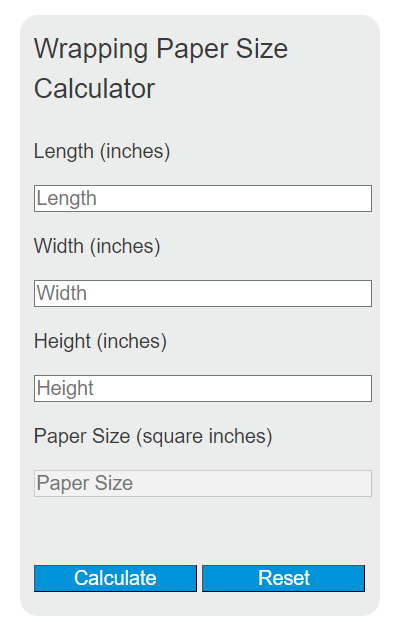
Wrapping Paper Size Calculator for boxes and cylinders with seam overlap, end allowance, orientation comparison, roll-width fit, and gift-count planning.
Related Calculators
- Package Girth Calculator
- Coverage Area Calculator
- Box Volume Calculator
- Fabric Consumption Calculator
- Wallpaper Yardage Calculator
- Picture Frame Size Calculator
- All Everyday Life and Education Calculators
Wrapping Paper Size Formula
For a rectangular box, this calculator finds the minimum wrapping paper area needed to cover all six faces. In geometry, that is the surface area of a rectangular prism.
- PS = total paper area required
- L = box length
- W = box width
- H = box height
Use the same measurement unit for every dimension. If the box dimensions are entered in inches, the result is in square inches. If the dimensions are entered in feet, centimeters, or meters, the result is returned in the matching square unit.
Why the Formula Works
A box has three unique face sizes: the length-by-width faces, the width-by-height faces, and the height-by-length faces. Each of those face sizes appears twice on the box, so adding the three face areas and multiplying by two gives the full outside coverage area.
How to Calculate Wrapping Paper Size
- Measure the box length, width, and height.
- Keep all measurements in one unit system.
- Substitute the values into the formula above.
- Use the result as the minimum surface coverage, then add extra paper if you want overlap, folded ends, or cutting margin.
Example
For a box that is 12 inches long, 8 inches wide, and 4 inches high:
This means the box itself has 352 square inches of exterior surface to cover.
Minimum Coverage vs. Real-World Wrapping
The calculator returns the theoretical coverage area of the box. In practice, most gifts require more paper than the raw surface area because the sheet must overlap at the seam, fold inward at the ends, and leave enough material for trimming and alignment.
A practical planning method is to add an allowance percentage to the calculated result:
Typical allowance ranges:
- 10% for thin paper and tight, efficient wrapping
- 15% for standard gift wrap and normal folds
- 20% or more for thick boxes, large seams, or extra room for mistakes
Using a 15% allowance on the example box:
Important Note About Roll Size
Area is useful for estimating how much paper is needed, but it does not always tell you whether a single rectangular sheet will fit around the box. Gift wrap is cut from rolls, so the cut piece must also have enough width and length for the chosen wrapping orientation.
For a common one-piece wrap, a simple cut-size estimate is:
- S1 = sheet dimension that wraps around the box
- S2 = sheet dimension that covers the box length and end folds
- o = seam overlap allowance
- f = extra paper for end folds
If the roll width is fixed, try both box orientations before cutting. Rotating the box can reduce waste and shorten the required cut length.
When This Calculator Is Most Useful
- Gift boxes with flat rectangular sides
- Shipping cartons and retail packaging
- Estimating decorative paper, craft paper, or adhesive film coverage
- Comparing packaging sizes before buying wrapping supplies
For cylinders, spheres, bags, or irregularly shaped items, this method becomes an approximation because those shapes do not follow the geometry of a rectangular box.
Quick Reference
| Goal | Best Use of the Result |
|---|---|
| Find the minimum coverage area | Use the calculator output directly |
| Buy enough wrapping paper | Add an extra 10% to 20% allowance |
| Check whether a roll will physically fit | Compare the roll dimensions to the estimated cut-sheet dimensions |
| Reduce wasted paper | Test both box orientations before making the final cut |