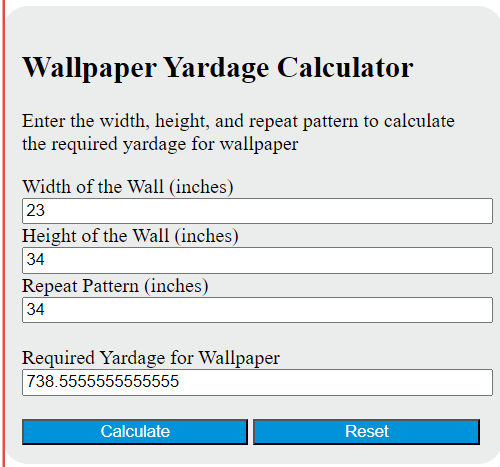
Calculate wallpaper linear yardage, repeat-adjusted strip length, and roll count for one wall or a room using wall size, paper width, pattern repeat, and waste.
Related Calculators
- Wall Area Calculator
- Coverage Area Calculator
- Paint Usage Calculator
- Window Area Calculator
- Cost Per Square Foot Calculator
- All Construction Calculators
Wallpaper Yardage Formula
This calculator estimates how many linear yards of wallpaper are needed to cover a wall based on the wall width, wall height, and wallpaper roll width. It is a fast planning method that works well for rectangular walls and early material estimates. Because wallpaper is installed in strips, the final purchase quantity should usually include extra material for trimming, alignment, corners, and pattern repeat.
In this formula, the wall dimensions and roll width are converted to inches first. The result is the required wallpaper length in linear yards.
| Variable | Meaning |
|---|---|
| Y | Required wallpaper length in linear yards |
| W | Wall width in inches |
| H | Wall height in inches |
| R | Wallpaper roll width in inches |
| 36 | Number of inches in one yard |
How the Estimate Works
The calculator first determines the wall area, then divides that area by the coverage provided by one linear yard of wallpaper. A wider roll covers more area per yard, so the required yardage goes down as roll width increases. Taller or wider walls increase the required yardage.
If you are measuring in feet, convert dimensions before applying the formula:
If you work entirely in metric, the same idea gives linear meters directly:
That metric form returns the wallpaper length in meters when the wall width, wall height, and roll width are all entered in meters.
Rearranged Forms
This calculator can also solve for a missing wall width, wall height, or wallpaper width when the other values are known. The formula can be rearranged as follows:
How to Calculate Wallpaper Yardage
- Measure the full width of the wall.
- Measure the wall height at the tallest point.
- Confirm the wallpaper roll width from the product specification.
- Convert all measurements to a consistent unit system.
- Apply the yardage formula to get the base requirement.
- Add extra material for trimming, pattern matching, and installation waste.
- Round up to a practical purchase quantity.
For several walls with different sizes, it is often easier to total the wall areas first:
If all walls have the same height, you can also add the widths together and treat them as one long wall.
Adding Waste and Pattern Repeat
The base formula gives a clean geometric estimate, but real installations almost always need more wallpaper than the minimum. Extra material is commonly needed for:
- Top and bottom trimming
- Pattern repeat and pattern matching
- Outside corners and difficult layouts
- Sloped ceilings or uneven floors
- Mis-cuts and installation errors
A simple way to account for this is to apply an allowance factor:
Here, a is the waste allowance written as a decimal. For example, use 0.10 for ten percent or 0.15 for fifteen percent. Plain or lightly textured papers may need less extra material than papers with large, repeating patterns.
Converting Yardage to Number of Rolls
If you know the length of wallpaper contained in one roll, you can convert the final yardage estimate into a roll count:
In this expression, N is the number of rolls to buy and Lroll is the usable wallpaper length per roll in yards. The ceiling brackets mean the result should always be rounded up to the next whole roll.
Example
Suppose a wall is 10 feet wide, 8 feet high, and the wallpaper roll is 24 inches wide.
The base estimate is 13.33 linear yards. If you add a ten percent waste allowance:
If each roll contains 9 linear yards, divide the adjusted requirement by 9 and round up. That means 2 rolls would be needed.
Practical Measuring Tips
- Measure height in more than one location and use the largest value.
- Measure full wall width before subtracting openings.
- Only subtract doors or windows when they are large enough to materially reduce coverage.
- Keep widths and heights in the same unit system throughout the calculation.
- Double-check whether the product is labeled by single roll or double roll.
- For expensive wallpaper, always round up rather than down.
When This Calculator Is Most Accurate
This estimate is most useful when:
- The wall is rectangular
- The wallpaper width is known
- You want a quick linear yardage estimate
- You plan to add a reasonable waste allowance afterward
For highly patterned wallpaper, murals, staircase walls, rooms with many corners, or projects where strip layout matters, a cut-plan-based estimate may be more precise than a simple area method.
Common Questions
- What is linear yardage?
- Linear yardage is the length of wallpaper measured along the roll. It is different from wall area because roll width affects how much area each yard can cover.
- Why does roll width matter so much?
- A wider roll covers more wall area per yard of length, which reduces the total yardage required.
- Should openings always be subtracted?
- Not always. In many rooms, the saved area is partly offset by trimming waste and pattern alignment, so estimators often leave small openings in the calculation.
- Why should I add extra wallpaper?
- Wallpaper is installed in vertical drops, not as one continuous sheet. Extra material helps cover trimming losses, matching waste, and mistakes during installation.