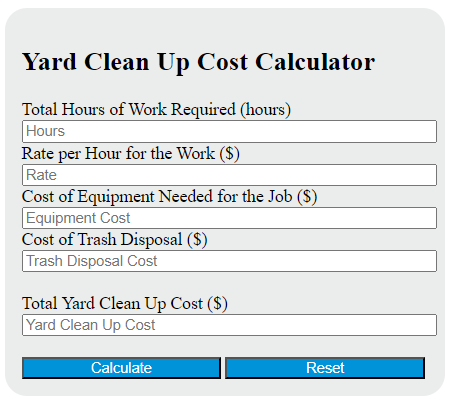
Calculate yard clean up cost, labor hours, hourly rate, equipment, or trash disposal by entering any four values to find the missing one.
Related Calculators
- Cost Per Hour Calculator
- Hourly Rate Calculator
- Man Hours Calculator
- Labor Productivity Calculator
- Service Price Calculator
- Cost Per Acre Calculator
- All Personal Finance Calculators
Yard Clean Up Cost Formula
The yard clean up cost calculator estimates the full price of a one-time yard cleanup by combining labor, equipment, and disposal into a single total. It is useful for seasonal cleanups, overgrown yards, move-out prep, storm debris removal, leaf pickup, brush hauling, and quote comparison.
In this pricing model, labor is the variable portion of the job, while equipment and disposal are fixed add-on costs for the project.
Variable Definitions
| Variable | Meaning | Typical Unit |
|---|---|---|
| YCC | Total yard clean up cost | Dollars ($) |
| H | Total hours of work required | Hours |
| R | Hourly labor rate for the worker or crew | Dollars per hour ($/hr) |
| E | Equipment, tools, rentals, or fuel cost | Dollars ($) |
| T | Trash disposal, green waste, haul-away, or dump fees | Dollars ($) |
How the Calculator Works
- Estimate the total labor time needed for the cleanup.
- Enter the hourly rate being charged for the work.
- Add any equipment-related costs that apply to the job.
- Add the expected disposal or haul-away cost.
- The calculator combines those amounts into one total project estimate.
This structure is especially helpful when the job scope is clear but the final price depends on how long the cleanup will take.
Rearranged Formula Versions
If you know the total project cost and need to solve for one missing input, use these equivalent forms:
These are useful when checking a contractor estimate, setting your own rate, or figuring out how much budget remains for equipment and disposal.
What to Include in Each Input
- Hours (H): Include all billable labor time, not just active yard work. Setup, loading, bagging, hauling, and final cleanup may all count.
- Rate (R): Use the rate actually charged for the job. If a contractor bills by crew rather than by individual worker, enter the full crew hourly rate.
- Equipment (E): Include mower or trimmer rental, blower use, chainsaw use, fuel, mulch spreader rental, trailer use, or other job-specific tools.
- Disposal (T): Include bag fees, green waste pickup, landfill or transfer station fees, trailer dumping costs, and brush haul-away charges.
If Multiple Workers Are Involved
When labor is priced per worker, you can first convert it into a single combined hourly rate for the crew:
Here, n is the number of workers and rw is the hourly rate per worker. Once you have the combined rate, use it in the main formula.
Example Calculation
Suppose a yard cleanup requires 6 hours of labor at $35 per hour, plus $40 for equipment and $25 for disposal.
The estimated total yard clean up cost is $275.
How to Estimate Hours More Accurately
- Break the job into tasks such as leaf removal, trimming, weeding, mowing, edging, bagging, and haul-away.
- Account for yard size, slope, fence access, debris volume, and how overgrown the property is.
- Add time for loading vehicles, transporting waste, and dumping material if that is part of the service.
- Use the contractor’s minimum billing increment if they round up to the nearest half-hour or hour.
Common Cost Drivers
- Debris volume: More leaves, branches, and brush increase both labor and disposal.
- Overgrowth: Tall grass, dense weeds, and neglected beds raise total work time.
- Access difficulty: Narrow gates, steep slopes, and limited parking can slow the job.
- Special tools: Chainsaws, hedge trimmers, stump tools, or trailers may add equipment cost.
- Disposal requirements: Haul-away fees can materially change the final estimate.
What This Formula Captures Best
This calculator works best for jobs priced with a straightforward labor-plus-fees structure. It is ideal when:
- the contractor charges by the hour,
- equipment is billed as a separate line item,
- haul-away or disposal is not included in the base labor rate, and
- you want to compare multiple quotes using the same assumptions.
If materials such as mulch, seed, sod, soil, or replacement plants are being added, those items may need to be tracked separately or included in the equipment/materials portion of the estimate.
Quote Comparison Checklist
- Confirm whether the hourly rate is for one worker or the full crew.
- Check whether disposal is included or billed separately.
- Make sure the quote includes the same scope of work for each contractor.
- Ask whether travel time, minimum charges, or fuel surcharges apply.
- Separate one-time cleanup pricing from ongoing maintenance pricing.
Frequently Asked Questions
- Does this calculator work for flat-fee yard cleanup quotes?
- Yes. If you know the fixed quote total, you can use the rearranged formulas to estimate the implied labor hours, hourly rate, or fee breakdown behind that quote.
- Should disposal always be entered separately?
- Only if it is charged separately. If the provider already included disposal in the hourly rate or total quote, do not add it again.
- What if I am doing the work myself?
- You can still use the calculator by entering your own estimated labor value, equipment cost, and any dump or haul-away fees to understand the full economic cost of the project.
- Is this formula good for recurring lawn service?
- It can be used for a single visit, but recurring mowing or maintenance contracts often include different pricing assumptions than a one-time cleanup job.