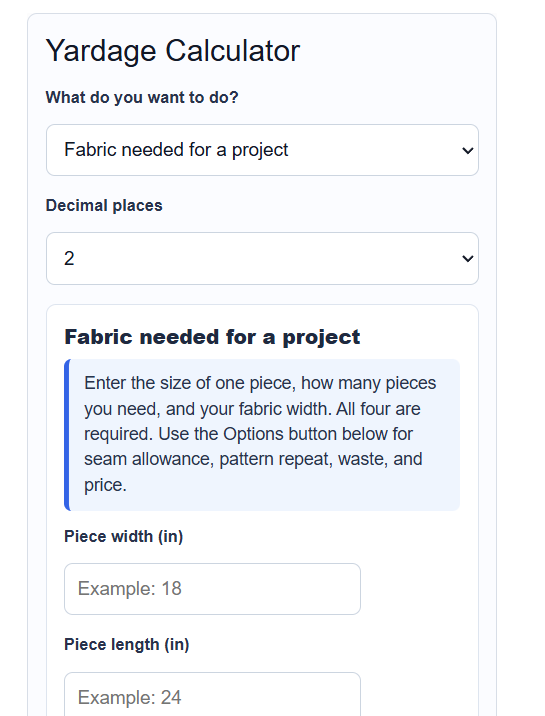
Calculate how much fabric yardage you need from your project pieces, fabric width, seam allowance, and waste, plus convert lengths and estimate cost.
Yardage Formula
The calculator works in four modes. Each mode uses its own formula.
Fabric needed for a project. Pieces are nested across the fabric width, then the rows are stacked to find the total length, which is converted to yards.
We = Wp + 2*S Le = Lp + 2*S
n = floor(Wf / We) R = ceil(P / n)
Y = R * Le * (1 + e/100) / 36
Convert a length to yards.
Y = L(in) / 36
Fabric cost from yards.
C = Y * Pr * (1 + t/100)
Where:
- Y = yardage (yards)
- Wp = width of one piece (inches)
- Lp = length of one piece (inches)
- S = seam allowance per side (inches)
- We, Le = effective piece width and length after seam allowance (inches)
- Wf = usable fabric width (inches)
- P = number of pieces
- n = pieces that fit across the fabric width
- R = rows of pieces to cut
- e = extra or waste allowance (percent)
- L(in) = a measured length in inches
- C = total cost, Pr = price per yard, t = sales tax (percent)
The project mode adds the seam allowance to every side of each piece, fits as many pieces as it can across the fabric width, and counts how many rows that takes. If you set a pattern repeat, the row length is rounded up to the next full repeat so prints line up. The extra percentage covers cutting mistakes and shrinkage. Convert mode turns any length into exact yards and rounds up to the next buying increment. Cost mode multiplies yards by your price and adds tax. The unit converter changes a value between inches, feet, yards, millimeters, centimeters, and meters.
Standard Fabric Widths
Fabric is sold by the linear yard, but the bolt width changes the math. A yard is always 36 inches long. Pick the width that matches your fabric before you calculate.
| Width | Common use |
|---|---|
| 36 in | Vintage cottons, some specialty prints |
| 44 / 45 in | Quilting cotton, light apparel cotton |
| 54 in | Home decor, upholstery, drapery |
| 58 / 60 in | Apparel wovens, knits, fleece |
How Much Extra to Add
The calculator gives you a theoretical minimum. Buy more than the exact figure so you have room for error. These are typical extra allowances to enter in the waste field or round up to.
| Situation | Extra to add |
|---|---|
| Solid fabric, no matching | 10% |
| Print with a pattern repeat | 15 to 20% |
| Directional or napped fabric | 15% |
| Fabric you will prewash | Add 5% for shrinkage |
Example Problems
Example 1: pieces for a project. You need 8 panels that each measure 18 in wide by 24 in long. The fabric is 44 in wide and you use a 0.5 in seam allowance with a 10% waste allowance. Each effective piece is 19 in by 25 in. Across a 44 in width you fit floor(44 / 19) = 2 pieces per row. You need ceil(8 / 2) = 4 rows. The cut length is 4 * 25 = 100 in, and with 10% extra that is 110 in. Dividing by 36 gives 3.06 yards, so you buy 3.25 yards.
Example 2: length to yards and cost. You measured 90 inches of fabric. 90 / 36 = 2.5 yards exactly. At $12.00 per yard with 8% sales tax, the cost is 2.5 * 12 = $30.00 plus $2.40 tax, for a total of $32.40.
FAQ
How long is one yard of fabric? One yard is 36 inches, or 3 feet, measured along the length of the bolt. The width is separate and depends on the fabric, usually 44 to 60 inches.
Why does the fabric width change the result? Wider fabric lets you fit more pieces side by side, so you need fewer rows and less total length. The same set of pieces can take noticeably more yardage on a narrow 44 in cotton than on a 60 in apparel fabric.
Should I use the exact yardage or the rounded amount when buying? Use the exact yardage for planning your cutting layout and the rounded "yards to buy" figure when you purchase. Fabric is usually cut in quarter or half yard increments, and the extra covers shrinkage and mistakes.