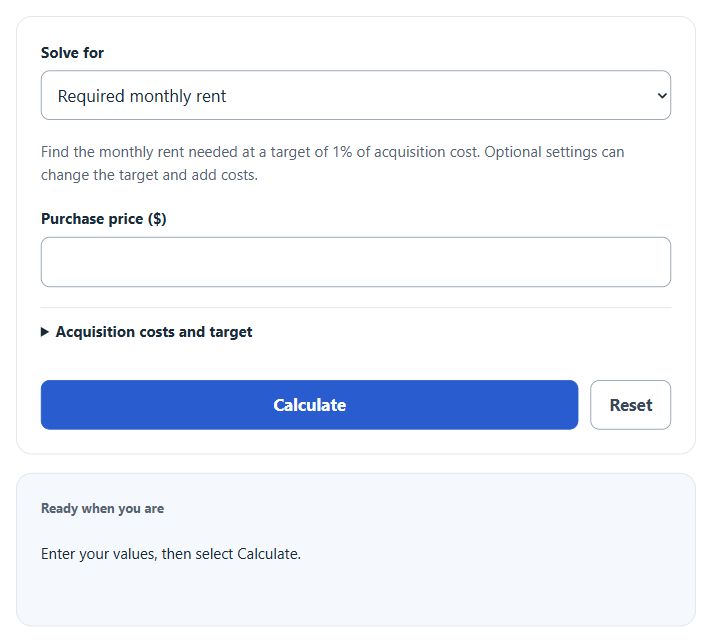
Use the 1% rule to find the monthly rent a rental property needs from its purchase price, the most you can pay for a given rent, or a deal’s cash flow.
- All Personal Finance Calculators
- Home Affordability Calculator (28/36 rule)
- 1 Percent Daily Return Calculator
- 10 Percent Annual Return Calculator
Calculator Functions
| Function | What it does | What it requires |
|---|---|---|
| Required monthly rent | Finds the monthly rent that meets the target for a given purchase price | Requires purchase price. Rehab and closing costs and a target other than 1% are optional |
| Maximum purchase price | Finds the highest purchase price a given rent supports at the target | Requires monthly rent. Rehab and closing costs and a target other than 1% are optional |
| Check a rental property | Finds the rent-to-cost ratio of a property and whether it meets the target | Requires purchase price and monthly rent. Rehab and closing costs and a target other than 1% are optional |
| Cash flow and financing | Finds monthly cash flow after operating costs and the loan payment | Requires purchase price, monthly rent, down payment, annual loan interest rate and loan term. Vacancy, management, maintenance, property taxes, insurance, HOA fees, utilities and acquisition costs are optional |
All amounts are in U.S. dollars. A blank optional cost counts as zero, and the monthly rent target starts at 1%. Loan terms of 10, 15, 20, 25 and 30 years are available.
1 Percent Rule Formulas
| R | Monthly rent that meets the target ($) |
| P | Purchase price ($) |
| C | Rehab and closing costs ($) |
| t | Monthly rent target as a decimal. The 1% rule uses 0.01 |
The 1% rule compares one month of rent with the total cost of acquiring a rental property. It is a quick screen that leaves out financing and operating costs, which the Cash flow and financing function adds back.
Required monthly rent
This is the formula above. A $200,000 purchase with $10,000 of rehab and closing costs needs (200,000 + 10,000) × 0.01 = $2,100 a month.
Maximum purchase price
A rent of $2,000 a month supports $200,000 of total acquisition cost at 1%. With $10,000 of rehab and closing costs, the purchase price can be at most $190,000.
Check a rental property
Gross yield = 12 × Ratio
GRM = (P + C) ÷ (12 × R)
The ratio is compared with the target, and a ratio equal to the target meets it. A $200,000 property renting for $1,800 a month has a ratio of 0.9%, which is below 1%. Its annual gross yield is 10.8% and its gross rent multiplier (GRM) is 9.259. The answer also lists the rent needed at the target, $2,000, and the highest price the current rent supports, $180,000.
Cash flow and financing
M = L × r ÷ (1 − (1 + r)−n)
Cash flow = NOI − M
NOI is monthly net operating income. e is vacancy, management and maintenance added together as a share of rent, and F is the fixed monthly costs: property taxes, insurance, HOA fees and utilities. M is the monthly principal and interest payment on a loan of L, where r is the annual rate ÷ 12 and n is the number of monthly payments. An interest-free loan is paid as L ÷ n.
For a $200,000 purchase with 20% down, a 30-year loan at 7% and $2,000 of rent, with 5% vacancy, 8% management, 5% maintenance, $200 of taxes and $100 of insurance, operating expenses are $660 and NOI is $1,340. The payment on the $160,000 loan is $1,064.48, which leaves $275.52 a month.
(P + C)
DSCR = NOI ÷ M
Cash-on-cash = 12 ×
Cash flow ÷ Cash invested
The cap rate follows the standard relation between income and value, in which net operating income divided by the capitalization rate gives value [1]. Here the value is the total acquisition cost, so the example gives 8.04%. The debt service coverage ratio (DSCR) divides income by the loan payment [2], 1.259 in the example. Cash invested is the down payment plus rehab and closing costs, $40,000, for a cash-on-cash return of 8.265%. Break-even rent is (F + M) ÷ (1 − e), or $1,664.00.
Limits of This Estimate
- The 1% rule is a rule of thumb for comparing properties quickly. It is not a valuation, and a property that meets it can still lose money each month. These estimates are based on the best available data and estimations.
- Cash flow leaves out income taxes, appreciation, sale costs and any expense that is not entered. Percentage expenses are taken from the full scheduled rent.
- The loan is treated as fixed-rate and fully amortizing, with no fees, mortgage insurance or escrow.
- Lenders measure DSCR with net cash flow, which is income after their own underwriting adjustments, against a level payment that includes amortization [2]. A lender’s figure can be lower than the one shown here.
Sources
- Freddie Mac Multifamily, Capitalization Rate Guidance (March 2025): net operating income divided by the capitalization rate equals value
- Fannie Mae, Multifamily Selling and Servicing Guide, Section 804.02 and Glossary: debt service coverage ratio as net cash flow divided by debt service on a level payment