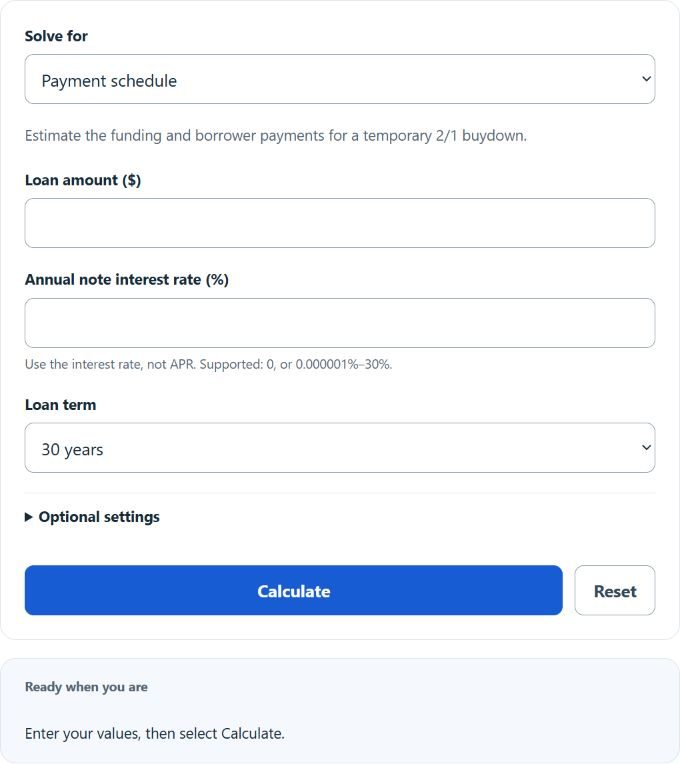
Calculate first-, second-, and third-year mortgage payments for a 2/1 temporary buydown, total subsidy funding, or the loan amount supported by a budget.
2/1 Buydown Formula
The standard fixed-rate monthly principal-and-interest payment formula is:
Payment = P × i × (1 + i)^N / ((1 + i)^N − 1), where i = (annual note interest rate/100)/12 and N is the total number of monthly payments.
For a 2/1 temporary buydown, the Year 1 payment is calculated using a payment rate that is 2 percentage points below the note rate, the Year 2 payment uses a payment rate that is 1 percentage point below the note rate, and the Year 3+ payment uses the note rate (all calculated over the original term N). The estimated buydown subsidy for the first two years is (Note Payment − Year 1 Payment) × 12 + (Note Payment − Year 2 Payment) × 12. The calculator offers 10-, 15-, 20- and 30-year terms. Payment rates are floored at 0%; at a zero note rate, subsidy is zero and a budget cannot determine a unique loan amount.
Variables:
- P is the principal loan amount
- The annual note interest rate is a percentage (e.g., 6 for 6%); APR also includes loan charges and is not the rate used here.
- i is the monthly note interest rate (annual note interest rate/100/12)
- N is the total number of monthly payments (e.g., 360)
What is a 2/1 Buydown?
A 2/1 buydown (more precisely, a 2/1 temporary buydown) uses subsidy funds to reduce the borrower’s out-of-pocket principal-and-interest payment for the first two years. The borrower remains obligated to make the full note payment if subsidy funds are unavailable. Fannie Mae qualification uses the note rate without the buydown. The reduced payments are commonly calculated as if the interest rate were 2 percentage points lower in Year 1 and 1 percentage point lower in Year 2 compared with the loan’s note (final) interest rate. The note rate itself is typically fixed and does not “adjust” because of the buydown; instead, the payment reduction is usually covered by funds paid at closing (often by the seller or builder) and held in a buydown escrow. After the first two years, the borrower’s payment steps up to the regular payment based on the note rate for the remainder of the term.
How to Calculate 2/1 Buydown?
The following steps outline how to calculate a 2/1 temporary buydown (principal-and-interest only).
- Determine the loan amount (principal), the note (final) interest rate, and the total loan term in months (N).
- Compute the Year 1 buydown rate as (note interest rate − 2 percentage points) and the Year 2 buydown rate as (note interest rate − 1 percentage point). If either result is below 0%, use 0%.
- Use the standard mortgage payment formula to calculate three payments (over the same total term N): one using the Year 1 rate, one using the Year 2 rate, and one using the note rate (Year 3+).
- Estimate the buydown subsidy needed by summing the monthly differences between the note-rate payment and the reduced payments over the first 12 months (Year 1) and next 12 months (Year 2).
Example Problem :
Use the following variables as an example problem to test your knowledge.
principal loan amount ($) = 300,000
note (final) interest rate (%) = 6.0
total number of monthly payments (N) = 360
calculated monthly payment at note rate (Year 3+) ($) ≈ 1798.65
calculated monthly payment in Year 1 at (note rate − 2 percentage points) = 4.0% ($) ≈ 1432.25
calculated monthly payment in Year 2 at (note rate − 1 percentage point) = 5.0% ($) ≈ 1610.46
estimated total buydown subsidy for first 2 years ($) ≈ 6655.11, using unrounded payments in 12 × (note payment − year 1 payment) + 12 × (note payment − year 2 payment). A lender’s monthly rounding may change actual escrow funding.