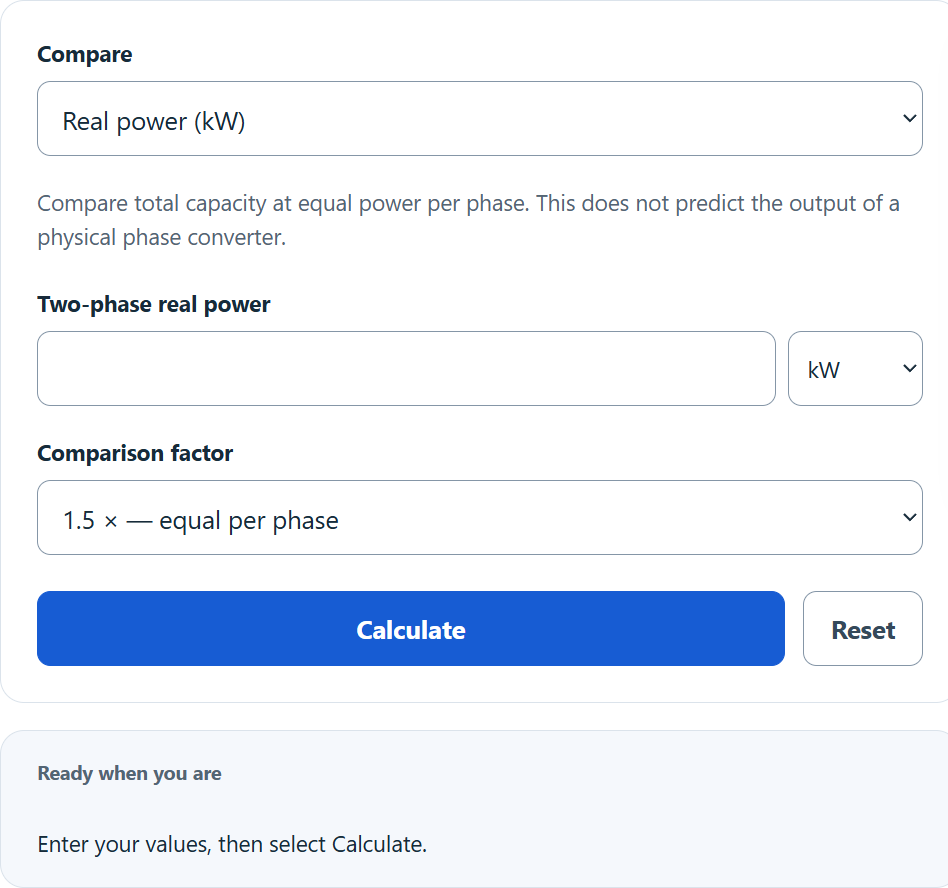
Compare two-phase and three-phase capacity under stated per-phase assumptions. Choose real power (kW) or apparent power (kVA); the comparison is not a prediction of physical converter output.
- RPM To Watts Calculator
- Watts to Amps Calculator
- Volts to mA Calculator
- GJ to MWh Conversion Calculator
- All Unit Converters
2 Phase to 3 Phase Formula
The following formula compares total capacities under a selected assumption; it does not describe power gained by a phase converter.
For the theoretical balanced case, the multiplier is k = 3 / 2 = 1.5, so the formula becomes P3φ = 1.5 × P2φ.
Variables:
- P3φ is the three-phase capacity comparison
- P2φ is the original 2-phase power
- k is the selected comparison factor
Multiply the two-phase total by the chosen comparison factor. The factor 1.5 assumes equal capacity per phase in both systems. The retained 1.6, 1.7, and 1.9 options are hypothetical margins, not verified motor or industrial sizing rules.
What is 2 Phase to 3 Phase Conversion?
2 phase to 3 phase conversion is an estimation method used to compare the total power capacity of a two-phase electrical system with that of a three-phase system. Under the same per-phase voltage, current, and power factor, a balanced three-phase system can deliver more total power because it has an additional phase. That is why the theoretical multiplier is 1.5, meaning a three-phase system can provide about 50% more power than a comparable two-phase system.
A physical phase converter cannot create additional real power. Its output depends on input power, losses, and equipment ratings. Two live conductors in a single-phase supply are not a true two-phase system; actual phase conversion requires suitable equipment.
How to Calculate 2 Phase to 3 Phase Power?
The following steps outline how to estimate the equivalent 3-phase power from a 2-phase system.
- First, determine the total power in the 2-phase system.
- Next, choose real or apparent power and the comparison assumption. kW and kVA are different quantities; changing the task does not convert one to the other.
- Then, multiply the 2-phase power by that factor using the formula P3φ = k × P2φ.
- Finally, review the result and compare it with the calculator above.
Example Problem:
Use the following example values to test your understanding.
2-Phase Power = 10 kW
Conversion Multiplier = 1.5
Equivalent 3-Phase Power = 10 × 1.5 = 15 kW
2 Phase to 3 Phase Conversion Table
The table compares a 10 kW two-phase total using one equal-per-phase ratio and three illustrative margins. These are not equipment recommendations.
| Scenario | Multiplier | 3-Phase Equivalent for 10 kW |
|---|---|---|
| Equal capacity per phase | 1.50 | 15.0 kW |
| Illustrative margin only | 1.60 | 16.0 kW |
| Illustrative margin only | 1.70 | 17.0 kW |
| Illustrative margin only | 1.90 | 19.0 kW |
This comparison does not predict the output of a physical converter. For actual equipment selection, cable sizing, or supply design, use the system voltage, current, power factor, efficiency, and manufacturer data rather than relying only on a single multiplier.