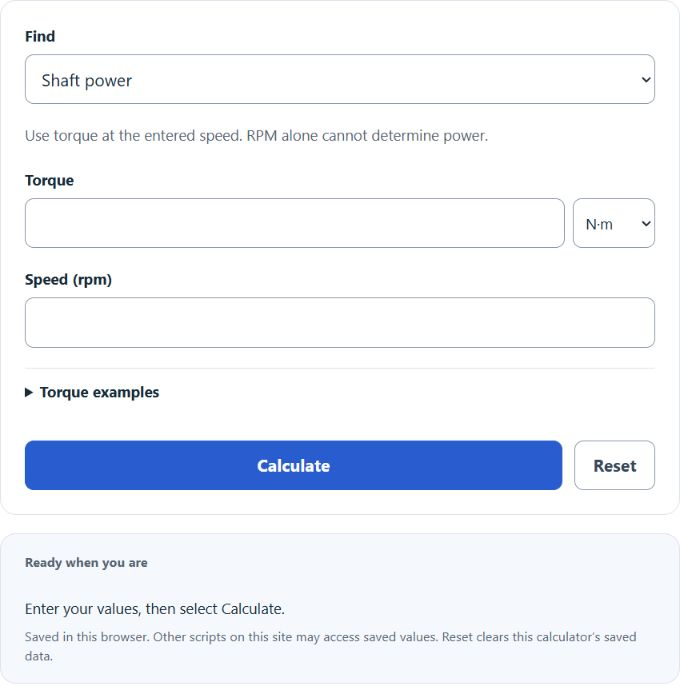
Calculate mechanical shaft power from RPM and torque, or solve for torque or speed. Results include watts, kilowatts and mechanical horsepower; optional numerical torque examples are illustrative.
- All Unit Converters
- Torque to Watts Calculator
- RPM to Torque Calculator
- Power to Torque Calculator
- Torque to Power Calculator
- RPM to Horsepower Calculator
- Watts to Torque Calculator
| RPM to Watts | Watts to RPM |
|---|---|
| 100 rpm ≈ 104.720 watts | 100 watts ≈ 95.493 rpm |
| 200 rpm ≈ 209.440 watts | 250 watts ≈ 238.732 rpm |
| 300 rpm ≈ 314.159 watts | 500 watts ≈ 477.465 rpm |
| 500 rpm ≈ 523.599 watts | 746 watts ≈ 712.378 rpm |
| 750 rpm ≈ 785.398 watts | 750 watts ≈ 716.197 rpm |
| 1000 rpm ≈ 1047.198 watts | 1000 watts ≈ 954.930 rpm |
| 1200 rpm ≈ 1256.637 watts | 1500 watts ≈ 1432.394 rpm |
| 1500 rpm ≈ 1570.796 watts | 2000 watts ≈ 1909.859 rpm |
| 1750 rpm ≈ 1832.596 watts | 2500 watts ≈ 2387.324 rpm |
| 1800 rpm ≈ 1884.956 watts | 3000 watts ≈ 2864.789 rpm |
| 2000 rpm ≈ 2094.395 watts | 3728 watts ≈ 3559.978 rpm |
| 2400 rpm ≈ 2513.274 watts | 4000 watts ≈ 3819.719 rpm |
| 2500 rpm ≈ 2617.994 watts | 5000 watts ≈ 4774.648 rpm |
| 3000 rpm ≈ 3141.593 watts | 5500 watts ≈ 5252.113 rpm |
| 3450 rpm ≈ 3612.832 watts | 7457 watts ≈ 7120.910 rpm |
| 3600 rpm ≈ 3769.911 watts | 7500 watts ≈ 7161.972 rpm |
| 5000 rpm ≈ 5235.988 watts | 10000 watts ≈ 9549.297 rpm |
| 6000 rpm ≈ 6283.185 watts | 11185 watts ≈ 10680.888 rpm |
| 8000 rpm ≈ 8377.580 watts | 14914 watts ≈ 14241.821 rpm |
| 10000 rpm ≈ 10471.976 watts | 20000 watts ≈ 19098.593 rpm |
| Formulas: P = τ × 2π × RPM ÷ 60 and RPM = P × 60 ÷ (τ × 2π). Table assumes constant torque τ = 10 N·m. | |
RPM to Watts Formula
You cannot convert RPM to watts by itself, because RPM only measures how fast something spins, not how hard it pushes. To get power you also need the torque. Power is torque multiplied by angular velocity, and angular velocity is just the RPM rewritten in radians per second:
P = T * 2 * pi * RPM / 60
Because 2 * pi / 60 is about 0.10472, the same relationship is often written with a single constant, which is handy for a quick check by hand:
P ≈ T * RPM / 9.5493
Rearrange the formula to solve for the other two quantities. Divide power by angular velocity to get torque, or divide power by torque to get the angular velocity and convert back to RPM:
T = P * 60 / (2 * pi * RPM)
RPM = P * 60 / (2 * pi * T)
Variables:
- P is the mechanical shaft power in watts (W)
- T is the torque in newton-meters (N·m)
- RPM is the rotational speed in revolutions per minute
- pi is approximately 3.14159
- The group 2 * pi * RPM / 60 is the angular velocity in radians per second, sometimes written as the Greek letter omega
Pick what you want to solve for at the top of the calculator. The default mode takes the torque and the RPM and returns the power, shown in watts, kilowatts, and horsepower at once. Switch the solve-for menu to work backward from a known power to the torque or to the RPM. The torque box has a unit menu, so you can enter newton-meters, pound-feet, pound-inches, kilogram-force centimeters, or ounce-inches without converting first, and the power box lets you enter watts, kilowatts, or horsepower. The optional torque menu provides illustrative numerical examples, not estimates for an unknown device. For a real device, use measured or rated torque and shaft power at the same operating speed.
Watts for Common Torque and RPM Values
The table below gives the mechanical power in watts for a range of torque and speed combinations. Read down to your torque and across to your speed. Every value uses the formula above, so it doubles as a way to check the calculator.
| Torque | 500 rpm | 1,000 rpm | 1,800 rpm | 3,000 rpm |
|---|---|---|---|---|
| 0.5 N·m | 26 W | 52 W | 94 W | 157 W |
| 1 N·m | 52 W | 105 W | 188 W | 314 W |
| 2 N·m | 105 W | 209 W | 377 W | 628 W |
| 5 N·m | 262 W | 524 W | 942 W | 1,571 W |
| 10 N·m | 524 W | 1,047 W | 1,885 W | 3,142 W |
| 20 N·m | 1,047 W | 2,094 W | 3,770 W | 6,283 W |
If your torque is in another unit, convert it to newton-meters first using the factors below. For power, remember that 1 kilowatt is 1,000 watts and 1 mechanical horsepower is 745.7 watts.
| Torque unit | Value in newton-meters |
|---|---|
| 1 newton-meter (N·m) | 1 |
| 1 pound-foot (lb·ft) | 1.3558 |
| 1 pound-inch (lb·in) | 0.1130 |
| 1 kilogram-force centimeter (kgf·cm) | 0.0981 |
| 1 ounce-inch (oz·in) | 0.007062 |
Example Problems
Example 1: Find the power from torque and speed.
A motor delivers 5 N·m of torque at 1,500 rpm. Put the torque and the speed into the formula:
P = 5 * 2 * pi * 1,500 / 60 ≈ 5 * 157.08 ≈ 785.4 W.
That is 0.785 kilowatts, or about 1.05 horsepower once you divide by 745.7.
Example 2: Find the torque from a known power and speed.
A 750 W motor runs at 1,800 rpm. Set the solve-for menu to torque and use the rearranged formula:
T = 750 * 60 / (2 * pi * 1,800) ≈ 45,000 / 11,309.7 ≈ 3.98 N·m.
That is about 2.94 pound-feet, so the same shaft power comes from more torque at a lower speed or less torque at a higher speed.
Frequently Asked Questions
Can you convert RPM to watts directly?
No. RPM measures rotational speed only, and watts measure power, so you need a second quantity to link them. That quantity is torque, the twisting force at the shaft. Two motors can both spin at 3,000 rpm, but the one producing more torque produces more power. Once you know the torque, the calculator combines it with the RPM to give the power in watts.
Is this the electrical power the motor uses?
No. The result is mechanical shaft power, the useful rotating power delivered at the output shaft. The electrical power a motor draws from the supply is higher because no motor is perfectly efficient. To estimate the electrical input, divide the mechanical watts by the motor efficiency written as a decimal, so a 785 W output at 85 percent efficiency draws about 924 W from the supply.
How do you convert the result to horsepower?
Divide the power in watts by 745.7, since one mechanical horsepower equals 745.7 watts. The calculator shows horsepower alongside watts and kilowatts automatically. If you prefer to work in imperial units from the start, you can also use the shortcut horsepower ≈ torque in pound-force feet times RPM divided by 5,252, which gives an approximate answer.