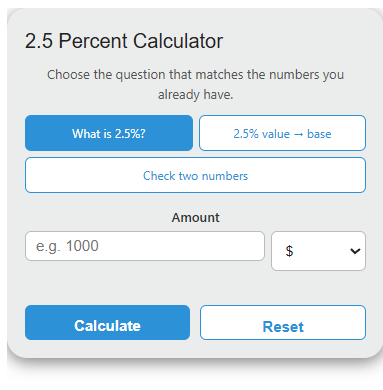
Calculate 2.5% of any amount, reverse a known 2.5% value to find the base, check two numbers, and see amounts increased or decreased by 2.5%.
Related Calculators
- Percent Correct Calculator
- Grid Percentage Calculator
- Page Percentage Calculator
- Passing Score Calculator
- All Math and Numbers Calculators
2.5 Percent Formula
The calculator uses three forms of the same percent relationship, one for each mode.
- Part: the 2.5% slice of the base amount.
- Base (or Whole): the original amount that 100% refers to.
- Percent: the share the part represents, expressed out of 100.
- 0.025: the decimal form of 2.5%.
- 40: the reciprocal of 0.025, since 2.5% equals 1/40.
The formulas assume the base is non-zero and that both numbers use the same unit. Currency symbols are cosmetic and do not affect the math. Results are rounded for display only; the underlying calculation uses full precision.
Mode behavior:
- What is 2.5%? multiplies your amount by 0.025 to get the part, then adds and subtracts that part to show the amount increased and decreased by 2.5%.
- 2.5% value → base divides the value you have by 0.025 (or multiplies by 40) to recover the original base.
- Check two numbers divides the part by the whole and multiplies by 100 to see the actual percent, then compares it to the 2.5% target.
Reference Tables
Quick lookup for 2.5% of common round amounts.
| Base amount | 2.5% of base | Base + 2.5% | Base − 2.5% |
|---|---|---|---|
| $50 | $1.25 | $51.25 | $48.75 |
| $100 | $2.50 | $102.50 | $97.50 |
| $500 | $12.50 | $512.50 | $487.50 |
| $1,000 | $25.00 | $1,025.00 | $975.00 |
| $2,500 | $62.50 | $2,562.50 | $2,437.50 |
| $10,000 | $250.00 | $10,250.00 | $9,750.00 |
| $100,000 | $2,500 | $102,500 | $97,500 |
Equivalent ways to express 2.5%.
| Form | Value |
|---|---|
| Decimal | 0.025 |
| Fraction | 1/40 |
| Per 1,000 | 25 per 1,000 |
| Basis points | 250 bps |
| Mental shortcut | divide by 40 |
Worked Examples and FAQ
Example 1. Sales tax style. A $480 invoice has a 2.5% surcharge. The surcharge is 480 × 0.025 = $12. Total billed is $492.
Example 2. Reverse a fee. You paid a $37.50 platform fee that the contract describes as 2.5% of the order. The order value is 37.50 ÷ 0.025 = 37.50 × 40 = $1,500.
Example 3. Spot-check a percentage. Someone quotes a $30 charge on a $1,000 base as “2.5%.” Actual percent is 30 ÷ 1,000 × 100 = 3.0%. The 2.5% target would be $25, so the charge is $5 over.
Why divide by 40? Because 2.5% = 2.5/100 = 1/40. Multiplying by 40 reverses it.
How do I add 2.5% to a number quickly? Multiply by 1.025. To remove 2.5%, multiply by 0.975. Note that removing 2.5% from a total is not the same as finding the pre-2.5% base; for that, divide by 1.025.
Is 2.5% the same as 2.5 basis points? No. 2.5% equals 250 basis points. One basis point is 0.01%.
Why does the calculator show different decimal places? Small results expand to more decimals so you do not lose precision, while large results round to whole units for readability.