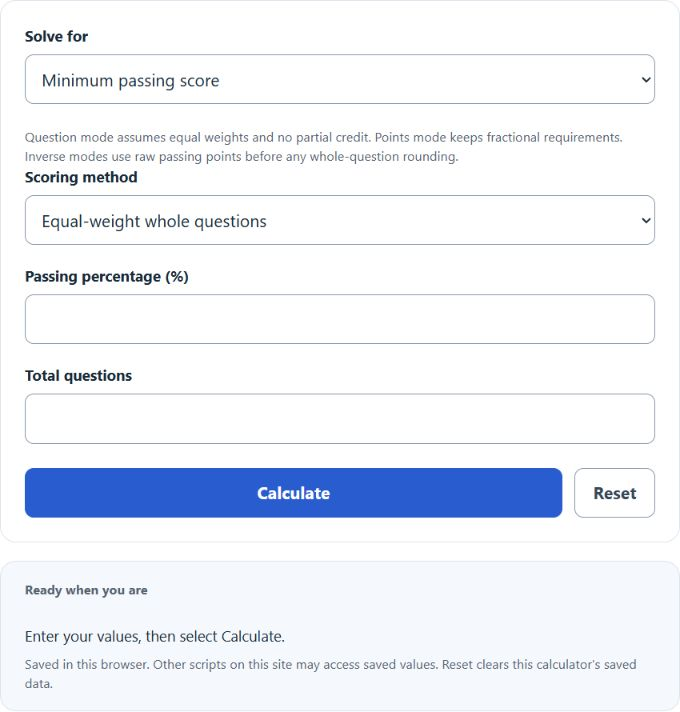
Calculate how many correct answers you need to pass a test, the maximum questions you can miss, or check your percentage score and pass/fail result.
- All Math and Numbers Calculators
- Time Per Test Question Calculator
- Scaling (Curving) Grades Calculator
- Quiz Grade Calculator
Passing Score Formula
The passing score is the minimum raw score needed to meet a required pass percentage. This calculator is useful when you know any two of the three values below and want to solve for the third:
- Total Score = the maximum number of points available
- Passing Percentage = the required percent to pass
- Passing Score = the number of points needed to pass
PS is the passing score, TS is the total possible score, and PP is the passing percentage.
Rearranged Forms
If you know the raw passing points before whole-question rounding, the same relationship can be rearranged as below. A rounded minimum question count does not uniquely identify the original percentage or total.
How to Calculate Passing Score
- Find the total possible points on the exam, quiz, or assignment.
- Identify the minimum passing percentage.
- Multiply total points by the passing percentage.
- Divide by 100 to convert the percentage into points.
- If the assessment is graded in whole questions only, round the result up to the next whole number unless partial credit is allowed.
Passing Score vs. Passing Percentage
A passing percentage is the rule, such as 70%. A passing score is the raw number of points that satisfies that rule, such as 56 points out of 80. These terms are often confused, but they are not the same value unless the total possible score is 100 points.
Examples
An 80-point exam with a 70% pass requirement needs 56 points to pass.
A 50-question test with a 75% pass requirement gives a raw result of 37.5. If only whole questions count, that typically means 38 correct answers are needed.
If a student must earn 30 points on a 40-point test, the passing percentage is 75%.
Equal-Value Question Shortcut
If every question is worth the same number of points, you can convert required correct answers into a passing percentage with this shortcut:
- CA = correct answers required
- TQ = total questions
This is helpful when a teacher says something like “you need 35 out of 50 correct to pass” and you want the equivalent pass mark in percent.
Quick Reference Table
| Total Points | 60% | 70% | 75% | 80% | 90% |
|---|---|---|---|---|---|
| 20 | 12 | 14 | 15 | 16 | 18 |
| 40 | 24 | 28 | 30 | 32 | 36 |
| 60 | 36 | 42 | 45 | 48 | 54 |
| 80 | 48 | 56 | 60 | 64 | 72 |
| 100 | 60 | 70 | 75 | 80 | 90 |
When to Round Up
Rounding matters most when the assessment is based on whole questions.
- If the result is a decimal and only full questions can be counted, round up.
- If the exam uses weighted points or partial credit, keep the decimal unless the grading policy says otherwise.
- If the total score is 100, the passing percentage and passing score will match numerically.
Common Mistakes
- Using the score earned so far instead of the total possible score.
- Mixing up the passing percentage with the passing score.
- Rounding down on whole-question tests.
- Ignoring weighted questions, bonus points, or partial-credit rules.
Where This Calculator Helps
- Estimating the minimum score needed on an exam or final
- Checking if a quiz or assignment meets a required pass mark
- Converting a percent threshold into raw points
- Finding the pass percentage when the required raw score is already known