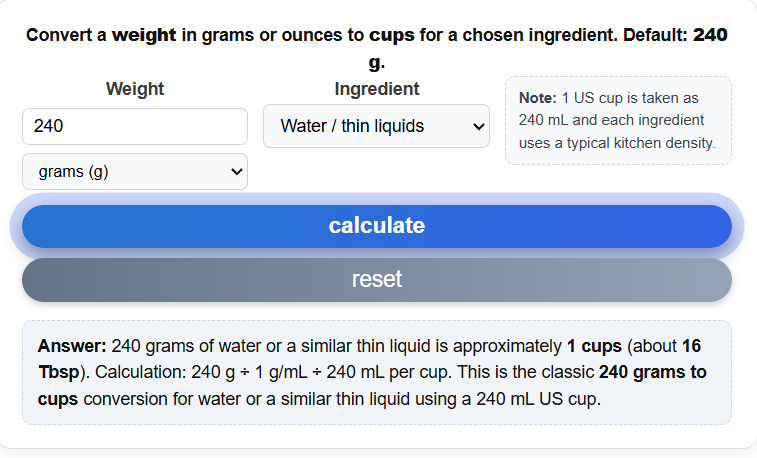
This page answers “How many cups is 240 grams?” and highlights that the result depends on which ingredient you are weighing. For instance, 240 g of water works out to roughly 1.00 cup, 240 g of granulated sugar comes to about 1.18 cups, and 240 g of all-purpose flour is close to 1.75 cups. The interactive 240 grams to cups calculator above lets you pick both the ingredient and the mass so you can match recipe instructions, nutrition labels, or tracking apps.
How the 240 grams to cups calculation works
Turning grams (g) into cups means converting a weight into a volume. To make that jump, you need the ingredient’s density (grams per milliliter) and the size of one measuring cup. On this page, a US cup of 240 mL is used for all calculations.
Under the hood, the converter applies the following general steps:
- mL = grams ÷ density (g/mL)
- cups = mL ÷ 240 (for a 240 mL US cup)
For water-like liquids, the density is close to 1 g/mL, so 240 mL weighs about 240 g and 240 g lines up with roughly one full cup. Low-density ingredients such as flour and cocoa are “fluffier”, so the same 240 g occupies more cup volume. Dense items like table salt, honey, or tightly packed brown sugar are heavier for the same volume and therefore use fewer cups for 240 grams.
The numbers are based on standard kitchen reference densities and assume level cups (not heaping). Brand differences, grind size, and how you fill the cup (scooping versus spoon-and-level) can shift the true value a bit, so treat these as practical, real-world approximations.
Exact 240 grams to cups values for common ingredients
The table below uses typical densities together with a 240 mL US cup. It shows about how many cups you need for 120 g and 240 g of each ingredient, plus how many grams are in a full 1 cup.
| Ingredient | Approx. density (g/mL) | 120 g (cups) | 240 g (cups) | 1 cup (g) |
|---|---|---|---|---|
| Water | ≈ 1.00 | ≈ 0.50 | ≈ 1.00 | ≈ 240 g |
| Milk (whole) | ≈ 1.04 | ≈ 0.48 | ≈ 0.96 | ≈ 249.6 g |
| Granulated sugar | ≈ 0.85 | ≈ 0.59 | ≈ 1.18 | ≈ 204 g |
| Brown sugar (packed) | ≈ 0.89 | ≈ 0.56 | ≈ 1.12 | ≈ 213.6 g |
| All-purpose flour | ≈ 0.57 | ≈ 0.88 | ≈ 1.75 | ≈ 136.8 g |
| Cocoa powder (unsweetened) | ≈ 0.53 | ≈ 0.94 | ≈ 1.89 | ≈ 127.2 g |
| Butter | ≈ 0.96 | ≈ 0.52 | ≈ 1.04 | ≈ 230.4 g |
| Vegetable oil | ≈ 0.92 | ≈ 0.54 | ≈ 1.09 | ≈ 220.8 g |
| Olive oil | ≈ 0.91 | ≈ 0.55 | ≈ 1.10 | ≈ 218.4 g |
| Table salt | ≈ 1.20 | ≈ 0.42 | ≈ 0.83 | ≈ 288 g |
| Honey | ≈ 1.42 | ≈ 0.35 | ≈ 0.70 | ≈ 340.8 g |
| Peanut butter | ≈ 0.94 | ≈ 0.53 | ≈ 1.06 | ≈ 225.6 g |
For everyday cooking and baking, these approximations are usually close enough to move between grams and cups when scales are not available. For very precise recipes, weighing in grams is best and you can use these figures as a reference for building your own preferred “house” conversions.
When to convert 240 grams to cups (and when to stay in grams)
Measuring by volume with cups is quick and familiar, but it depends heavily on technique. Converting 240 grams to cups is especially useful in situations like:
- You have a recipe written in grams but only cup measures available in the kitchen.
- You want to scale a recipe that calls for “240 g of X” and prefer to think in cups instead.
- You are tracking food intake in an app that expects cups, while packaging lists nutrition per 100 g or 240 g.
For strict baking or detailed macro counting, sticking with grams generally gives the most reliable results. Use this page when you need a fast, ingredient-aware estimate of how many cups correspond to 240 grams or any other weight you enter into the calculator.
Related conversions:
- 450 grams to cups
- 70 grams to cups
- 140 grams to cups
- 15 grams to cups
- 3 cups to grams
- 35 grams to cups
- 45 grams to cups
- 100 grams to cups
- 200 grams to cups
- 150 grams to cups
- 50 grams to cups
- 250 grams to cups
- 300 grams to cups
- 500 grams to cups
- 400 grams to cups
- 120 grams to cups
- 60 grams to cups
Most popular conversions:
- 100 grams to cups
- 200 grams to cups
- 150 grams to cups
- 50 grams to cups
- 250 grams to cups
- 300 grams to cups
- 500 grams to cups
- 400 grams to cups
- 120 grams to cups
- 60 grams to cups