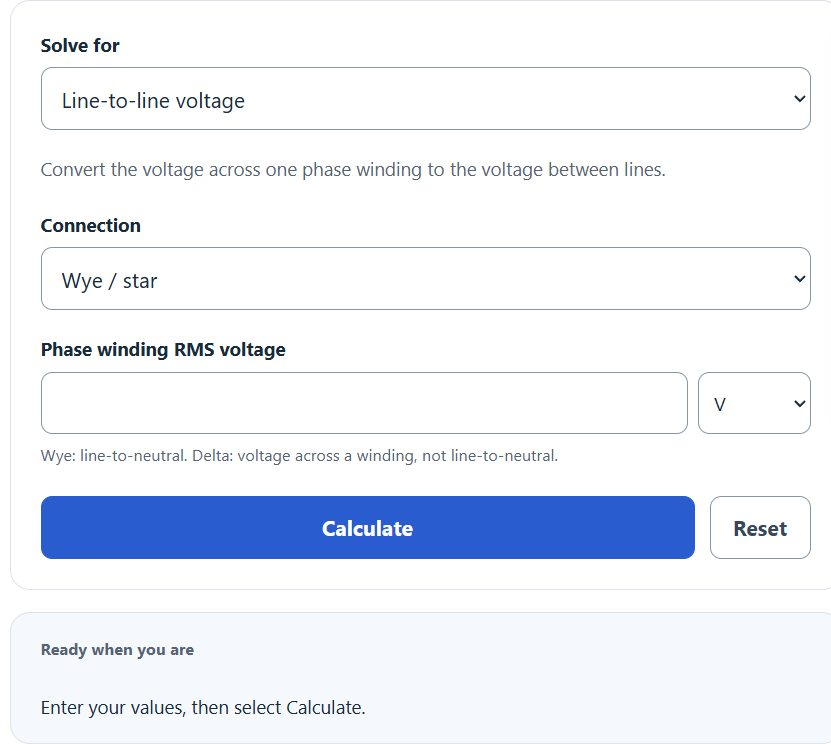
Convert line-to-line and phase winding RMS voltage for balanced wye or delta systems. Wye uses √3; delta uses a factor of 1.
Related Calculators
- Series Voltage Calculator
- Thevenin Voltage Calculator
- Fusing Transformer Calculator
- RC Circuit Calculator
- All Physics Calculators
3-Phase Voltage Formula
The following equation is used to calculate the relationship between line voltage, phase voltage, and the conversion factor.
- Where LV is the line voltage (V)
- PV is the phase voltage (V)
- CF is √3 for wye/star and 1 for delta; delta winding voltage is not line-to-neutral voltage
Choose the desired voltage under Solve for, select the connection, and enter the known voltage.
What is a 3-Phase Voltage?
Definition:
Three-phase voltage refers to the relationship between the line and phase voltages in a three-phase power system. The conversion factor is used to correlate these two values and depends on the system’s configuration.
How to Calculate 3-Phase Voltage?
Example Problem:
The following example outlines the steps and information needed to calculate the missing value in a three-phase system.
First, enter the phase voltage. In this example, the phase voltage is 230 V.
Next, select Wye / star. The calculator uses the full value of √3.
Select Line-to-line voltage under Solve for.
Finally, calculate the line voltage using the formula above:
LV = PV × CF
LV = 230 × √3
LV ≈ 398.3717 V
FAQ
What is the conversion factor used for in a three-phase system?
The factor is √3 (approximately 1.73205) for balanced wye/star and exactly 1 for delta winding voltage.
How do I choose the unknown voltage?
Select the desired voltage under Solve for. Only the known voltage input is shown.
Can this calculator be used for both star and delta configurations?
Yes. Select Wye / star or Delta and the calculator applies the correct relationship. In delta, phase means voltage across a winding, not voltage to neutral.