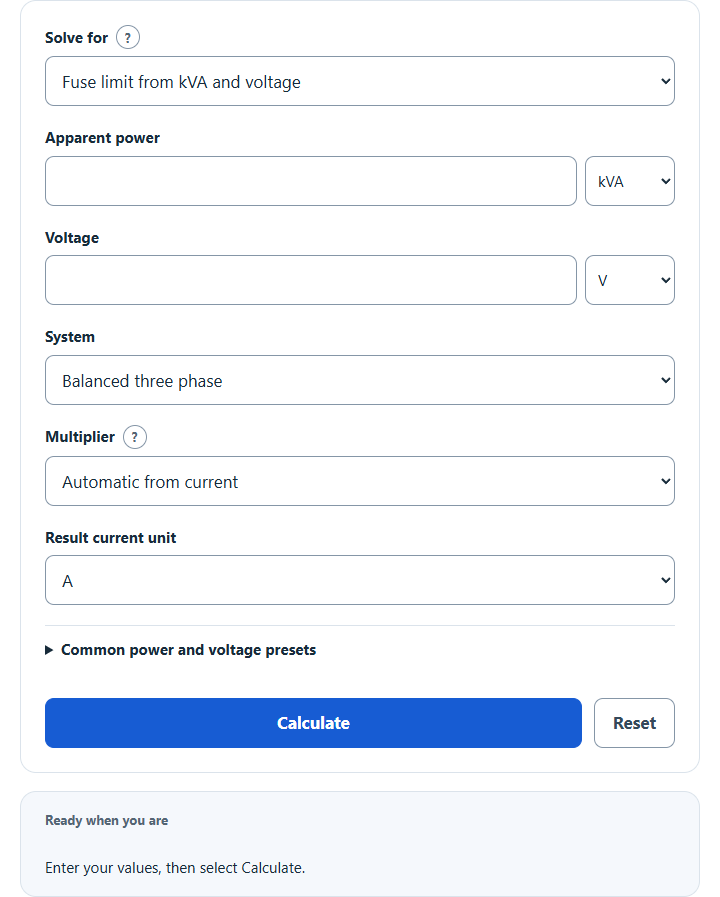
Calculate transformer primary fuse size from kVA and voltage for single- or three-phase units, with a fuse sizing chart, or start from rated current.
- All Physics Calculators
- All Electrical Calculators
- Transformer Calculator
- Transformer Impedance Calculator
- Circuit Breaker Size Calculator
- Fusing Current Calculator
- CT Ratio to Current Calculator
- Transformer Efficiency Calculator
Fusing Transformer Formula
The formula estimates an unrounded primary-only fuse-rating limit using the traditional general-transformer 125%, 167% and 300% percentages. These are not universal control-circuit transformer limits: motor-control transformer protection has separate provisions. Confirm the adopted code edition, voltage scope, protection arrangement and manufacturer requirements before selecting a fuse.
- Where FS is the maximum primary fuse rating (amps)
- TA is the transformer primary current (amps)
- OF is the overcurrent protection factor
- = 125% for 9 amps or more (OF = 1.25)
- = 167% for 2 amps to less than 9 amps (OF = 1.67)
- = 300% for less than 2 amps (OF = 3.00)
To calculate the maximum primary fuse rating, multiply the transformer primary current by the overcurrent protection factor.
Definition
What is transformer fusing?
Transformer fusing is selecting and installing fuses (or other overcurrent protective devices) on a transformer’s primary and/or secondary to protect the transformer and connected conductors from overcurrent and short-circuit conditions. Proper fusing helps limit damage and fire risk during faults, but it does not increase the transformer’s kVA rating or its normal current-carrying capability.
Example Problem
How do you calculate the maximum primary fuse rating for a transformer?
First, determine the transformer primary current. In this example, the primary current is 7 amps.
Next, reference the factor list above to determine which overcurrent protection factor applies. In this case, it is 167% (OF = 1.67).
Finally, calculate the primary fuse-rating limit for this model:
FS = TA * OF
FS = 7 * 1.67
FS = 11.69 amps