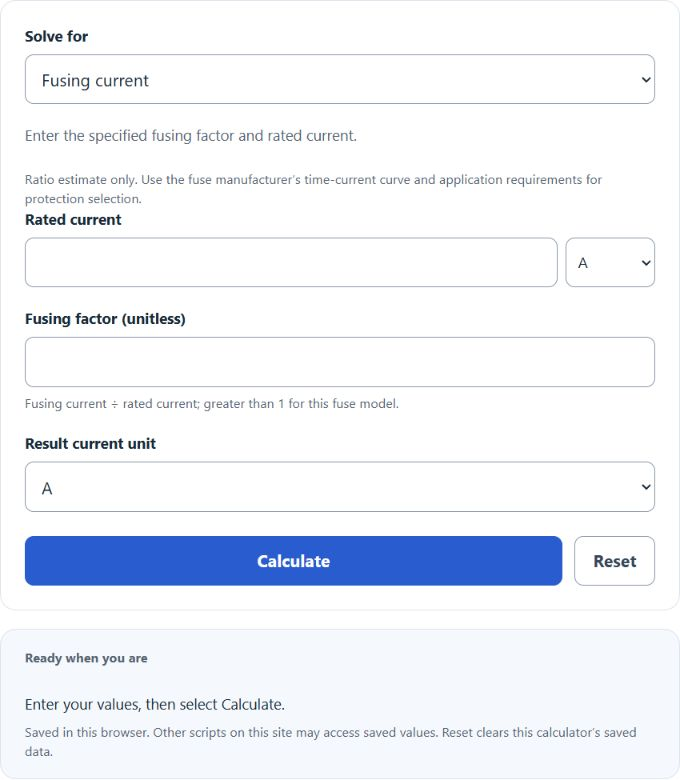
Calculate fusing current, fusing factor, or current rating of a fusing element by selecting the value to solve for and choosing amps, mA, or kA.
- All Physics Calculators
- All Electrical Calculators
- Fusing Transformer Calculator
- CT Ratio Calculator
- Shunt Current Calculator
Fusing Current Formula
Fusing current describes melting under specified time and test conditions. This calculator estimates its ratio to rated current from a supplied fusing factor; it does not predict opening time.
In this relationship, If is the fusing current, FF is the fusing factor, and CR is the current rating of the fusing element. A higher fusing factor means a higher current is required before the fuse element opens.
Variable Definitions
| Variable | Description | Typical Unit | What It Tells You |
|---|---|---|---|
| If | Fusing current | A, mA, or kA | The approximate current at which the fuse element melts |
| FF | Fusing factor | Unitless | The ratio between fusing current and current rating |
| CR | Current rating of the fusing element | A, mA, or kA | The nominal continuous current rating of the fuse element |
How to Calculate Fusing Current
- Identify the current rating of the fuse element.
- Find the fusing factor from the fuse specification, design assumptions, or known ratio.
- Multiply the fusing factor by the current rating.
- Keep units consistent throughout the calculation. Choose the desired result unit; mixed input units are converted automatically.
Rearranged Forms
Select the value to solve for and enter the other two values.
Example Calculations
Example 1: A fuse element has a current rating of 8 A and a fusing factor of 1.25.
The estimated fusing current is 10 A.
Example 2: A small fuse is rated at 250 mA with a fusing factor of 1.6.
The estimated fusing current is 400 mA.
Example 3: A fuse has a specified fusing current of 30 A and a rated current of 20 A under the same conditions. Solve for the fusing factor.
The fusing factor is 1.5.
Fusing Current vs. Current Rating
These two values are related, but they are not the same:
- Current rating is the nominal current the fuse is designed to carry under specified conditions.
- Fusing current is the higher current level that causes the fuse element to melt.
- Fusing factor connects the two values by showing how far above the current rating the element must go before opening.
Practical Notes
- Choose the unit beside each input; the calculator converts current units before calculating.
- This calculator gives an estimate based on the basic ratio, not a full time-current performance curve.
- Actual fuse behavior can vary with ambient temperature, surge duration, installation conditions, and fuse construction.
- Fast-acting and time-delay fuses can behave very differently even when their current ratings are similar.
- For final protection selection, compare the calculated result with the manufacturer’s time-current characteristics and the required safety margin.
Common Uses
- Understanding the fusing-current ratio alongside manufacturer specifications
- Comparing current ratios; startup-surge survival requires time-current and I²t data
- Comparing fuse behavior across different current ratings
- Estimating the current required to melt a fuse element in a design review
- Back-calculating a fusing factor from known fuse performance data
Quick Interpretation Guide
| If FF is... | Then... |
|---|---|
| Larger | The fuse requires a higher multiple of rated current before the element melts |
| Smaller | The fuse reaches its melting point closer to its rated current |
| Known along with If | You can calculate the rating implied by the ratio; this does not select a safe application rating |
| Known along with CR | You can estimate the expected fusing current directly |
This fusing current calculator is most useful when you need a fast estimate of the melt-current relationship and want a simple way to move between current rating, fusing factor, and fusing current.