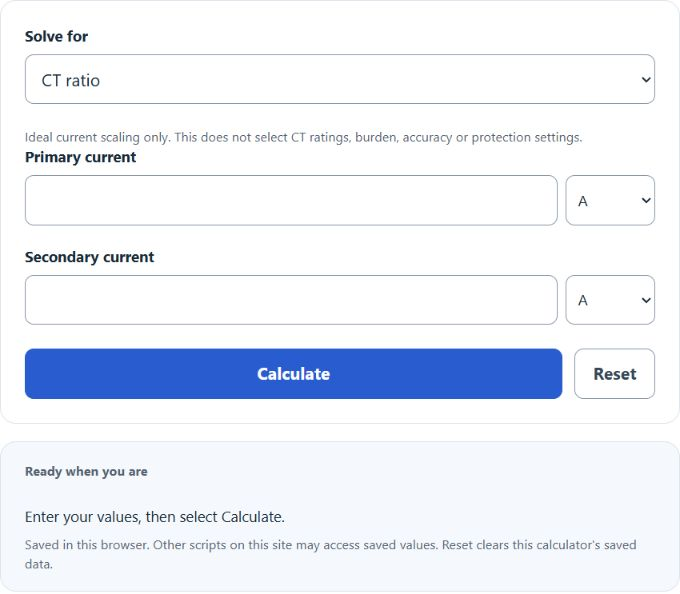
Calculate current transformer ratio, primary current, or secondary current using A, mA, or kA, with ratio notation, multiplier, and ideal turns relationship.
- All Physics Calculators
- All Electrical Calculators
- VT Ratio Calculator
- Fusing Transformer Calculator
- Knee Point Voltage Calculator
- CT Ratio to Current Calculator
- Current Per Phase Calculator
CT Ratio Formula
The CT ratio compares the primary current flowing through a current transformer to the secondary current produced by the transformer. The calculator uses amperes as the base unit, then converts a calculated current to the selected result unit.
- CT Ratio is the current transformer ratio, written as a number such as 100, 200, or 600.
- I_p is the primary current.
- I_s is the secondary current.
The calculator has three basic functions:
- Find CT ratio: enter the primary current and secondary current. The calculator divides primary current by secondary current.
- Find primary current: enter the secondary current and CT ratio. The calculator multiplies secondary current by the CT ratio.
- Find secondary current: enter the primary current and CT ratio. The calculator divides primary current by the CT ratio.
If you enter values in mA or kA, the calculator first converts them to amperes:
- mA to A: multiply by 0.001
- kA to A: multiply by 1000
Common CT Ratio Values
Many current transformers use a 5 A or 1 A secondary current. The table below shows common CT ratios and what they mean for primary and secondary current.
| CT Marking | Primary Current | Secondary Current | CT Ratio |
|---|---|---|---|
| 100/5 | 100 A | 5 A | 20 |
| 200/5 | 200 A | 5 A | 40 |
| 400/5 | 400 A | 5 A | 80 |
| 600/5 | 600 A | 5 A | 120 |
| 1000/5 | 1000 A | 5 A | 200 |
Current Unit Conversions
Use the same current unit on both sides when calculating by hand, or convert both values to amperes first.
| Unit | Meaning | Conversion to A |
|---|---|---|
| mA | milliampere | 1 mA = 0.001 A |
| A | ampere | 1 A = 1 A |
| kA | kiloampere | 1 kA = 1000 A |
Example CT Ratio Calculations
Example 1: Find the CT ratio
A current transformer has a primary current of 400 A and a secondary current of 5 A.
The CT ratio multiplier is 80, equivalently 80:1. The matching current pair is 400 A:5 A; a nameplate rating is distinct from an arbitrary measured current pair.
Example 2: Find the secondary current
A CT has a primary current of 600 A and a CT ratio of 120.
The secondary current is 5 A.
FAQ
What does a CT ratio of 100 mean?
A CT ratio of 100 means the primary current is 100 times the secondary current. For example, if the secondary current is 5 A, the primary current is 500 A.
Is CT ratio the same as the marking on the transformer?
The marking often shows the primary and secondary current, such as 400/5. The numerical CT ratio is found by dividing those values. For 400/5, the CT ratio is 400 divided by 5, which equals 80.
Why does the secondary current matter?
The secondary current is the scaled output from the current transformer. Meters, relays, and protection devices use this smaller current instead of measuring the large primary current directly. Common secondary ratings are 5 A and 1 A.