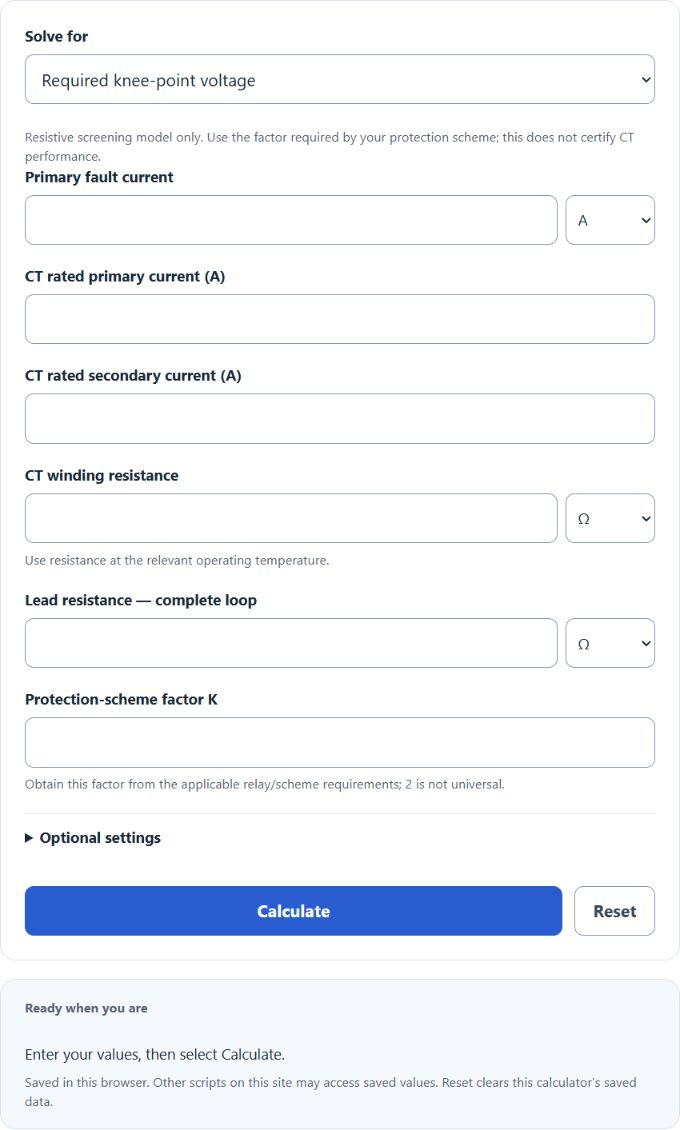
Estimate a required CT knee-point voltage, reverse the maximum primary fault current, or find the maximum lead-loop resistance for an entered voltage.
- All Physics Calculators
- All Electrical Calculators
- CT Ratio Calculator
- Secondary Voltage Calculator
- Voltage Calculator
- Battery Voltage Percentage Calculator
Required Knee-Point Voltage Formula
This calculator estimates secondary voltage demand under an explicitly assumed resistive model and user-selected protection-scheme factor. It does not measure the CT knee point, guarantee freedom from saturation, or establish standards compliance. Use the exact relay requirements, CT excitation curve and manufacturer data for final selection.
K is the factor specified for the protection scheme, and M is an additional voltage margin in percent. Neither is a universal design constant. The rated primary and secondary current inputs determine CTR. The inverse modes rearrange this same model to estimate a primary fault-current limit or a complete lead-loop resistance limit.
- Vk,req = screening voltage in volts (Vscreen)
- IF = primary fault current in amps
- CTR = CT ratio factor expressed as primary divided by secondary current
- RCT = CT secondary winding resistance in ohms
- RL = total lead-loop resistance in ohms
- RB = total device burden modeled as relay resistance plus additional VA divided by rated secondary current squared; do not count a burden twice
What Knee-Point Voltage Means
Knee-point voltage is the point on a CT excitation curve where a relatively small rise in secondary voltage causes a much larger rise in excitation current. In practical terms, this is where the core starts moving out of its linear operating region and into saturation much more easily. When that happens during a fault, the CT may no longer reproduce the primary current accurately on the secondary side, which can reduce relay accuracy and protection dependability.
The exact formal knee-point definition can vary by CT class and standard, but the design goal is consistent: the CT must be able to develop enough secondary voltage to push the required current through the connected burden without saturating excessively.
How the Estimate Is Built
The calculator first converts the primary fault current into the equivalent secondary current, then multiplies that by the total secondary resistance. The user supplies K from the applicable protection-scheme requirements and may enter additional percentage margin. A fixed factor of 2 is not universally conservative.
This is a voltage-demand screening model, not a saturation study. It does not model DC offset, system X/R, remanence, excitation current, nonlinear burden or relay operating time. These require application-specific evaluation; adding an arbitrary margin is not a substitute.
Input Guidance
| Input | What to Enter | Practical Note |
|---|---|---|
| Fault Current (Primary) | The fault current expected at the CT location | Use the value the CT will actually see, not a remote bus fault level from elsewhere in the system. |
| CT Rated Primary and Secondary Current | The two nameplate currents, in amps | A CT rated 1000 to 5 has a ratio factor of 200. |
| CT Secondary Winding Resistance | The internal secondary winding resistance of the CT | This value increases with temperature, so hot operating conditions matter. |
| Lead Resistance (Total Loop) | The complete round-trip resistance of the secondary wiring | Include both outgoing and return conductors, plus terminal and switch contributions if material. |
| Relay Burden | The relay and connected device burden expressed as equivalent resistance | Enter ohms, or use Additional burden in VA at the rated secondary current. Do not enter the same burden in both fields. |
Converting Relay Burden from Volt-Amps to Ohms
Many relays specify burden in volt-amps at a stated secondary current. The Additional burden field converts VA using the entered CT rated secondary current. Treating VA/I² as resistance assumes unity power factor; a complex burden requires a suitable impedance model instead.
For example, if the connected burden is 15 volt-amps on a 5-amp secondary circuit, the equivalent resistance is:
Under the resistive assumption, that value is added once to the winding, complete lead loop and any separate device resistance.
Example 1
Assume a primary fault current of 10,000 amps, a CT ratio factor of 200, CT winding resistance of 1.5 ohms, lead resistance of 0.5 ohm, and relay burden of 0.2 ohm. For this illustration only, set K = 2, additional margin = 0%, and additional VA = 0.
The screening voltage under those assumptions is 220 volts.
Example 2
Assume a primary fault current of 4,900 amps, a CT ratio factor of 100, CT winding resistance of 0.8 ohm, lead resistance of 0.3 ohm, and relay burden of 0.4 ohm. For this illustration only, set K = 2, additional margin = 0%, and additional VA = 0.
The screening voltage under those assumptions is 147 volts.
How to Interpret the Result
- Compare the modeled demand with the requirements and excitation data for the exact CT and relay scheme; exceeding this estimate alone does not prove suitability.
- A value below the selected screening criterion calls for engineering review; this calculator does not predict saturation timing or waveform error.
- If the actual rating is very close to the estimate, review assumptions carefully and consider additional margin.
Why CT Saturation Matters
When a CT saturates during a fault, the secondary current waveform becomes distorted and may be lower than the relay expects. That can affect overcurrent, differential, restricted earth fault, distance, and other protection functions that rely on accurate secondary current reproduction. The result may be slower tripping, reduced sensitivity, unwanted restraint, or incorrect operation during severe system conditions.
Common Errors When Using This Calculator
- Using one-way lead resistance instead of the full loop resistance.
- Entering a ratio factor in a rated-current field; enter the separate CT primary and secondary nameplate currents.
- Ignoring burden from terminals, test switches, transducers, or auxiliary devices.
- Comparing the estimate directly to a CT class marking without checking how that class is defined.
- Using a cold winding resistance value when the CT will operate hot.
Practical Design Tips
- Keep secondary leads as short as practical to reduce voltage drop.
- Use larger conductors when long CT secondary runs are unavoidable.
- Include all connected devices in the burden estimate, not just the relay input.
- Confirm the final CT selection against the excitation curve for the exact protection application.
- For long runs, evaluate whether a lower secondary current design can reduce burden and improve performance.
Use this calculator for preliminary comparisons under stated assumptions. Final CT suitability requires the applicable relay criteria, tested excitation characteristics and transient-duty evaluation. SEL’s current-transformer application paper explains voltage demand and the limits of simplified saturation estimates. Siemens’ 7SR242 manual demonstrates that required factors depend on the protection scheme.