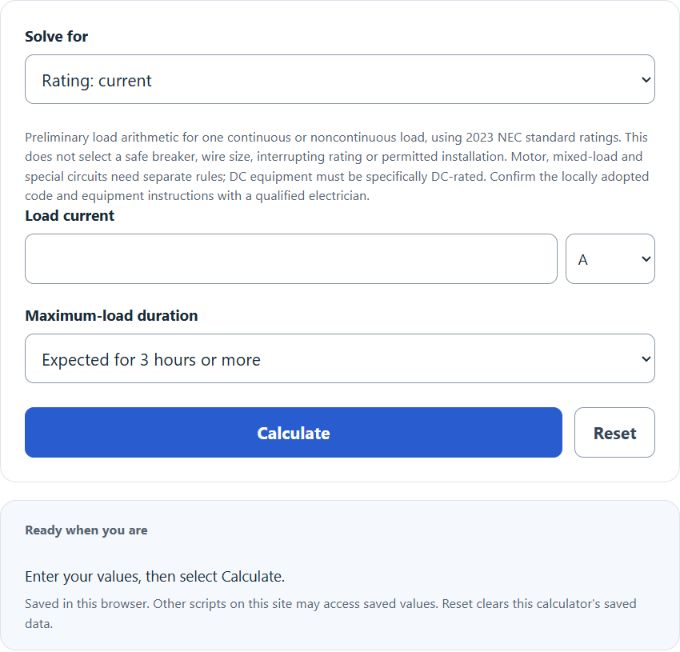
Calculate a standard circuit breaker size from amps or electrical power, voltage, phase, power factor, and load duration, or find maximum supported load.
- All Construction Calculators
- Amp to Volt Calculator
- Peak Voltage Calculator
- Fault Current Calculator
- Dimmer Wattage Calculator
- Power Rack Consumption Calculator
- Short Circuit Current Calculator
Circuit Breaker Size Formula
For electrical input real power, DC uses I = P/V; single-phase AC uses I = P/(V × PF); balanced three-phase AC uses I = P/(√3 × V × PF), where V is line-to-line voltage and P is total three-phase input power. Enter power factor directly for AC; do not divide watts by power factor beforehand.
- I = load current in amperes (A), distinct from a breaker rating
- P = electrical input real power in watts (W); PF = power factor for AC
- V = source voltage, in volts (V)
The widget finds a preliminary standard-rating candidate from load current or input power, or calculates a load-current limit from an existing rating. For one ordinary continuous load, minimum rating = 1.25 × load current; for one noncontinuous load, minimum rating = load current. A continuous load is one whose maximum current is expected to continue for at least three hours. Mixed loads need 1.25 × continuous current plus noncontinuous current; this widget does not combine mixed loads.
Unit selectors convert mA/kA to A, W/kW/MW to W, and V/kV to V. The next rating comes from the 2023 NEC standard list, including 10 A; the locally adopted edition and permitted equipment may differ. Capacity arithmetic is rating ÷ 1.25 for the ordinary continuous-load rule, or rating for a noncontinuous load. A listed 100%-rated assembly has specific installation conditions and is not modeled.
Common Breaker Sizes and Load Current Reference
These are preliminary load calculations, not permission to install a selected rating. Verify conductor ampacity, terminals, temperature adjustments, available fault current, interrupting capacity, voltage, AC/DC rating, equipment instructions and locally adopted code. Motor, compressor, battery, PV and other special circuits require separate rules. The table shows the ordinary continuous-load arithmetic, not a universal maximum safe load.
| Breaker rating | Approx. 80% continuous load | Typical use note |
|---|---|---|
| 15 A | 12 A | Lighting and general small loads |
| 20 A | 16 A | General receptacle circuits |
| 30 A | 24 A | Larger dedicated loads |
| 40 A | 32 A | Higher-power appliances or equipment |
| 50 A | 40 A | Large dedicated circuits |
| 60 A | 48 A | Subpanels or large equipment, when permitted |
Power, Voltage, and Current Examples
These examples use DC or single-phase AC with power factor 1 and electrical input power. Balanced three-phase loads use the separate √3 relationship.
| Load power | Voltage | Calculated current |
|---|---|---|
| 1,500 W | 120 V | 12.5 A |
| 2,400 W | 240 V | 10 A |
| 5,000 W | 240 V | 20.83 A |
| 10 kW | 240 V | 41.67 A |
Example Calculations
Example 1: Find the current for a 1,500 W load on 120 V
Use the current formula:
Substitute the values:
The load current is 12.5 A. If this is a continuous load, breaker sizing may need additional adjustment, such as using 125% of the continuous current where required.
Example 2: Find the load power on a 240 V circuit with 30 A current
Use the power formula:
Substitute the values:
The load power is 7,200 W, or 7.2 kW.
FAQs
Is the calculated current the same as the breaker size I should install?
Not always. The calculated current is the expected load current from the power and voltage values you entered. The actual breaker size must also match the conductor ampacity, circuit type, temperature rating, load type, and applicable electrical code. Continuous loads may require sizing at 125% of the load current.
How do I use this calculator for an AC load with power factor below 1?
For single-phase or balanced three-phase AC, enter total real electrical input power and power factor greater than zero and no more than one. The calculator includes PF in the denominator. Do not enter apparent power in VA as if it were watts unless PF is 1; do not pre-divide real watts by PF. For three-phase AC, use line-to-line voltage and balanced loads.
Can I use mechanical horsepower to select a motor breaker?
No. This widget accepts electrical input real power, not mechanical horsepower. Motor efficiency, power factor, starting current, service factor and special motor circuit rules need separate treatment. A qualified electrician must select equipment under the applicable code and manufacturer instructions.