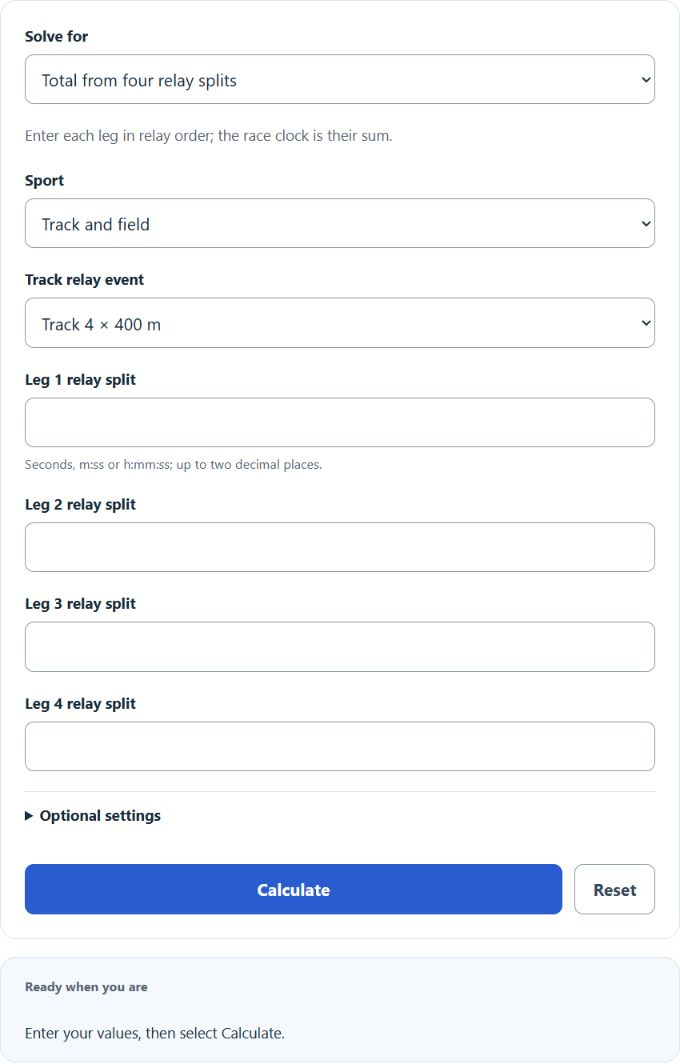
Calculate track or swimming relay totals, required leg splits, even split plans, and predicted relay times from four athlete performances.
Relay Split Formulas for Track and Swimming
A relay total is the sum of four leg splits. When one leg is unknown, subtract the three known splits from the goal time. The calculator adds and subtracts entered times in integer hundredths of a second. Averages, paces and equal-time plans are rounded to hundredths for display.
Prediction mode starts with four open or flat-start times and subtracts the user-entered exchange gain from the applicable later legs. The exchange value is an estimate, not an officiating decision or a universal bonus.
| Relay example | Four legs represent | Important comparison note |
|---|---|---|
| Track 4 × 400 m | Four 400-meter running splits | Later legs may use a moving exchange; leg 1 uses the race start. |
| Swimming 4 × 100 freestyle | Four 100-meter or 100-yard freestyle splits | Later swimmers use relay takeovers; leg 1 starts from the block. |
| Swimming 4 × 100 medley | Backstroke, breaststroke, butterfly, freestyle | Keep course units consistent and enter legs in relay order. |
| Swimming 4 × 50 freestyle | Four 50-meter or 50-yard freestyle splits | Hundredths matter because exchange effects are large relative to each short leg. |
How to Use the Relay Calculator
- Choose total time, required leg, prediction, or even-split planning.
- Select Track and field or Swimming, then choose the matching relay event.
- Enter times as seconds or minutes and seconds according to the visible field format.
- For prediction mode, keep athletes in relay order and enter an exchange gain only when you have a defensible team-specific estimate. Blank gain means zero. Any track timing adjustment must come from the applicable timing policy; no universal hand-to-automatic conversion is assumed.
- Select Calculate and review the team total, four legs, average, fastest and slowest legs, and spread.
Worked Example
Suppose four swimming splits are 52.34, 49.76, 49.75, and 47.55 seconds. Their total is 199.40 seconds, or 3:19.40. The average is 49.85 seconds, the fourth leg is fastest, and the spread between the fastest and slowest legs is 4.79 seconds.
What the Result Means
- Team total is the exact sum of the four entered or predicted legs.
- Required split is the remaining time budget for the selected leg.
- Average split divides the team total by four; it is not necessarily a realistic target for every athlete.
- Split spread is the slowest leg minus the fastest leg and helps show lineup balance.
Important Relay Limitations
Relay splits are not automatically equivalent to individual-event times. Track runners after the first leg may receive the baton while moving, and swimmers after the first leg may benefit from a relay takeover. Actual exchanges, reaction timing, event rules, course length, and officiating determine whether a performance is valid. Use the calculator for arithmetic and planning, not to judge a legal exchange.
Frequently Asked Questions
Can this calculate swimming medley relay splits?
Yes. Select Swimming and a medley event, then enter the legs in backstroke, breaststroke, butterfly, and freestyle order.
Why can a relay split be faster than an open time?
Later relay athletes may anticipate the exchange. In swimming, the outgoing swimmer’s feet must remain in contact with the starting platform until the incoming swimmer touches the wall. The lead-off leg uses the event’s normal start.
Should every athlete receive the same exchange adjustment?
No. Use a team-specific estimate when you have reliable timing data, or leave the gain at zero for simple split addition.
Sources
USA Swimming, 2026 Mini Rulebook, relay and automatic-officiating provisions.
World Aquatics, Competition Regulations in force from February 2026, swimming relay and takeover provisions.