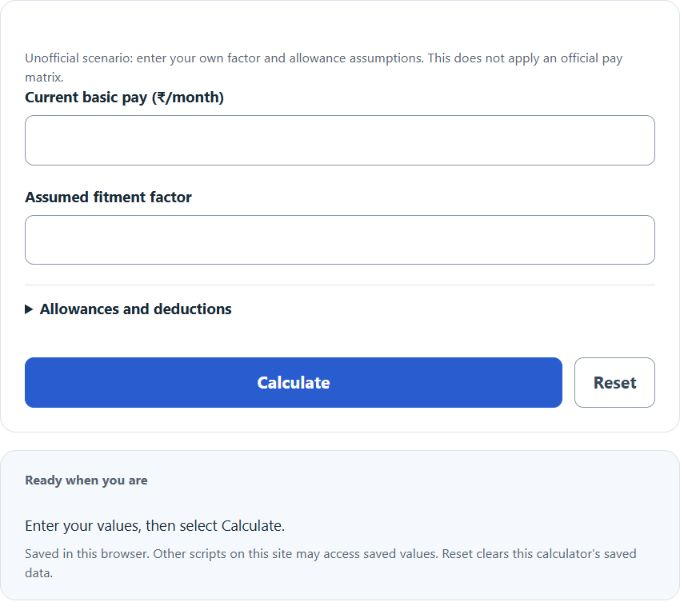
Model a possible 8th Central Pay Commission salary from an assumed fitment factor, allowances, and deductions. This is a scenario tool: it does not claim that an official fitment factor or final pay matrix has been announced.
The official 8th Central Pay Commission site publishes its formation, terms of reference, and continuing work. This calculator remains a scenario model: its fitment factor, allowance rates, deductions, and implementation details are user assumptions unless final government orders specify them.
How to Use This Calculator
- Enter current basic pay from the latest official pay record.
- Choose a fitment factor as a scenario—not as an announced fact.
- Enter allowance rates and fixed monthly allowances.
- Enter expected deductions and compare gross with take-home.
After a successful calculation, your input snapshot is saved in this browser and the estimate is recomputed when restored. Select Reset to clear the saved values and return to empty required inputs. Blank optional allowances and deductions mean zero.
How the 8th Pay Commission Salary Calculator Works
Revised basic pay is modeled first. Percentage allowances are then applied to that revised basic, fixed allowances are added, and entered deductions are subtracted to estimate take-home pay.
The primary relationship is Revised basic = current basic × assumed fitment factor. Calculations retain full available precision internally; displayed values are rounded for readability.
Formula Variables and Input Guide
Enter current basic pay and your own scenario assumptions for the fitment factor, DA, HRA, other allowances, and deductions.
| Variable or term | Meaning | Unit or note |
|---|---|---|
| B | Current basic pay | ₹/month |
| F | Assumed fitment factor | scenario input |
| DA | Dearness allowance | % of revised basic |
| HRA | House rent allowance | % of revised basic |
| D | Estimated deductions | ₹/month |
Choosing the Right Inputs
Use current basic pay from an official pay record, not gross salary or take-home pay. Treat the fitment factor as a scenario input until an applicable government order establishes the final method for the employee’s pay level. Comparing several factors is more informative than treating one circulating estimate as certain.
Enter percentage allowances only when they apply to the modeled revised basic, and keep fixed monthly allowances separate. Deductions should cover the same monthly period as the salary figures and should not include an item already netted from another input. Preserve the pay level, location classification, pension arrangement, and source date alongside any scenario you save or share.
Practical Uses
- Comparing user-defined salary revision scenarios.
- Understanding how allowance assumptions affect gross pay.
- Estimating deduction sensitivity before official implementation.
- Separating revised basic pay from take-home pay.
Fitment-factor sensitivity for ₹44,900 basic pay
| Assumed factor | Revised basic |
|---|---|
| 1.8 | ₹80,820 |
| 2.0 | ₹89,800 |
| 2.2 | ₹98,780 |
| 2.5 | ₹112,250 |
Understanding Your Results
The result separates revised basic, estimated monthly and annual gross pay, and take-home after the entered deductions.
Gross pay is not take-home pay. NPS or pension contributions, tax, insurance, recoveries, and other payroll items can materially change the amount received.
Worked Example
With ₹44,900 basic pay and a 2.0 assumed factor, revised basic is ₹89,800 before allowances or deductions.
At a 2.0 assumed factor, revised basic is ₹89,800. If HRA is modeled at 18%, that adds ₹16,164 before fixed allowances or deductions. Every one of these values remains a scenario input.
Checking the Result by Hand
Multiply current basic pay by the assumed fitment factor to reproduce revised basic. Apply each percentage allowance by dividing its rate by 100 and multiplying by revised basic, add fixed allowances, and then subtract the entered deductions. Annual gross should equal monthly gross multiplied by 12.
Check that take-home does not exceed gross when deductions are positive and that deductions do not exceed gross. Compare one scenario at a time; changing only the fitment factor should move revised basic and percentage-based allowances together while fixed allowances remain unchanged.
Common Mistakes to Avoid
- Presenting an assumed factor as an official announcement.
- Applying every allowance when a rule may reset or replace it.
- Ignoring pay-level mapping and rounding rules.
- Allowing deductions to exceed gross without reviewing the assumptions.
Assumptions and Limitations
This is not an official Government of India pay statement. Final recommendations, implementation rules, pay levels, allowances, effective dates, tax, NPS, and recovery items can change the result. Use official orders for employment decisions.
Frequently Asked Questions
Has a final fitment factor been announced?
Use the linked official sources for the current status; the calculator does not assume one is final.
Is DA automatically carried forward?
Not necessarily. Final implementation orders determine how allowances are treated.
Is take-home the same as gross?
No. Take-home subtracts the deductions entered in the model.
Can this calculate arrears?
No. Arrears require official effective dates, eligible periods, and implementation rules.
Sources