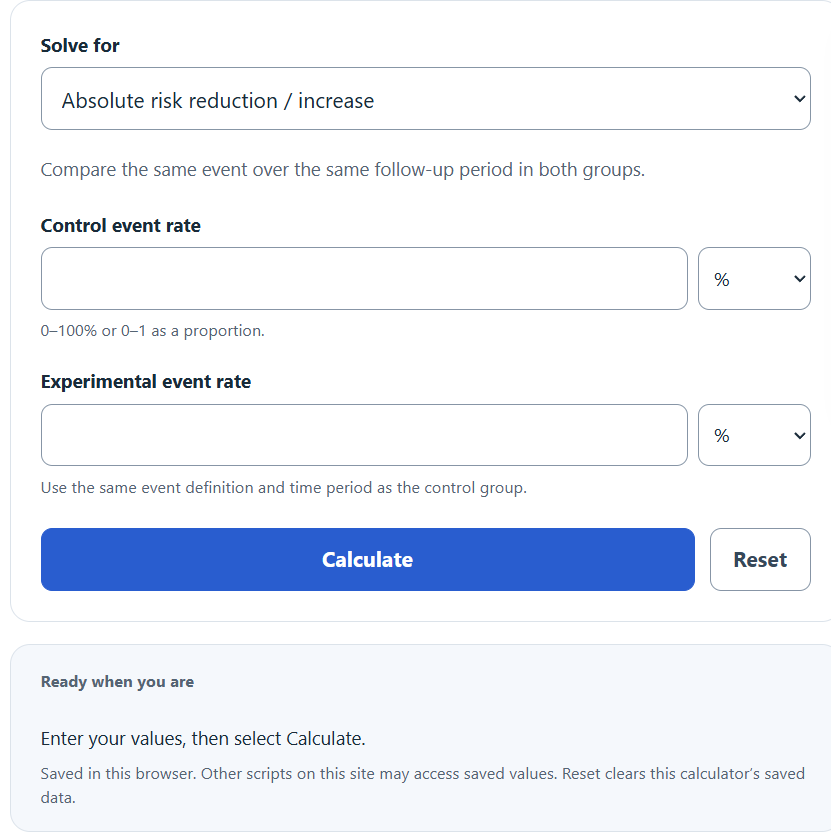
Calculate absolute risk reduction, risk increase, control event rate or experimental event rate from the other two values in percent or proportion.
How to interpret the result
ARR is calculated as CER − EER. If the result is positive, the experimental group had a lower event rate than the control group (risk reduction). If the result is negative, the experimental group had a higher event rate (risk increase, often reported as ARI).
When interpreting results, consider the study design, the baseline risk, and statistical uncertainty (such as confidence intervals) rather than relying on a single point estimate.
Related Calculators
- Event Rate Calculator
- Hazard Ratio Calculator
- Cumulative Incidence Calculator
- Crude Death Rate Calculator
- All Statistics Calculators
Absolute Risk Reduction Formula
The absolute risk reduction calculator uses the difference between the control event rate and the experimental event rate. Both rates are converted to proportions before calculation, even if you enter them as percentages.
To solve for the control event rate:
To solve for the experimental event rate:
If the result is negative, the value represents an absolute risk increase instead of a reduction:
- ARR = absolute risk reduction, equal to the control event rate minus the experimental event rate
- ARI = absolute risk increase, used when the experimental event rate is higher than the control event rate
- CER = control event rate, or the event rate in the control group
- EER = experimental event rate, or the event rate in the treatment or experimental group
Choose the result under Solve for, then enter the other two values. Percentage differences are reported in percentage points; negative signed ARR inputs represent an increase. If you enter CER and EER, it calculates ARR. If EER is higher than CER, the signed ARR is negative and the result is treated as an absolute risk increase. If you enter ARR and one event rate, it rearranges the same formula to find the missing event rate.
ARR and ARI Result Interpretation
Use this table to interpret the direction of the result.
| Relationship | Signed Result | Meaning |
|---|---|---|
| CER > EER | Positive ARR | The experimental group had fewer events than the control group. |
| CER = EER | ARR = 0 | There is no absolute difference in event rates. |
| CER < EER | Negative ARR, shown as ARI | The experimental group had more events than the control group. |
Percent and proportion entries represent the same rates in different formats.
| Percent | Proportion | How to Convert |
|---|---|---|
| 1% | 0.01 | Divide percent by 100 |
| 5% | 0.05 | 5 ÷ 100 = 0.05 |
| 12.5% | 0.125 | 12.5 ÷ 100 = 0.125 |
| 25% | 0.25 | 25 ÷ 100 = 0.25 |
Example Calculations
Example 1: Calculate ARR from CER and EER
You have a control event rate of 12.5% and an experimental event rate of 10%.
The absolute risk reduction is 2.5%, or 0.025 as a proportion.
Example 2: Calculate EER from CER and ARR
You have a control event rate of 20% and an absolute risk reduction of 4%.
The experimental event rate is 16%, or 0.16 as a proportion.
FAQ
What is absolute risk reduction?
Absolute risk reduction is the direct difference between the event rate in a control group and the event rate in an experimental group. For example, if 10% of people in the control group have an event and 7% in the treatment group have the event, the absolute risk reduction is 3 percentage points.
What is the difference between ARR and relative risk reduction?
ARR is the simple subtraction of event rates. Relative risk reduction compares that difference to the control event rate. For example, reducing risk from 10% to 5% gives an ARR of 5 percentage points, but a relative risk reduction of 50%. ARR is often easier to connect to real-world impact because it shows the actual percentage point change.
Why does a negative ARR become an absolute risk increase?
A negative ARR occurs when the experimental event rate is higher than the control event rate. Since the event became more common rather than less common, the result is better described as an absolute risk increase. For example, if CER is 8% and EER is 11%, the signed ARR is -3%, which means a 3-percentage-point absolute risk increase.