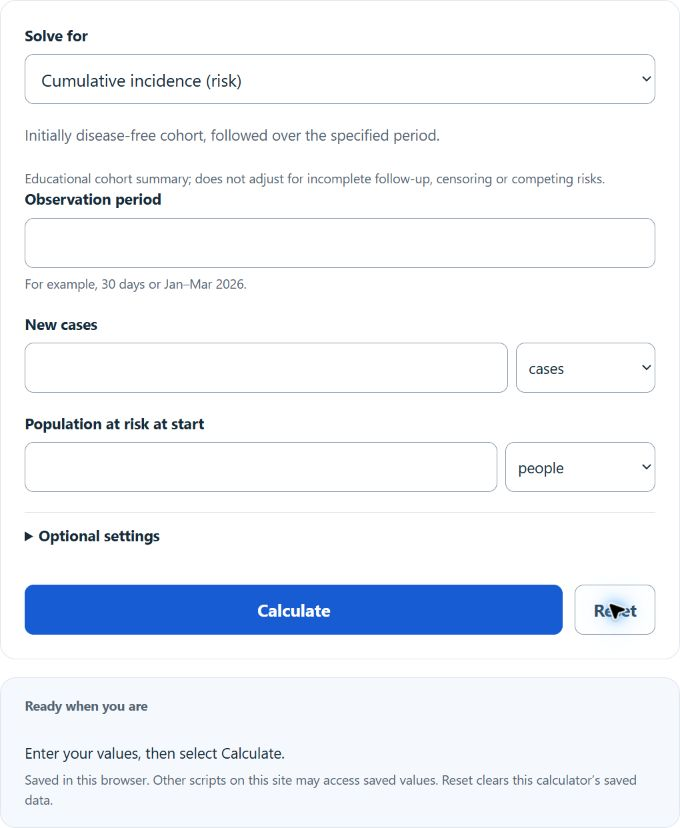
Choose cumulative risk, incidence rate, an inverse calculation, or exposed/unexposed attack rates. Enter the labeled inputs; results appear separately below the calculator.
Note: Cumulative incidence (risk) is a proportion over a specified time period; incidence rate uses person-time in the denominator; attack rate is cumulative incidence commonly used in outbreak settings. Conversions in the incidence rate tab assume 1 year = 365 days and 12 months. Educational use only (not medical advice). For public health reporting or clinical decisions, consult qualified professionals and follow CDC/local health authority guidance.
Cumulative Incidence Formula
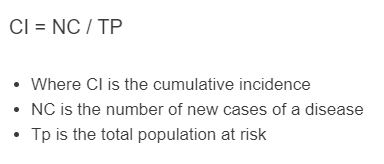
The following formula is used to calculate cumulative incidence (risk) during a specified time period among those at risk at the start of the period (a defined cohort).
- Where CI is the cumulative incidence
- NC is the number of new cases of a disease
- TP is the total population at risk
To calculate cumulative incidence, divide new cases during the specified period by the initially disease-free population at risk at the start of that period. Inverse count calculations show model-implied estimates without silently rounding fractional people or cases.
Cumulative Incidence Definition
A cumulative incidence is the proportion of initially disease-free people who develop the outcome during a specified time period.
Cumulative Incidence Example
How to calculate cumulative incidence?
- First, determine the number of new cases.
Measure the total number of new cases of the disease.
- Next, determine the total population.
Calculate the total population at risk.
- Finally, calculate the cumulative incidence.
Calculate the cumulative incidence using the equation above.
FAQ
Cumulative incidence is the proportion of initially disease-free people who develop the outcome during a specified time period.