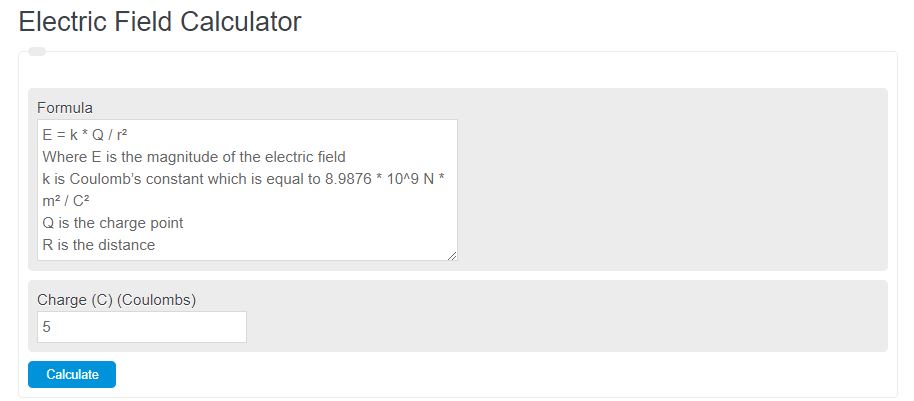
Calculate the magnitude of the electric field from a point charge. Enter the charge magnitude and distance to calculate the electric field at that distance (in free space/air). This calculator can also determine the charge magnitude or distance given the electric field magnitude and one of those values.
Electric Field Formula
The formula used to calculate the magnitude of an electric field from a point charge at a given distance (in free space/air) is as follows:
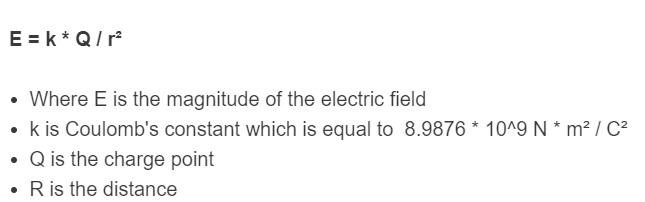
E = k * |Q| / r^2
- Where E is the magnitude of the electric field (in N/C or V/m)
- k is Coulomb’s constant (approximately 8.9876 × 10^9 N·m²/C²)
- Q is the charge magnitude
- r is the distance from the charge to the point where the field is evaluated
To calculate the magnitude of an electric field from a point charge, divide the charge magnitude by the distance squared, then multiply the result by Coulomb’s constant.
Electric Field Definition
An electric field is a vector field that assigns to each point in space the electric force per unit positive test charge, E = F/q.
Electric fields are produced by electric charges (point charges or continuous charge distributions). At the atomic scale, electric attraction between negatively charged electrons and the positively charged nucleus (together with quantum effects) underlies the structure of atoms and chemical bonding. Electric fields and magnetic fields are part of the overarching electromagnetic interaction.
The following example will show you how you can calculate the electric field of a point charge.
How to calculate the electric field from a point charge
- First, determine the charge magnitude
This is typically measured or given. For this example, assume a charge magnitude of 1 microcoulomb (1 × 10⁻⁶ C), which is a small static charge in many situations.
- Next, determine the distance from the charge
Choose or use the given distance from the charge to the point where you want the field. For this example, let the distance be r = 5 meters.
- Finally, enter the information into the formula
Use E = k|Q|/r². For the example: E = (8.9876 × 10⁹) × (1 × 10⁻⁶) / (5²) ≈ 3.60 × 10² N/C (≈ 360 V/m). You can also use the calculator above.
- Analyze the results
Check units (N/C or V/m) and that the magnitude is reasonable. The field points radially outward for a positive charge and inward for a negative charge.
FAQ
An electric field is a vector field that gives the electric force per unit positive test charge at each point in space (E = F/q).