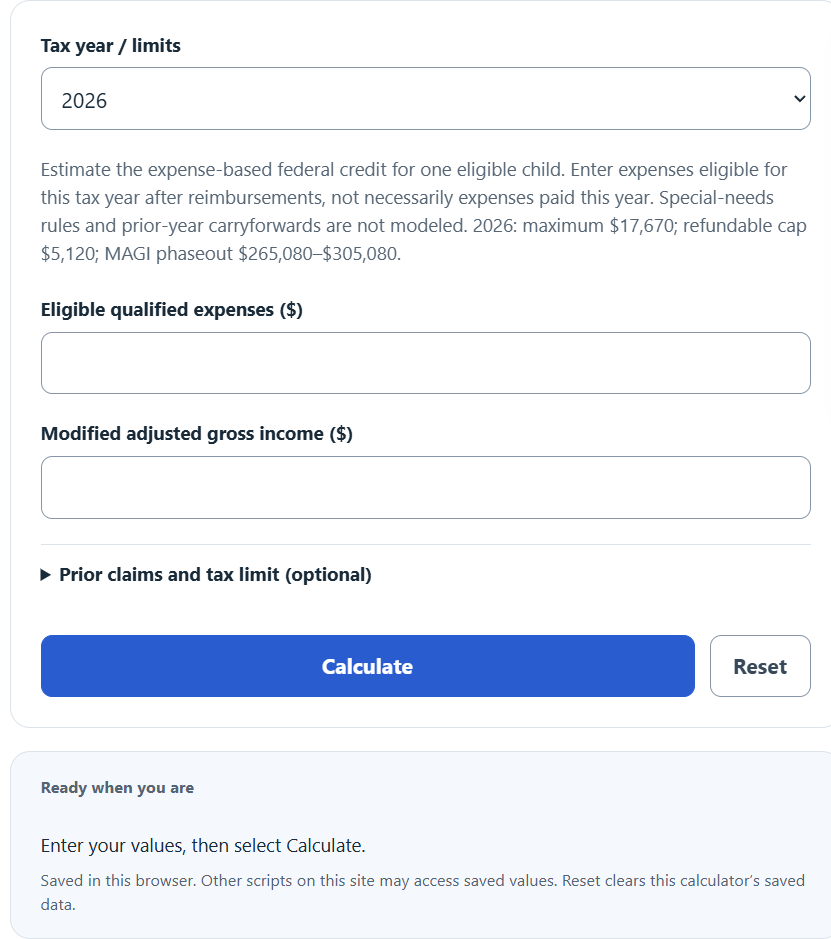
Choose 2026, 2025, or custom tax-year limits to estimate the expense-based federal adoption credit for one eligible child, including its refundable and nonrefundable portions.
Related Calculators
- Cost Of Daycare Calculator
- Expense Percentage Calculator
- 70/20/10 Calculator
- Percent Of Income Calculator
- All Personal Finance Calculators
Adoption Credit Formula
The adoption credit starts with your qualified adoption expenses, caps them at the remaining per-child maximum after prior claims, then reduces the result if your modified adjusted gross income, or MAGI, is inside the phaseout range. If you enter the available nonrefundable credit limit from the applicable Form 8839 worksheet, only the nonrefundable portion is limited. Prior-year carryforwards and special-needs rules are not modeled.
- QAE = qualified adoption expenses, such as eligible adoption fees, court costs, attorney fees, and travel expenses.
- MaxCredit = the federal adoption credit maximum per child for the tax year; PriorClaims is the amount reducing that maximum under Form 8839 line 3.
- RefundableCap = the maximum refundable portion for the tax year.
- MAGI = modified adjusted gross income.
- Start = MAGI amount where the adoption credit phaseout begins.
- End = MAGI amount where the adoption credit is fully phased out.
- TaxLiability = the available nonrefundable credit limit from the applicable Form 8839 Credit Limit Worksheet, if entered.
Eligible expenses and the remaining per-child maximum determine the starting credit. MAGI reduces the total first; the refundable portion is then the smaller of that total and the refundable cap. The rest is nonrefundable. Calculations retain the full phaseout fraction and round the credit to cents; tax-return rounding can differ.
Federal Adoption Credit Amounts and Phaseout Ranges
Use the figures for the tax year you are estimating. Phaseout amounts are based on MAGI. For 2026, the maximum is $17,670, the refundable cap is $5,120, and phaseout runs from $265,080 to $305,080. For 2025, the refundable cap is $5,000. See IRS Revenue Procedure 2025-32 and Form 8839 instructions.
| Tax year | Maximum credit | Phaseout begins | Phaseout ends |
|---|---|---|---|
| 2025 | $17,280 | $259,190 | $299,190 |
| 2024 | $16,810 | $252,150 | $292,150 |
| 2023 | $15,950 | $239,230 | $279,230 |
How MAGI Affects the Adoption Credit
| MAGI position | Effect on credit |
|---|---|
| At or below the phaseout start | No MAGI reduction. Eligible expenses and the remaining per-child maximum limit the total; a tax liability limit applies only to the nonrefundable portion. |
| Between the phaseout start and end | The credit is reduced proportionally as MAGI moves through the phaseout range. |
| At or above the phaseout end | The estimated federal adoption credit is $0. |
Example Adoption Credit Calculations
Example 1: MAGI below the phaseout range
For tax year 2024, suppose you have $12,000 of qualified adoption expenses, a $16,810 annual maximum credit, MAGI of $100,000, a phaseout start of $252,150, and a phaseout end of $292,150.
Because MAGI is below the phaseout start, there is no MAGI reduction. If no tax liability limit is entered, the estimated credit is $12,000.
Example 2: MAGI halfway through the phaseout range
For tax year 2024, suppose you have $16,810 of qualified adoption expenses, a $16,810 annual maximum credit, MAGI of $272,150, a phaseout start of $252,150, and a phaseout end of $292,150.
The estimated credit after the MAGI phaseout is $8,405, before applying any tax liability limit.
FAQ
Is the adoption credit refundable?
Beginning in 2025, part of the credit is refundable: up to $5,000 per eligible child for 2025 and $5,120 for 2026, limited by the credit after income phaseout. The remaining portion is nonrefundable. Unused nonrefundable credit may carry forward up to five years and does not become refundable. Prior-year carryforwards are outside this calculator’s scope.
What expenses count as qualified adoption expenses?
Qualified adoption expenses can include reasonable and necessary adoption fees, court costs, attorney fees, travel expenses, and other expenses directly related to the legal adoption of an eligible child. Expenses reimbursed by an employer or another party generally cannot also be claimed for the credit.
Does a special-needs adoption use the same calculation?
Special-needs adoptions can have different rules. In some cases, you may be eligible for the full credit amount even if your actual qualified expenses are lower. This calculator estimates the standard expense-based credit and MAGI phaseout, so special-needs adoption situations may require a separate review.