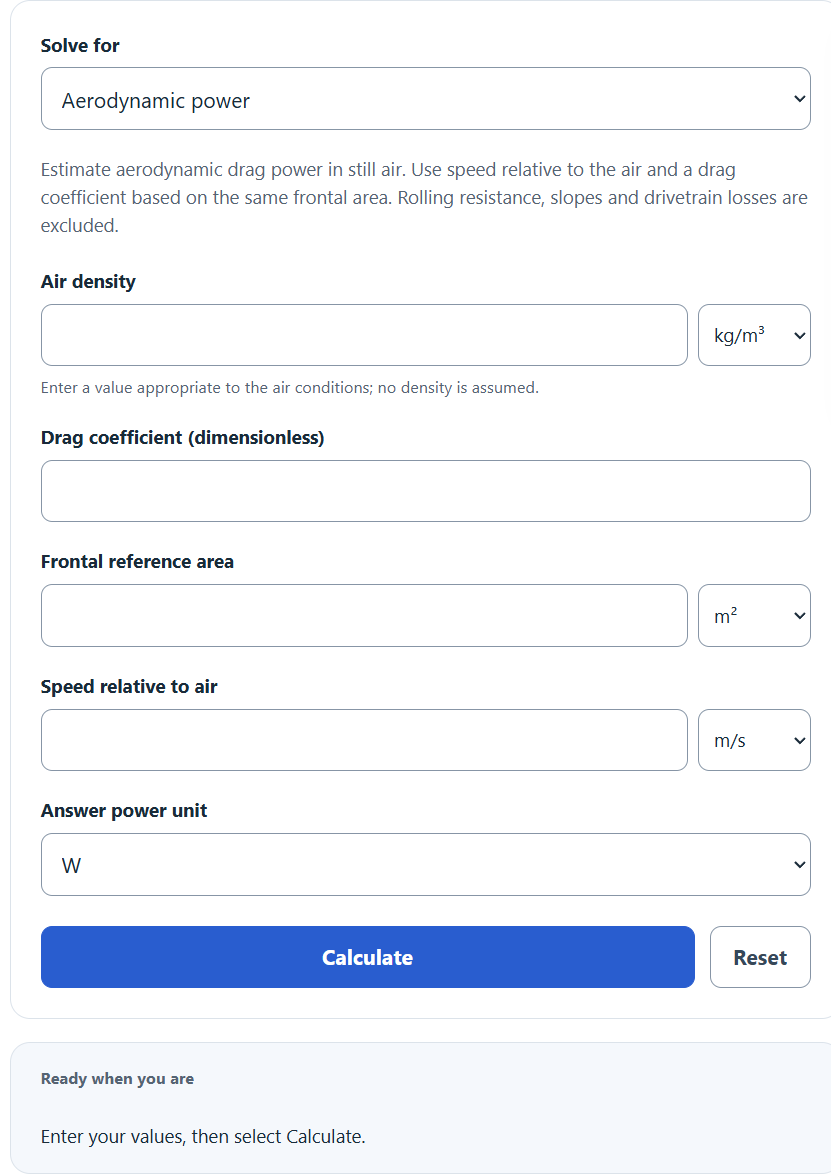
Calculate aerodynamic power, air density, drag coefficient, frontal area, or velocity by choosing the unknown in Solve for and entering the four displayed values with their units.
Related Calculators
- Air Mass Calculator
- Square Cube Law Calculator
- Energy Calculator
- Mach Temperature Relation Calculator
- All Physics Calculators
Aerodynamic Power Formula
The aerodynamic power calculation is based on drag power, which is the power needed to overcome aerodynamic drag at a given speed in still air. It excludes rolling resistance, slopes and drivetrain losses.
- P = aerodynamic power, in watts (W)
- rho = air density, in kilograms per cubic meter (kg/m³)
- C_d = drag coefficient, unitless
- A = frontal area, in square meters (m²)
- v = speed relative to the air, in meters per second (m/s)
If one value is missing, the calculator rearranges the same formula to solve for that value.
The calculator accepts power, air density, drag coefficient, frontal area, and velocity. Choose the unknown in Solve for and enter the other four values. Internally, values are converted to base SI units before the formula is applied: watts, kg/m³, m², and m/s. The result is then converted back to the selected answer unit. Density and frontal area must be positive; zero power, drag coefficient or speed is accepted when the solution is unique.
Typical Aerodynamic Inputs
These are illustrative assumptions, not universal values. Enter density for the actual air conditions and a drag coefficient based on the same reference area.
| Condition | Air Density | Notes |
|---|---|---|
| Sea level, standard atmosphere | 1.225 kg/m³ | Common default value for basic aerodynamic calculations |
| Warm day near sea level | about 1.15 to 1.20 kg/m³ | Warmer air is less dense |
| High altitude | below 1.0 kg/m³ | Lower density reduces aerodynamic drag power |
| Object Type | Illustrative Drag Coefficient | Illustrative Frontal Area |
|---|---|---|
| Passenger car | 0.25 to 0.35 | 2.0 to 2.5 m² |
| SUV or pickup | 0.35 to 0.50 | 2.5 to 3.5 m² |
| Cyclist, upright position | about 0.8 to 1.1 | 0.4 to 0.6 m² |
| Streamlined cyclist | about 0.5 to 0.8 | 0.3 to 0.5 m² |
Example Calculations
Example 1: Calculate aerodynamic power
Suppose you have these values:
- Air density = 1.225 kg/m³
- Drag coefficient = 0.30
- Frontal area = 2.2 m²
- Velocity = 30 m/s
The aerodynamic power is 10,914.75 W, or about 10.91 kW.
Example 2: Calculate velocity
Suppose you know:
- Power = 500 W
- Air density = 1.225 kg/m³
- Drag coefficient = 0.90
- Frontal area = 0.50 m²
The velocity is about 12.20 m/s, which is about 43.91 km/h.
FAQ
Why is velocity cubed in the aerodynamic power formula?
Aerodynamic drag force increases with the square of velocity. Power is force multiplied by velocity, so aerodynamic power increases with the cube of velocity. This means that doubling speed requires about 8 times as much aerodynamic power, assuming air density, drag coefficient, and frontal area stay the same.
What air density value should you use?
For many basic calculations, use 1.225 kg/m³, which represents standard air density at sea level. If you are calculating a real situation at high altitude, in hot weather, or under unusual atmospheric conditions, use an air density appropriate to the actual temperature, pressure and humidity. The calculator does not assume a density.
Is drag coefficient the same as frontal area?
No. Drag coefficient describes the shape-related aerodynamic resistance of the object and has no units. Frontal area is the projected area facing the airflow and is measured in square units such as m² or ft². Both affect aerodynamic power, but they represent different physical properties.