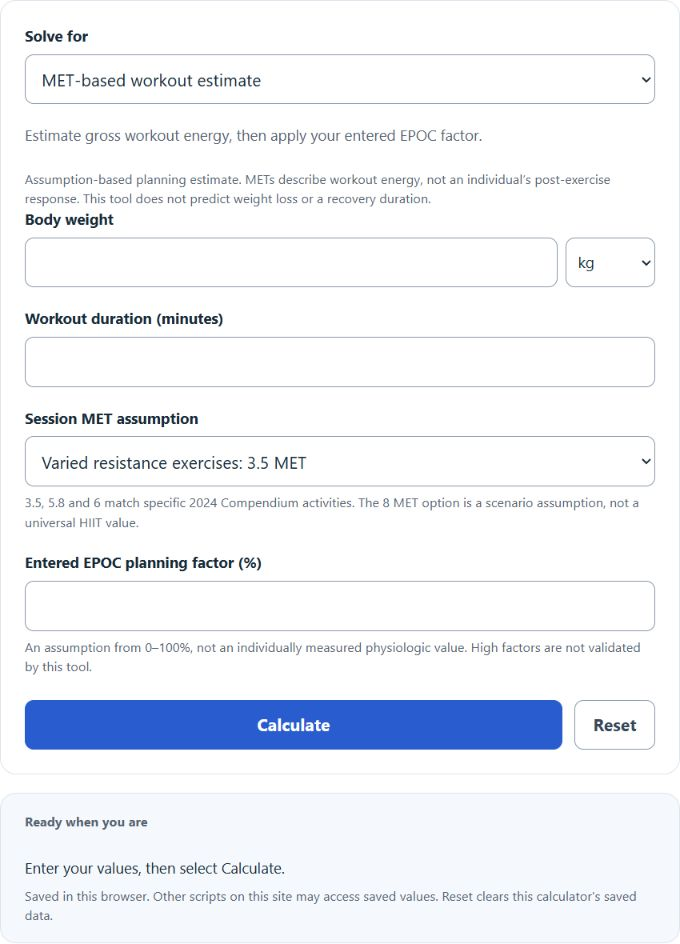
Estimate post-exercise EPOC energy from a MET-based workout or known calories using an explicit planning factor, with gross, above-rest, and sensitivity detail.
Disclaimer: This is just an estimate for planning purposes. Real calories burn depends on many individual factors. Seek medical professionals for help.
Afterburn Effect Formula
Excess post-exercise oxygen consumption (EPOC) describes elevated oxygen consumption during recovery. This calculator provides two assumption-based methods: estimating workout energy from METs or using a known workout-energy value, then applying an explicitly entered percentage. It does not measure an individual’s EPOC.
MET-based workout mode
- MET is the session metabolic-equivalent assumption, including rest intervals.
- kg is body mass in kilograms; pounds are converted using 0.45359237 kg per pound.
- minutes is workout duration.
- The standard oxygen-based calorie approximation uses 3.5 mL oxygen/kg/min per MET and about 5 kcal per litre oxygen, giving 0.0175 kcal/kg/min per MET. Individual resting metabolism and energy use differ.
Entered-factor method, in both modes
The MET mode applies the factor to gross workout energy, which includes a resting-equivalent portion. Known-energy mode uses the entered value directly. Check whether a device reports gross or active energy, and exclude post-exercise energy already included to avoid double counting. The current calculator has no distance mode, reverse MET solver, automatic factor, or weekly/yearly projection.
Afterburn Percentage Sensitivity
A 2006 review by LaForgia, Withers and Gore reported 6–15% of net exercise oxygen cost in studied protocols producing prolonged EPOC. That is a different basis from gross MET workout energy. The calculator’s 6% and 15% values are illustrative sensitivity scenarios, not a validated personal range, confidence interval, or universal ceiling.
| Entered workout energy | 6% scenario | 10% scenario | 15% scenario |
|---|---|---|---|
| 300 kcal | 18 kcal | 30 kcal | 45 kcal |
| 500 kcal | 30 kcal | 50 kcal | 75 kcal |
| 600 kcal | 36 kcal | 60 kcal | 90 kcal |
Session MET Assumptions
The first three presets match specific 2024 Adult Compendium conditioning activities. Choose a value that fits the actual session; a peak effort does not represent the entire workout.
| Preset | MET | Scope |
|---|---|---|
| Varied resistance exercises | 3.5 | Multiple exercises, 8–15 repetitions; code 02054 |
| Reciprocal superset circuit | 5.8 | Peripheral heart action training; code 02055 |
| Vigorous lifting | 6.0 | Vigorous lifting, powerlifting or bodybuilding; code 02050 |
| Interval session scenario | 8.0 | User scenario assumption, not the Compendium’s universal HIIT value |
Example Calculations
Example 1: MET-based workout
For 80 kg, 45 minutes, an assumed 8 MET session, and an explicitly chosen 10% factor:
Example 2: Known exercise energy
For 600 kcal of workout energy and a chosen 12.5% factor, estimated EPOC is 600 × 12.5 / 100 = 75 kcal. Combined energy is 675 kcal. The factor remains an assumption, even when workout energy comes from a device or lab.
FAQ
What is the afterburn effect?
It is elevated energy use during recovery as the body returns toward its resting state. Its size and duration vary with exercise protocol, fitness and measurement conditions.
Why do the two modes give different results?
They can use different workout-energy inputs. With the same energy value and percentage they give the same estimate. Gross and active energy are different bases, so check the input definition before comparing outputs.
Which percentage should I use?
Use a clearly identified scenario or appropriately measured value. The tool does not choose a physiological factor for you. Higher intensity alone does not establish an individual’s percentage. These results do not predict weight loss or prescribe exercise or recovery.