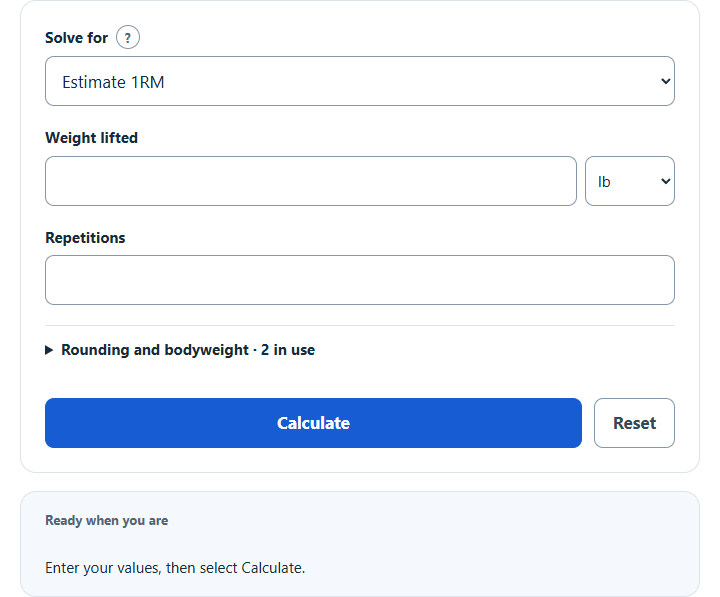
Calculate your one-rep max with the Epley formula from lifted weight and reps, and find training weights for target percentages or reps.
Calculator Functions
| Function | What it does | What it requires |
|---|---|---|
| Estimate 1RM | Estimates a one-rep max from a set taken close to failure, and compares the Epley result with six other equations | Requires the weight lifted in lb, kg or stone and the repetitions completed, from 1 to 30 |
| Percentages and rep projections | Builds a table of loads from 50% to 100% of a one-rep max and the Epley load for each repetition count | Requires a known or estimated 1RM |
| Weight for target repetitions | Finds the load the Epley formula predicts for a chosen number of repetitions | Requires a known or estimated 1RM and the target repetitions, from 1 to 30 |
Every function shows the percentage loads and rep projections under the result. Optional settings round each displayed load to the nearest 0.5, 1, 2.5, 5 or 10 in the result unit and choose how many repetition rows appear. Estimate 1RM can also take a bodyweight, which adds the ratio of the estimated 1RM to bodyweight, and a lift label.
Epley Formulas
| 1RM | Estimated one-repetition maximum, in the same unit as W |
| W | Weight lifted (lb, kg or stone) |
| R | Repetitions completed with that weight |
The formula adds one thirtieth of the weight for every repetition. It is also written 1RM = W × (1 + 0.0333 × R) [1].
Estimate 1RM
The main formula applies directly. A set of 5 repetitions at 200 lb gives 200 × (1 + 5 ÷ 30) = 233.33 lb, which rounds to 235 lb at the nearest 5. For a single repetition the calculator returns the weight lifted as the 1RM. It does not apply the formula there, which would add 3.3% to a lift that is already a maximum.
The results table sets the Epley estimate beside the Brzycki, Lombardi, Mayhew, O’Conner, Wathan and Lander equations for the same set, and each equation is printed under Calculation details. The spread between them is not a confidence range.
| Repetitions | 1RM as a multiple of the weight | Weight as a share of 1RM |
|---|---|---|
| 1 | 1.000 | 100% |
| 2 | 1.067 | 93.8% |
| 3 | 1.100 | 90.9% |
| 4 | 1.133 | 88.2% |
| 5 | 1.167 | 85.7% |
| 6 | 1.200 | 83.3% |
| 8 | 1.267 | 78.9% |
| 10 | 1.333 | 75.0% |
| 12 | 1.400 | 71.4% |
| 15 | 1.500 | 66.7% |
| 20 | 1.667 | 60.0% |
Percentages and rep projections
The percentage rows run from 100% down to 50% in steps of 5. With a 300 lb 1RM, 80% is 240 lb. The projection rows use the formula under Weight for target repetitions for each repetition count up to 5, 10, 12 or 20, and always include 20 repetitions. Every row starts from the unrounded 1RM, and rounding is applied once to each displayed load.
Weight for target repetitions
This is the main formula rearranged. A 300 lb 1RM gives 300 ÷ (1 + 10 ÷ 30) = 225 lb for 10 repetitions and 300 ÷ (1 + 5 ÷ 30) = 257.14 lb for 5. A target of one repetition returns the 1RM itself.
Limits of This Estimate
- Equations based on repetitions are more accurate with heavy sets. In the studies summarized in a 2022 paper, the Epley equation came within 2.7 kg of a tested back squat 1RM from a five-rep maximum, and predictions from a 5RM load were more accurate than those from 10RM and 20RM loads [1]. The calculator shows a caution above 10 repetitions.
- The set has to be taken close to failure with consistent technique. Projected loads are model estimates, not training prescriptions, and the bodyweight ratio is not a strength grade.
- Heavy lifting, including an attempt at a true 1RM, carries a risk of injury. The estimate is for planning training loads, and no equation makes a maximal attempt safe. A maximal lift calls for sound technique, a warm-up and appropriate supervision. People who are new to lifting, pregnant, in pain, injured or living with a medical condition, including heart or blood pressure concerns, should consult a clinician or a certified coach first.
Sources
- Macarilla and others, Accuracy of Predicting One-Repetition Maximum from Submaximal Velocity in the Barbell Back Squat and Bench Press, Journal of Human Kinetics 82, 2022: the Epley equation and the accuracy of repetition-based equations at heavy and light loads