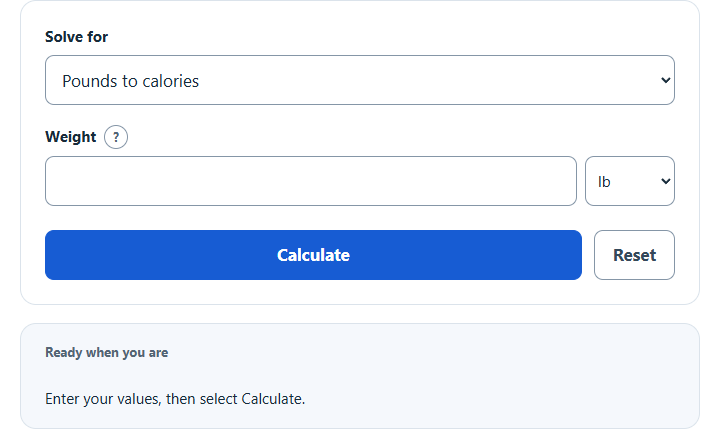
Convert lbs to calories using the common 3,500 kcal per pound estimate, or convert calories to pounds and find the daily calories for a weight change.
Lbs to Calories Formula
- Calories — total energy deficit in kilocalories (Cal or kcal)
- Pounds — approximate mass equivalent in lb
- Daily Energy Magnitude — arithmetic energy amount in kcal/day
- Days — selected arithmetic period
- 3,500 — Calories stored in roughly one pound of body fat
The 3,500 Cal per pound figure is an estimate based on the energy density of adipose tissue. Real weight changes also include water, glycogen, and lean tissue, and your maintenance Calories shift as you lose weight. Treat the result as a planning estimate, not a guarantee. For kg, the calculator converts using 1 lb = 0.45359237 kg. For kJ, it uses 1 Cal = 4.184 kJ.
Reference Tables
These tables show the same static energy conversion. They do not establish safe deficits or expected weight-loss rates.
| Mass Equivalent | Energy Equivalent | Kilojoules |
|---|---|---|
| 1 lb | 3,500 Cal | 14,644 kJ |
| 5 lb | 17,500 Cal | 73,220 kJ |
| 10 lb | 35,000 Cal | 146,440 kJ |
| 20 lb | 70,000 Cal | 292,880 kJ |
| 1 kg | 7,716 Cal | 32,284 kJ |
| Daily Energy | 7-Day Mass Equivalent | Notes |
|---|---|---|
| 250 Cal | 0.5 lb | Static arithmetic only |
| 500 Cal | 1.0 lb | Static arithmetic only |
| 750 Cal | 1.5 lb | Static arithmetic only |
| 1,000 Cal | 2.0 lb | No safety assessment |
| 1,500 Cal | 3.0 lb | No safety assessment |
Example and FAQ
Arithmetic example: 8 lb × 3,500 = 28,000 kcal. Dividing by 500 kcal/day gives 56 arithmetic days, or 8 weeks. This does not mean a person will lose 8 lb in that time.
Is the 3,500 rule accurate? It is a rough static energy equivalent, not a reliable forecast of body-weight change. Metabolism, body composition and water changes affect the outcome. NIH/NIDDK explains why metabolic adaptation makes the static rule overestimate weight loss.
Does this work for gaining weight? The arithmetic can express a positive energy equivalent, but a given surplus does not guarantee a fixed amount or composition of weight gain.
Why does my scale not match? Day-to-day weight fluctuates with water, sodium, glycogen, and digestion. Compare weekly averages instead of single readings.
Does this set a daily intake or exercise target? No. It does not estimate individual maintenance needs, safe intake or activity requirements. Those need an individualized assessment.