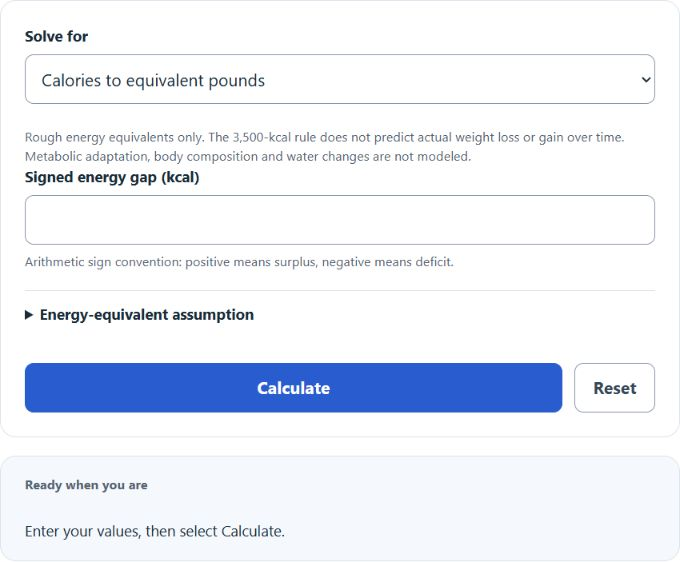
Explore rough energy-equivalent pounds from a calorie gap, a daily gap over time, or the reverse calculation using an adjustable kcal-per-pound assumption. These calculations do not predict actual body-weight change.
Disclaimer: This calculator provides rough educational estimates (often using the ~3,500 kcal-per-pound rule-of-thumb). Actual body weight change varies, and short-term scale weight can shift due to water/glycogen. If you are under 18, pregnant/breastfeeding, have a medical condition, or a history of eating disorders, consult a licensed clinician; many guidelines suggest aiming for about 1–2 lb/week unless medically supervised.
- All Health and Medical Calculators
- All Medical and Health Unit Converters
- Kettlebell Calories Calculator
- Mowing Lawn Calories Calculator
- Star Jumps Calories Calculator
Calories To Pounds Formula
Variables:
- P is the rough energy-equivalent amount (lb), not a predicted body-weight change
- C is the net calorie change (kcal / food Calories)
To estimate Calories To Pounds, divide the net calorie change (deficit or surplus) by ~3,500. This is a rough rule-of-thumb; longer-term predictions can differ because energy needs and metabolism change over time. For longer-range planning, consider using an evidence-based dynamic model (for example, the NIH Body Weight Planner).
| Energy (kcal) | Rough energy equivalent (lb) |
|---|---|
| 100 | 0.029 |
| 250 | 0.071 |
| 300 | 0.086 |
| 350 | 0.100 |
| 500 | 0.143 |
| 600 | 0.171 |
| 750 | 0.214 |
| 900 | 0.257 |
| 1,000 | 0.286 |
| 1,200 | 0.343 |
| 1,500 | 0.429 |
| 1,750 | 0.500 |
| 2,000 | 0.571 |
| 2,500 | 0.714 |
| 3,000 | 0.857 |
| 3,500 | 1.000 |
| 4,000 | 1.143 |
| 5,000 | 1.429 |
| 7,000 | 2.000 |
| 10,000 | 2.857 |
| * Rounded to 3 decimals. Uses a common estimate (~3,500 kcal per lb); actual body weight change varies and short-term scale weight can shift due to water/glycogen. | |
How to Calculate Calories To Pounds?
The following steps outline how to estimate Calories To Pounds.
- First, determine the net calorie change (kcal / food Calories).
- Next, gather the formula from above: P ≈ C / 3500.
- Finally, calculate the rough energy equivalent in pounds.
- After inserting the variables and calculating the result, check your answer with the calculator above.
Example Problem :
Use the following variables as an example problem to test your knowledge.
net calorie change (kcal) = 3740
FAQs
How accurate is the calories to pounds conversion formula?
The 3,500-kcal-per-pound rule is a rough energy-equivalent assumption, not a universal conversion between dietary energy and body weight. The energy associated with weight change depends on body composition and changing expenditure. NIH research explains why the fixed rule can fail.
Can I use the calories to pounds calculator for weight loss planning?
It illustrates arithmetic under a chosen energy-per-pound assumption. It cannot determine a suitable personal calorie deficit or forecast exact weight loss. For individualized planning, consider a clinician or registered dietitian and the NIDDK Body Weight Planner, which has its own adult eligibility limits.
Are there any limitations to the calories to pounds calculator?
Yes. The calculator does not account for metabolic adaptation over time, differences in body composition, or day-to-day water fluctuations. It is best used as a general estimate rather than an exact prediction.
How can I adjust my diet or exercise plan based on the calculator’s results?
Use the result to understand the chosen assumption and arithmetic. It does not establish a safe intake, appropriate exercise amount or a calorie gap needed to reach a personal goal.