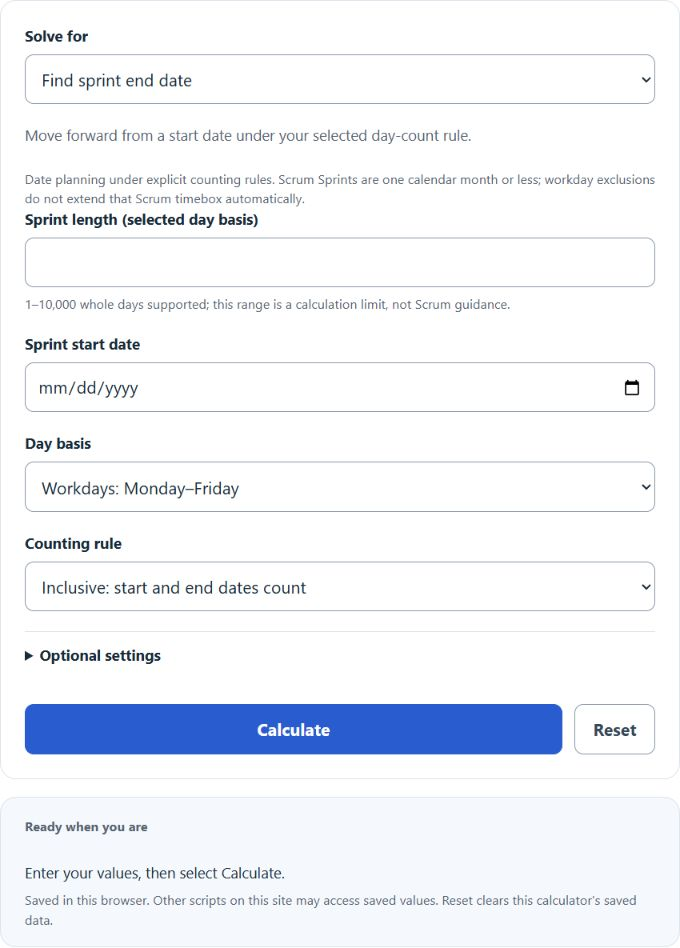
Calculate Agile sprint start, end, or duration and generate a sprint schedule using calendar or workdays, inclusive rules, and custom excluded dates.
Agile Sprint Date Formula
For calendar days with the exclusive start rule, the relationship between start date, end date, and duration is:
- D = sprint duration in calendar days
- S = sprint start date
- E = sprint end date
With the inclusive rule, calendar duration is E − S + 1. In workday mode, count eligible Monday–Friday dates and remove the entered exclusions; the exclusive rule omits the start date. For example, 14 inclusive calendar days beginning Monday, August 3, 2026 end Sunday, August 16. Ten inclusive workdays end Friday, August 14; ten exclusive workdays end Monday, August 17. The calculator can also reverse this operation to find a start date. The 2020 Scrum Guide limits a Scrum Sprint to one calendar month or less, rather than a fixed 30 days. This general date tool allows longer spans but does not make them Scrum-compliant.
What Is an Agile Sprint?
A Scrum Sprint is a fixed-length event in which the team works toward a Sprint Goal and a usable Increment. Planning, the Daily Scrum, Review, and Retrospective fit within that timebox. Dates help coordinate those events, while actual delivery depends on the team’s capacity and work.
In Digital.ai’s 2021 State of Agile survey summary, 66% of respondents reported Scrum, 9% Scrumban, and 6% Scrum/XP: 81% combined. These are historical survey responses, not a current census of all agile teams. A consistent cadence can help teams and stakeholders coordinate recurring events.
Sprint Duration: What the Data Shows
Broadcom’s 2022 Rally report, The Impact of Agile. Quantified., page 12 reports iteration lengths of one week for 6.2% of its sample, two weeks for 59.1%, three weeks for 23.4%, four weeks for 9.8%, and five or more weeks for 1.5%. This historical customer sample does not establish a universal ideal. A 14-day cadence fits 26 complete timeboxes into 364 days, before considering the chosen start date.
Holidays, vacations, and release restrictions can reduce available capacity within a timebox. They do not automatically change a Scrum Sprint’s duration. In workday mode, this tool instead advances across the number of eligible dates requested, so excluding holidays may move the calculated boundary. Choose calendar mode when preserving a fixed elapsed timebox is the priority.
Ceremony Time as a Percentage of Sprint Length
For a one-month Sprint, the Scrum Guide sets maximums of eight hours for Planning, four for Review, and three for Retrospective; these events are usually shorter for shorter Sprints. It does not prescribe fixed weekly fractions. The Daily Scrum is 15 minutes each working day. The following are illustrative per-person meeting budgets, assuming eight-hour working days and attendance at all listed events:
1-week sprint (5 working days): a chosen budget of 4 to 5 meeting hours out of 40 scheduled hours is 10% to 12.5%.
2-week sprint (10 working days): a chosen budget of 7 to 9 meeting hours out of 80 scheduled hours is 8.75% to 11.25%.
4-week sprint (20 working days): a chosen budget of 12 to 16 meeting hours out of 160 scheduled hours is 7.5% to 10%.
These examples are arithmetic budgets, not observed averages or mandatory Scrum allocations. Record actual attendance and meeting durations to estimate overhead for your team. A longer timebox spaces formal reviews farther apart, but testing and stakeholder feedback can also occur during the Sprint.
Effective Working Days Inside a Sprint
Calendar duration differs from available working time. A Monday-to-Sunday 14-day span contains ten weekdays before exclusions. Ten 15-minute Daily Scrums total 2.5 hours, not 1.25. In an illustrative budget with four hours of Planning, two hours of Review, and 1.5 hours of Retrospective, meetings total ten hours, leaving 70 of 80 scheduled hours per attendee. Leave, other meetings, reviews, support, and communication may reduce that remainder further.
The 70-hour remainder in that example is not a promise of focused coding time or delivery. Estimate capacity from each person’s actual availability, and compare forecasts with the team’s own past outcomes. Choose an averaging window appropriate to changing membership and work rather than assuming one fixed number of Sprints is universally reliable.
Aligning Sprint Dates with Business Cadence
The selected counting rule changes the meaning of the end date. With no exclusions, ten inclusive workdays beginning Monday finish on the second Friday. Fourteen inclusive calendar days finish on Sunday; fourteen exclusive calendar days reach the following Monday. For distributed teams, agree on the intended boundary date and local meeting time; this calculator returns dates without time-zone or hour scheduling.
Six 14-day timeboxes total 84 calendar days. A calendar quarter has 90 to 92 days, so starting on its first day would leave 6 to 8 days; starting on its first Monday changes that remainder. These are explicit arithmetic assumptions, not a guaranteed quarterly schedule. Scrum starts the next Sprint immediately after the previous one. The schedule mode shows adjacent exclusive boundaries or the next eligible start after an inclusive end, according to the selected rule.
For coordinated teams, use an agreed shared calendar and record which dates represent starts, last included days, and exclusive boundaries. Review the generated schedule against your organization’s planning and review dates. A date calculation alone does not establish compliance with a particular multi-team framework.
Choosing Sprint Length Based on Project Context
Sprint length should be treated as a deliberate architectural decision rather than a default. One-week sprints suit teams working in high-uncertainty environments where requirements shift rapidly, products that rely on continuous user feedback (such as consumer apps with active A/B testing), or newly formed teams building shared working agreements. The short cycle forces prioritization discipline and surfaces integration problems quickly, but the high frequency of planning and review events demands strong facilitation maturity.
Two-week Sprints can provide a practical balance between frequent feedback and time to complete work. With a Monday start and no exclusions, the span includes ten weekdays. Check the team’s actual work, dependencies, and availability before choosing this cadence.
Three-week and four-week sprints are most appropriate when work items are inherently large (hardware integration, regulatory compliance deliverables, data migration projects), when significant research or prototyping phases precede implementation, or when the team's stakeholders cannot commit to review participation more frequently than monthly. The risk of longer sprints is that scope creep goes undetected longer, and teams that miss a four-week sprint goal lose a month of delivery momentum rather than two weeks.
When completion is inconsistent, inspect scope, dependencies, and actual availability before changing the timebox. Compare the team’s own planned and completed work over several Sprints. A universal completion percentage does not reliably predict every team’s delivery dates.