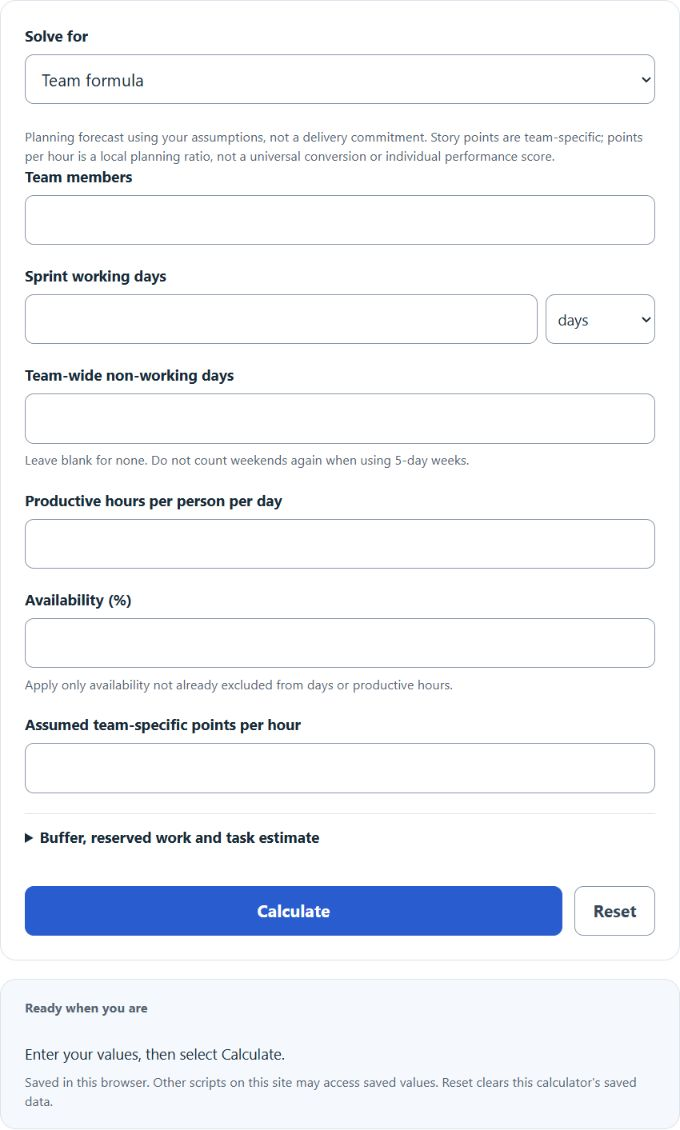
Calculate sprint capacity in story points from team size, availability, sprint length, hours per day, velocity, planning buffer, and carry-over.
Related Calculators
- Effective Capacity Calculator
- Tasks Per Hour Calculator
- Work Rate Calculator
- Labor Productivity Calculator
- Schedule Variance Calculator
- Manhours Calculator
- All Business Calculators
Sprint Capacity Formula
The team formula estimates productive hours and a team-specific story-point forecast. The optional task estimate divides remaining new-work points by average points per task.
Variables:
- SCtasks is the Sprint Capacity (tasks)
- M is the number of team members (count)
- S is an assumed team-specific planning ratio (points/hour); story points have no universal conversion to time and are not individual performance measures.
- D is scheduled working days before team-wide days off O; weeks mean five working days. Enter productive hours/day h and availability A separately without double-counting absences. B is buffer percent and R is reserved remaining points.
- C is the average task complexity (story points per task, pts/task)
Calculate productive hours, multiply by the assumed planning ratio, then apply the buffer and subtract reserved remaining work. The optional task estimate divides remaining points by average points per task. People Breakdown sums up to six capacity assumptions; Historical planning ratio uses total completed points divided by total comparable capacity hours across up to five sprints.
What is a Sprint Capacity?
Sprint Capacity is a planning measure used in Agile project management (commonly Scrum) to estimate how much work a team can complete in a sprint. Capacity is often expressed in available time (person-hours) or in an equivalent workload measure (such as story points) and helps the team forecast work given time off, non-project work and other constraints. It does not guarantee delivery or replace discussion of the Sprint Goal and Definition of Done.
How to Calculate Sprint Capacity?
The following steps outline how to calculate the Sprint Capacity:
- First, determine the number of team members (M).
- Next, choose a team-specific planning ratio S from comparable history or an explicitly stated assumption.
- Next, enter working days, team-wide days off, productive hours/day and remaining availability; avoid counting the same absence twice.
- Next, determine the average task complexity (C) in story points per task (pts/task).
- Finally, apply any buffer and reserved remaining work to the point estimate. Divide by C only when the optional equivalent task estimate is desired.
- After inserting the values into the formula, calculate the result.
Example Problem:
Use the following variables as an example problem to test your knowledge:
Number of team members (M) = 4 members
Individual work speed (S) = 1.5 pts/h
Working duration per member = 10 days × 8 productive hours/day × 100% availability = 80 hours; no team-wide days off, buffer or reserved work.
Average task complexity (C) = 6 pts/task
Raw planning estimate = 4 × 80 × 1.5 = 480 story points. With no buffer or reserved work, the optional equivalent task estimate is 480 ÷ 6 = 80 tasks.