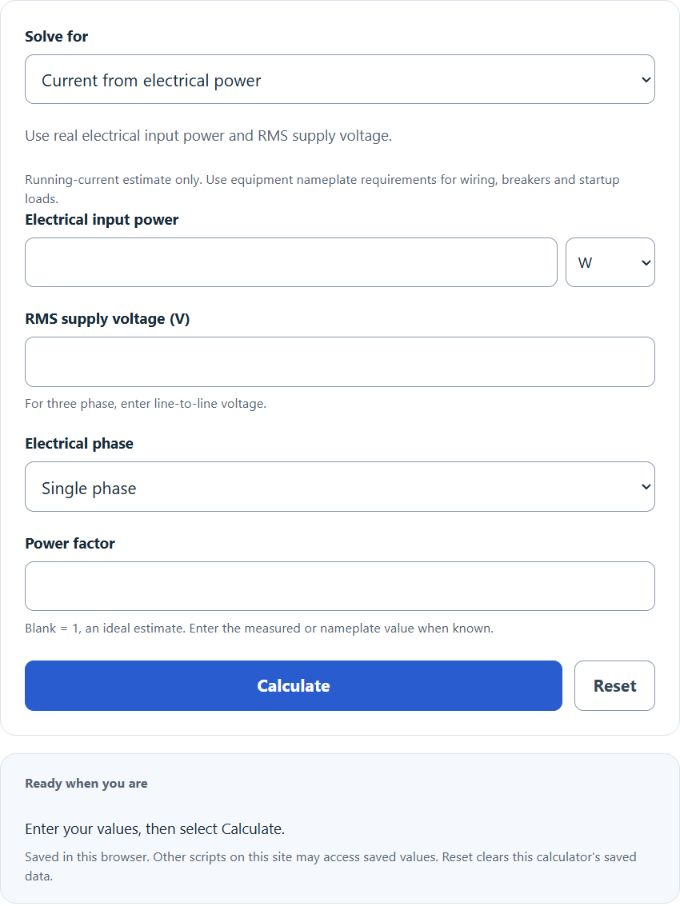
Estimate air conditioner running current from electrical power or cooling capacity and EER, with supply voltage, phase and power factor.
- All Physics Calculators
- All Electrical Calculators
- Amps Draw Calculator
- Short Circuit Current Calculator
- 3 Phase Current Calculator
Air Conditioner Current Formula
The calculator finds air conditioner current draw from power, voltage, power factor, and electrical phase. If you do not know the power in watts, it can first estimate watts from cooling capacity and EER.
- I = current draw in amperes, A
- W = electrical power consumption in watts
- BTU/hr = cooling capacity of the air conditioner
- EER = energy efficiency ratio
- V = voltage supplied to the air conditioner
- PF = power factor, greater than zero and at most 1; blank defaults to 1
- sqrt(3) = 1.732, used for three-phase current calculations
Select electrical power or cooling capacity and EER as the input method. In the EER method, watts equal cooling capacity in Btu/h divided by EER at matching rating conditions; do not substitute SEER or SEER2. Three-phase current assumes a balanced load and line-to-line RMS voltage.
Typical Air Conditioner Power and Current Ranges
Actual current depends on the specific unit, voltage, efficiency, compressor type, and operating conditions. These illustrative power and current ranges assume single phase and unity power factor; they are not equipment ratings or startup surge estimates.
| Cooling Size | Typical Power Range | Approx. Current at 120 V | Approx. Current at 240 V |
|---|---|---|---|
| 5,000 BTU/hr window AC | 450 to 600 W | 3.8 to 5.0 A | 1.9 to 2.5 A |
| 8,000 BTU/hr window AC | 650 to 900 W | 5.4 to 7.5 A | 2.7 to 3.8 A |
| 12,000 BTU/hr portable or window AC | 1,000 to 1,500 W | 8.3 to 12.5 A | 4.2 to 6.3 A |
| 24,000 BTU/hr mini-split | 1,800 to 2,800 W | 15.0 to 23.3 A | 7.5 to 11.7 A |
Common Voltage and Power Factor Inputs
| Input | Common Value | When to Use It |
|---|---|---|
| 120 V | Small window or portable AC units | Use when the unit plugs into a standard 120 V outlet. |
| 208 V | Commercial systems | Use when the nameplate shows 208 V service. |
| 240 V | Larger residential AC units | Use when the unit is on a 240 V circuit. |
| Power factor 1.0 | Simplified estimate | Use when power factor is unknown and you only need an ideal current estimate. |
| Power factor 0.85 to 0.95 | Motor-driven equipment | Use a measured or manufacturer-specified value; do not infer the power factor from this example range. |
Examples
Example 1: Single-phase air conditioner with known watts
You have a 1,200 W air conditioner on 120 V single-phase power with a power factor of 0.95.
The running current is about 10.53 A.
Example 2: Estimate current from BTU/hr and EER
You have a 12,000 BTU/hr air conditioner with an EER of 10 on a 240 V single-phase circuit. Use a power factor of 1 if no power factor is known.
The estimated running current is 5 A.
FAQ
Is air conditioner current the same as the breaker size?
No. The calculated current is an estimate of running current. Breaker size depends on the equipment nameplate, wire size, startup current, and electrical code requirements. Use the nameplate values and the required circuit rating when sizing a circuit.
Why does the calculator ask for power factor?
Power factor adjusts the current calculation for AC electrical loads. A motor load can draw more current than a simple watts divided by volts calculation suggests. If you do not know the power factor, using 1 gives an ideal estimate. Using a lower value, such as 0.9, gives a higher and often more realistic current estimate.
Does this include startup current?
No. The result is running current based on power consumption. Compressor startup current can be much higher for a short time. For equipment protection, generator sizing, or circuit design, check the unit nameplate for values such as RLA, FLA, LRA, MCA, and MOCP.